+
ePlane Opens India’s Largest eVTOL Facility at IIT Madras
AVIATION & AIRPORTS

ePlane Opens India’s Largest eVTOL Facility at IIT Madras


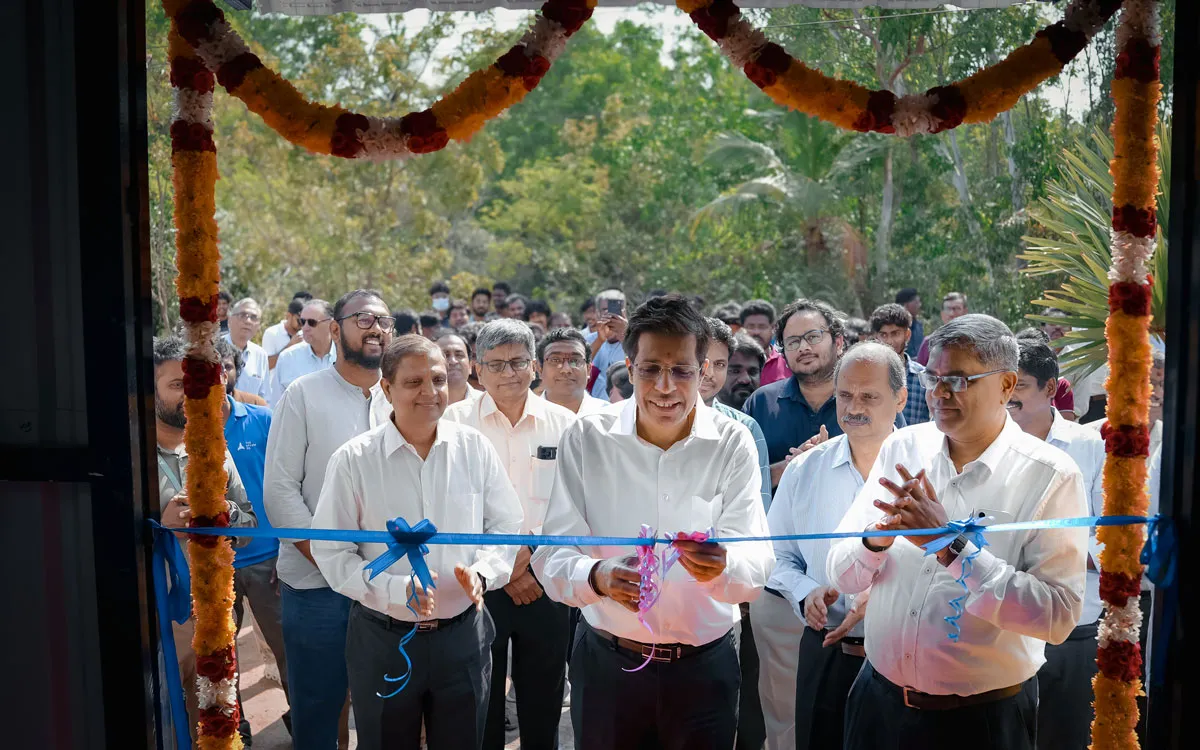
The ePlane Company (Ubifly Technologies Pvt. Ltd.) has inaugurated India’s largest integrated prototyping and testing facility for electric vertical take-off and landing (eVTOL) aircraft at the IIT Madras Discovery Campus in Thaiyur. Spread across 60,000 sq. ft., the facility marks a significant step in the country’s urban air mobility sector, advancing from design-stage concepts and subscale prototypes to flight-ready systems and full-scale certification testing.

The facility was inaugurated by V. Kamakoti, Director of IIT Madras and Padma Shri recipient. The 163-acre Discovery Campus is designed to provide advanced infrastructure for deep-tech innovation and industrial-scale research.

Positioned as a strategic engineering hub, the site will support critical development milestones such as tethered hover testing as the company moves towards Type Certification from the Directorate General of Civil Aviation. The facility integrates design, prototyping, subsystem testing and system integration teams in one location, supporting the development of passenger, cargo and relief eVTOL aircraft.

The campus houses composite fabrication units, electric powertrain assembly lines, avionics testing systems and a dedicated Ground Test Vehicle facility for subsystem validation and full-scale development. The company’s flagship e200X aircraft is engineered for dense urban environments, featuring an 8m x 10m footprint designed to enable compact rooftop-to-rooftop operations.

Commenting on the launch, Satya Chakravarthy, Founder and Technical Lead, The ePlane Company, said the facility represents a major step towards commercial deployment of urban air mobility solutions and aims to make air transport as accessible as conventional urban mobility.

The facility is also expected to strengthen India’s deep-tech ecosystem by enabling the physical integration and validation of complex aerospace systems while contributing to regulatory frameworks for electric aviation. Supported by IIT Madras’ incubation ecosystem, the initiative highlights the role of academic collaboration, specialised engineering talent and advanced infrastructure in driving indigenous aerospace innovation and sustainable mobility solutions.

The ePlane Company (Ubifly Technologies Pvt. Ltd.) has inaugurated India’s largest integrated prototyping and testing facility for electric vertical take-off and landing (eVTOL) aircraft at the IIT Madras Discovery Campus in Thaiyur. Spread across 60,000 sq. ft., the facility marks a significant step in the country’s urban air mobility sector, advancing from design-stage concepts and subscale prototypes to flight-ready systems and full-scale certification testing.The facility was inaugurated by V. Kamakoti, Director of IIT Madras and Padma Shri recipient. The 163-acre Discovery Campus is designed to provide advanced infrastructure for deep-tech innovation and industrial-scale research.Positioned as a strategic engineering hub, the site will support critical development milestones such as tethered hover testing as the company moves towards Type Certification from the Directorate General of Civil Aviation. The facility integrates design, prototyping, subsystem testing and system integration teams in one location, supporting the development of passenger, cargo and relief eVTOL aircraft.The campus houses composite fabrication units, electric powertrain assembly lines, avionics testing systems and a dedicated Ground Test Vehicle facility for subsystem validation and full-scale development. The company’s flagship e200X aircraft is engineered for dense urban environments, featuring an 8m x 10m footprint designed to enable compact rooftop-to-rooftop operations.Commenting on the launch, Satya Chakravarthy, Founder and Technical Lead, The ePlane Company, said the facility represents a major step towards commercial deployment of urban air mobility solutions and aims to make air transport as accessible as conventional urban mobility.The facility is also expected to strengthen India’s deep-tech ecosystem by enabling the physical integration and validation of complex aerospace systems while contributing to regulatory frameworks for electric aviation. Supported by IIT Madras’ incubation ecosystem, the initiative highlights the role of academic collaboration, specialised engineering talent and advanced infrastructure in driving indigenous aerospace innovation and sustainable mobility solutions.

Next Story
Infrastructure Urban

Implementation Status of Jal Jeevan Mission

Since August 2019 the Government has implemented Jal Jeevan Mission to provide assured potable water through household tap connections in rural India. At the start of the mission only 32.3 million (mn) rural households, representing 16.7 per cent, were reported to have tap water connections. States and union territories have reported that 125.8 mn additional rural households have since been provided with tap connections. As a result, of about 193.6 mn rural households roughly 158.2 mn, or 81.71 per cent, are reported to have tap water supply at home.\n\nThe State, district and village level st..

Next Story
Infrastructure Urban

Jal Jeevan Mission Reaches Eighty One Per Cent Rural Coverage

The Government reported substantial progress under the Jal Jeevan Mission, launched in August 2019 to provide tap water to every rural household. At launch only 32.3 million (mn) rural households had tap connections and states and Union territories reported provision of 125.8 mn additional households by March 2026. Consequently, out of about 193.6 mn rural households around 158.2 mn, or 81.71 per cent, are reported to have tap water at home. The Finance Minister announced extension of the mission until 2028 in the 2025-26 budget speech. The Swachh Bharat Mission Grameen, launched in October 20..

Next Story
Infrastructure Urban

Empowering Local Governance for Sustainable Rural Water Supply

The Ministry of Jal Shakti has aligned the Jal Jeevan Mission (JJM) with the 73rd Amendment to strengthen village level planning and community ownership of water supply. Gram Panchayats, village water and sanitation committees and Pani Samitis are to plan, implement, manage and maintain piped water systems, with gram sabha processes formalising handover and oversight. Implementation support agencies including non government organisations, community based organisations and self help groups have been empanelled to train local committees and promote women participation. Under JJM, the department ..

Advertisement

Subscribe to Our Newsletter

Get daily newsletters around different themes from Construction world.

STAY CONNECTED

Advertisement

Advertisement

Advertisement