Mining Sector Seeks Budget Relief On Exports And Overseas Risks
COAL & MINING

Mining Sector Seeks Budget Relief On Exports And Overseas Risks

India’s mining industry is urging the government to remove export duties on low-grade bauxite, retain the current duty structure for iron ore, offer tax concessions and introduce a government-backed insurance mechanism to shield overseas mining investments from geopolitical risks in the upcoming Union Budget.

A senior executive at the Federation of Indian Mineral Industries (FIMI) said the industry body has proposed scrapping the 15 per cent export duty on low-grade bauxite. India is self-sufficient in bauxite, particularly in Gujarat and Maharashtra, where low-grade deposits are dominant and largely unused by domestic industry. Removing the duty would support exports of these grades, the executive said.

On iron ore, the sector wants the government to maintain the existing zero-duty regime for low-grade ore. Currently, iron ore with less than 58 per cent iron content attracts no export duty, while higher-grade ore is subject to a 30 per cent levy. Industry representatives said low-grade iron ore is not consumed domestically and cautioned against any new duties.

A major new demand is the creation of a government-backed insurance mechanism for overseas mining investments, especially in Africa and South America, where political instability and geopolitical risks can threaten projects. Rajib Maitra, partner and sector leader at Deloitte South Asia, said the proposal mirrors the sovereign-backed guarantees extended to exporters through the Export Credit Guarantee Corporation.

Such a mechanism would help mining companies secure financing from banks and financial institutions, as conventional insurance often excludes political or financial instability. Maitra said the proposed cover would be particularly relevant for critical mineral projects, including lithium processing, rare earth separation and magnet manufacturing.

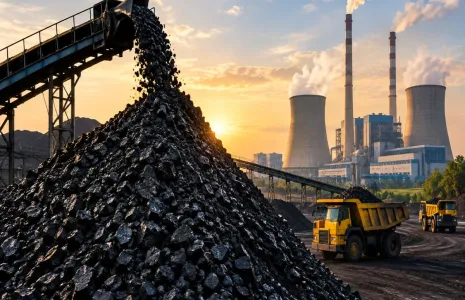
Separately, the industry is seeking a significantly larger push for coal gasification, with Budget support of Rs 350 billion. In January 2024, the Cabinet approved an outlay of Rs 85 billion to promote coal and lignite gasification. Coal gasification converts coal into syngas through high-temperature processing with limited oxygen or steam, and is being promoted as a cleaner industrial fuel to reduce emissions and dependence on conventional fuels.

A Deloitte report on Budget expectations noted that the metals and mining sector has outlined several tax-related demands. These include higher depreciation in the early years of projects and the introduction of investment tax credits to ease upfront capital expenditure for mining, mineral processing and downstream manufacturing.

The industry has also sought targeted tax credits for critical mineral projects, where India currently faces scale limitations and higher costs, and the reintroduction of the concessional 15 per cent corporate tax rate for new manufacturing units, which was discontinued in 2024 and replaced with the standard 25 per cent rate. In addition, companies are seeking conditional tax holidays for strategic greenfield projects.

Another key request is a reduction in basic customs duties on imported raw materials such as coking coal, a crucial input for the steel industry that is not available in adequate quantities domestically.

India’s mining industry is urging the government to remove export duties on low-grade bauxite, retain the current duty structure for iron ore, offer tax concessions and introduce a government-backed insurance mechanism to shield overseas mining investments from geopolitical risks in the upcoming Union Budget. A senior executive at the Federation of Indian Mineral Industries (FIMI) said the industry body has proposed scrapping the 15 per cent export duty on low-grade bauxite. India is self-sufficient in bauxite, particularly in Gujarat and Maharashtra, where low-grade deposits are dominant and largely unused by domestic industry. Removing the duty would support exports of these grades, the executive said. On iron ore, the sector wants the government to maintain the existing zero-duty regime for low-grade ore. Currently, iron ore with less than 58 per cent iron content attracts no export duty, while higher-grade ore is subject to a 30 per cent levy. Industry representatives said low-grade iron ore is not consumed domestically and cautioned against any new duties. A major new demand is the creation of a government-backed insurance mechanism for overseas mining investments, especially in Africa and South America, where political instability and geopolitical risks can threaten projects. Rajib Maitra, partner and sector leader at Deloitte South Asia, said the proposal mirrors the sovereign-backed guarantees extended to exporters through the Export Credit Guarantee Corporation. Such a mechanism would help mining companies secure financing from banks and financial institutions, as conventional insurance often excludes political or financial instability. Maitra said the proposed cover would be particularly relevant for critical mineral projects, including lithium processing, rare earth separation and magnet manufacturing. Separately, the industry is seeking a significantly larger push for coal gasification, with Budget support of Rs 350 billion. In January 2024, the Cabinet approved an outlay of Rs 85 billion to promote coal and lignite gasification. Coal gasification converts coal into syngas through high-temperature processing with limited oxygen or steam, and is being promoted as a cleaner industrial fuel to reduce emissions and dependence on conventional fuels. A Deloitte report on Budget expectations noted that the metals and mining sector has outlined several tax-related demands. These include higher depreciation in the early years of projects and the introduction of investment tax credits to ease upfront capital expenditure for mining, mineral processing and downstream manufacturing. The industry has also sought targeted tax credits for critical mineral projects, where India currently faces scale limitations and higher costs, and the reintroduction of the concessional 15 per cent corporate tax rate for new manufacturing units, which was discontinued in 2024 and replaced with the standard 25 per cent rate. In addition, companies are seeking conditional tax holidays for strategic greenfield projects. Another key request is a reduction in basic customs duties on imported raw materials such as coking coal, a crucial input for the steel industry that is not available in adequate quantities domestically.

Next Story
Resources

YTL Cement’s CDL Academy, UTM Sign MoU on Talent and Research

CDL Academy, the learning and development arm of YTL Cement Group, has signed a Memorandum of Understanding with Universiti Teknologi Malaysia (UTM) to strengthen collaboration in talent development, applied learning and research innovation for Malaysia’s construction and engineering sector.The MoU, signed on January 9, 2026, formalises an ongoing partnership focused on equipping students with industry exposure and practical experience aligned with emerging requirements in sustainable construction. Under the agreement, the two institutions will jointly undertake professional training program..

Next Story
Technology

Truva Raises Rs 78 Crore to Scale Resale Homes Platform

Truva, a full-stack resale homes platform, has raised Rs 780 million in fresh capital to accelerate expansion and deepen its technology-led operating model. The funding comprises Rs 610 million in equity led by Stellaris Venture Partners and Orios Venture Partners, along with Rs 170 million in venture debt from Stride Ventures. The round also saw participation from angel investors including Mukesh Bansal, Ramakant Sharma, Natasha Malpani Oswal and Ram Raheja.The capital will be used to expand Truva’s presence across Mumbai and enter new metros such as Delhi NCR and Bengaluru, strengthen TruI..

Next Story
Infrastructure Transport

BLR Airport Eyes Global Expansion After Strong 2025

Kempegowda International Airport Bengaluru on Monday said it will expand international connectivity, add capacity and deepen airline partnerships in 2026, after closing calendar year 2025 with higher passenger volumes and moderate cargo growth. The operator said its focus will be on scaling both passenger and cargo operations while supporting wider network expansion. Total passenger traffic stood at 43.82 million in 2025, up from 40.73 million in 2024. The airport also recorded its highest-ever single-day passenger movement of 137,317 travellers on 23 November 2025. Daily aircraft movements p..

Advertisement

Subscribe to Our Newsletter

Get daily newsletters around different themes from Construction world.

STAY CONNECTED

Advertisement

Advertisement

Advertisement

Advertisement

Open In App