

India to Lead Global Oil Demand Growth till 2050: OPEC
OIL & GAS

India to Lead Global Oil Demand Growth till 2050: OPEC

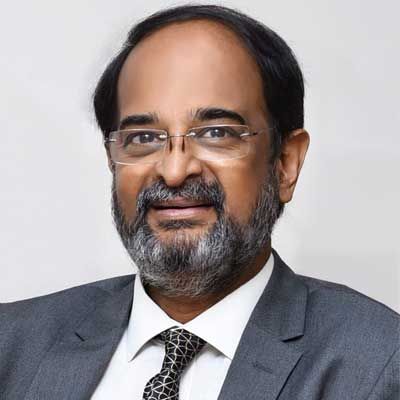
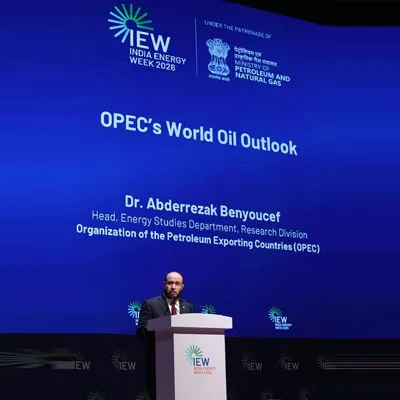
India is projected to be the largest contributor to global oil demand growth through 2050, according to the World Oil Outlook 2025 released by Organization of the Petroleum Exporting Countries (OPEC). The outlook was presented recently by Dr Abderrezak Benyoucef, Head, Energy Studies Department, Research Division, OPEC, at India Energy Week 2026 in Goa.

Addressing the Resilience Stage on the second day of the event, Dr Benyoucef said India alone is expected to add 8.2 million barrels per day of oil demand by 2050, driven mainly by growth in transportation, petrochemicals and industrial activity. Globally, oil demand is projected to rise to nearly 123 million barrels per day by 2050, with most growth coming from non-OECD economies.

The report highlights India as the largest and most stable contributor to global primary energy demand growth. India’s total primary energy demand is expected to almost double from around 22 million barrels of oil equivalent per day in 2024 to about 43.6 million barrels of oil equivalent per day by 2050. Over the same period, global primary energy demand is projected to increase by 23 per cent, with non-OECD countries accounting for nearly 72 per cent of total demand by 2050.

On the economic front, the outlook notes that India is expected to be the world’s fastest-growing major economy, with average annual GDP growth of around 5.8 per cent between 2024 and 2050. India’s share of global GDP is projected to rise sharply, reinforcing its influence on global energy markets. Demographic trends, including population growth, urbanisation and improving living standards, are expected to further strengthen India’s central role in future energy demand.

The outlook also underlines the need for sustained investment to meet rising demand and offset natural decline rates. Globally, cumulative oil-related investment requirements are estimated at around USD 18.2 trillion between 2025 and 2050, including nearly USD 15 trillion in upstream investment.

India is projected to be the largest contributor to global oil demand growth through 2050, according to the World Oil Outlook 2025 released by Organization of the Petroleum Exporting Countries (OPEC). The outlook was presented recently by Dr Abderrezak Benyoucef, Head, Energy Studies Department, Research Division, OPEC, at India Energy Week 2026 in Goa. Addressing the Resilience Stage on the second day of the event, Dr Benyoucef said India alone is expected to add 8.2 million barrels per day of oil demand by 2050, driven mainly by growth in transportation, petrochemicals and industrial activity. Globally, oil demand is projected to rise to nearly 123 million barrels per day by 2050, with most growth coming from non-OECD economies. The report highlights India as the largest and most stable contributor to global primary energy demand growth. India’s total primary energy demand is expected to almost double from around 22 million barrels of oil equivalent per day in 2024 to about 43.6 million barrels of oil equivalent per day by 2050. Over the same period, global primary energy demand is projected to increase by 23 per cent, with non-OECD countries accounting for nearly 72 per cent of total demand by 2050. On the economic front, the outlook notes that India is expected to be the world’s fastest-growing major economy, with average annual GDP growth of around 5.8 per cent between 2024 and 2050. India’s share of global GDP is projected to rise sharply, reinforcing its influence on global energy markets. Demographic trends, including population growth, urbanisation and improving living standards, are expected to further strengthen India’s central role in future energy demand. The outlook also underlines the need for sustained investment to meet rising demand and offset natural decline rates. Globally, cumulative oil-related investment requirements are estimated at around USD 18.2 trillion between 2025 and 2050, including nearly USD 15 trillion in upstream investment.

Next Story
Real Estate

Union Budge: Infra-Led Urban Shift

The Union Budget FY27 reinforces infrastructure-led urbanisation as the backbone of India’s real estate and housing growth. Higher public capital expenditure, City Economic Regions, risk-mitigation mechanisms and REIT-led asset monetisation are being widely viewed as long-term enablers, even as the industry continues to seek sharper supply-side reforms and affordability-focused measures. Here are a few industry insights:Dr Niranjan Hiranandani, Chairman, NAREDCO & Hiranandani Group“The Union Budget 2026-27 is growth-oriented and stability-focused, supporting consumption and aiming to s..

Next Story
Infrastructure Urban

Budget 2026 Charts Path for Infrastructure-Led, Tech-Driven Growth

The Union Budget 2026–27 signals strong continuity in India’s macroeconomic strategy, anchored in elevated public capital expenditure, fiscal discipline, and a sharper focus on manufacturing, infrastructure, and regional development. With capital outlay pegged at ₹12.2 lakh crore and a fiscal deficit target of around 4.3 per cent, the Budget balances growth ambition with stability, offering long-term visibility to investors and project developers.A dominant theme is the centrality of infrastructure as a multiplier for economic expansion. Public capex now accounts for over 3.3 per cent of..

Next Story
Infrastructure Energy

Tata Power Arm Crosses 10 GW EPC Milestone

Tata Power Renewable Energy Ltd (TPREL) has achieved a major milestone by executing 10 gigawatts of engineering, procurement and construction (EPC) renewable energy projects to date, reinforcing its position in India’s clean energy infrastructure sector. According to the company, the executed portfolio comprises 4.2 gigawatts of in-house projects and 5.8 gigawatts of third-party projects. Of the total 10 gigawatts commissioned so far, 9.7 gigawatts are solar projects and 290 megawatts are wind projects. In the first nine months of FY26, TPREL commissioned 1.88 gigawatts of EPC renewable en..

Advertisement

Subscribe to Our Newsletter

Get daily newsletters around different themes from Construction world.

STAY CONNECTED

Advertisement

Advertisement

Advertisement

Advertisement

Open In App