
+
PRAGATI Marks 50th Meet With Gas Pipeline Milestone
OIL & GAS

PRAGATI Marks 50th Meet With Gas Pipeline Milestone

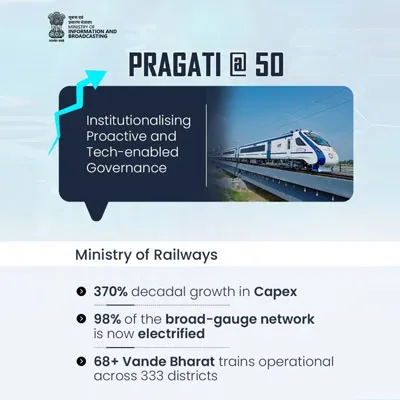
The Prime Minister’s flagship platform for Pro-Active Governance and Timely Implementation, PRAGATI, has reached a major milestone with the successful conduct of its 50th meeting, underscoring a decade of real-time monitoring and resolution of infrastructure bottlenecks and public grievances.

Launched in 2015 by Prime Minister Narendra Modi, PRAGATI has reshaped governance by bringing the Centre, states and Union ministries onto a single digital interface. Over the past ten years, the platform has accelerated decision-making, addressed delays in major infrastructure projects and reinforced accountability through direct Prime Ministerial oversight.

The focus of the milestone meeting was the Ennore–Thiruvallur–Bengaluru–Puducherry–Nagapattinam–Madurai–Tuticorin Natural Gas Pipeline project of the Ministry of Petroleum and Natural Gas. The project is one of southern India’s most significant clean-energy logistics assets and was executed by Indian Oil Corporation Limited to extend natural gas access from coastal import and domestic production points to inland industrial and urban centres.

Sanctioned on 27 May 2016 at a cost of over Rs 60 billion, the project was designed as an integrated natural gas trunk network of about 1,400 km, with an authorised capacity of 84.67 million metric standard cubic metres per day. The pipeline passes through Tamil Nadu, Karnataka, Andhra Pradesh and Puducherry, supplying anchor industries and enabling the rollout of city gas distribution networks across multiple districts.

When the project was reviewed under PRAGATI on 29 August 2018, physical progress stood at just 17.4 per cent, constrained by unresolved land acquisition, right-of-way issues, forest and environmental clearances, and corridor interface permissions across states.

Following the PRAGATI review chaired by the Prime Minister, the project was prioritised by state governments and central ministries, supported by sustained follow-ups. As a result, execution accelerated sharply, leading to the commissioning of the entire trunkline on 25 September 2023.

Officials said the project illustrates how PRAGATI’s proactive governance model can convert long-pending, multi-jurisdictional infrastructure challenges into time-bound outcomes by aligning state administrations, sponsoring ministries and regulators within a single accountability framework.

The Prime Minister’s flagship platform for Pro-Active Governance and Timely Implementation, PRAGATI, has reached a major milestone with the successful conduct of its 50th meeting, underscoring a decade of real-time monitoring and resolution of infrastructure bottlenecks and public grievances. Launched in 2015 by Prime Minister Narendra Modi, PRAGATI has reshaped governance by bringing the Centre, states and Union ministries onto a single digital interface. Over the past ten years, the platform has accelerated decision-making, addressed delays in major infrastructure projects and reinforced accountability through direct Prime Ministerial oversight. The focus of the milestone meeting was the Ennore–Thiruvallur–Bengaluru–Puducherry–Nagapattinam–Madurai–Tuticorin Natural Gas Pipeline project of the Ministry of Petroleum and Natural Gas. The project is one of southern India’s most significant clean-energy logistics assets and was executed by Indian Oil Corporation Limited to extend natural gas access from coastal import and domestic production points to inland industrial and urban centres. Sanctioned on 27 May 2016 at a cost of over Rs 60 billion, the project was designed as an integrated natural gas trunk network of about 1,400 km, with an authorised capacity of 84.67 million metric standard cubic metres per day. The pipeline passes through Tamil Nadu, Karnataka, Andhra Pradesh and Puducherry, supplying anchor industries and enabling the rollout of city gas distribution networks across multiple districts. When the project was reviewed under PRAGATI on 29 August 2018, physical progress stood at just 17.4 per cent, constrained by unresolved land acquisition, right-of-way issues, forest and environmental clearances, and corridor interface permissions across states. Following the PRAGATI review chaired by the Prime Minister, the project was prioritised by state governments and central ministries, supported by sustained follow-ups. As a result, execution accelerated sharply, leading to the commissioning of the entire trunkline on 25 September 2023. Officials said the project illustrates how PRAGATI’s proactive governance model can convert long-pending, multi-jurisdictional infrastructure challenges into time-bound outcomes by aligning state administrations, sponsoring ministries and regulators within a single accountability framework.

Next Story
Infrastructure Transport

Second Mountain Tunnel Breakthrough in Palghar Advances High Speed Rail

The Mumbai-Ahmedabad high speed rail (MAHSR) project reached a milestone with the breakthrough of a mountain tunnel in Palghar, Maharashtra. Mountain tunnel MT-six measures 454 metres long and 14.4 metres wide and will accommodate up and down tracks. The breakthrough follows MT-five near Saphale on second January 2026 and the MT-six excavation was completed from both ends using the New Austrian Tunnelling Method. The ministry reported that the tunnelling was completed within 12 months. The New Austrian Tunnelling Method is favoured for its flexibility in complex geology and irregular tunnel s..

Next Story
Infrastructure Transport

Modi Government Pushes Atmanirbhar Container Drive With BCSL MoU

The Union Government advanced a plan to create an integrated, domestically anchored container ecosystem with the signing of a Memorandum of Understanding to establish the Bharat Container Shipping Line (BCSL). The MoU was signed by key agencies including the Shipping Corporation of India and Container Corporation of India alongside major port authorities and Sagarmala Finance Corporation Limited under the Ministry of Ports, Shipping and Waterways, in the presence of senior ministers. The initiative aligns with the Container Manufacturing Assistance Scheme announced in the Union Budget 2026–2..

Next Story
Infrastructure Urban

Ministry Reports Gains In Mobility For Marginalised Communities

The Ministry of Social Justice and Empowerment is implementing skill development, education and rehabilitation schemes to promote socio-economic mobility and sustainable livelihoods for marginalised and disadvantaged communities across the country. Programmes target Scheduled Castes, Other Backward Classes, Economically Weaker Sections, De-notified Tribes and Safai Karamcharis through specialised implementing corporations and empanelled training institutes. Pradhan Mantri Dakshata Aur Kushalta Sampann Hitgrahi Yojana, or PM-DAKSH, provided skill training and placement support through the Nati..

Advertisement

Subscribe to Our Newsletter

Get daily newsletters around different themes from Construction world.

STAY CONNECTED

Advertisement

Advertisement

Advertisement

Open In App