+
ADB Partners With GULF To Fund Thailand Renewable Projects
POWER & RENEWABLE ENERGY

ADB Partners With GULF To Fund Thailand Renewable Projects

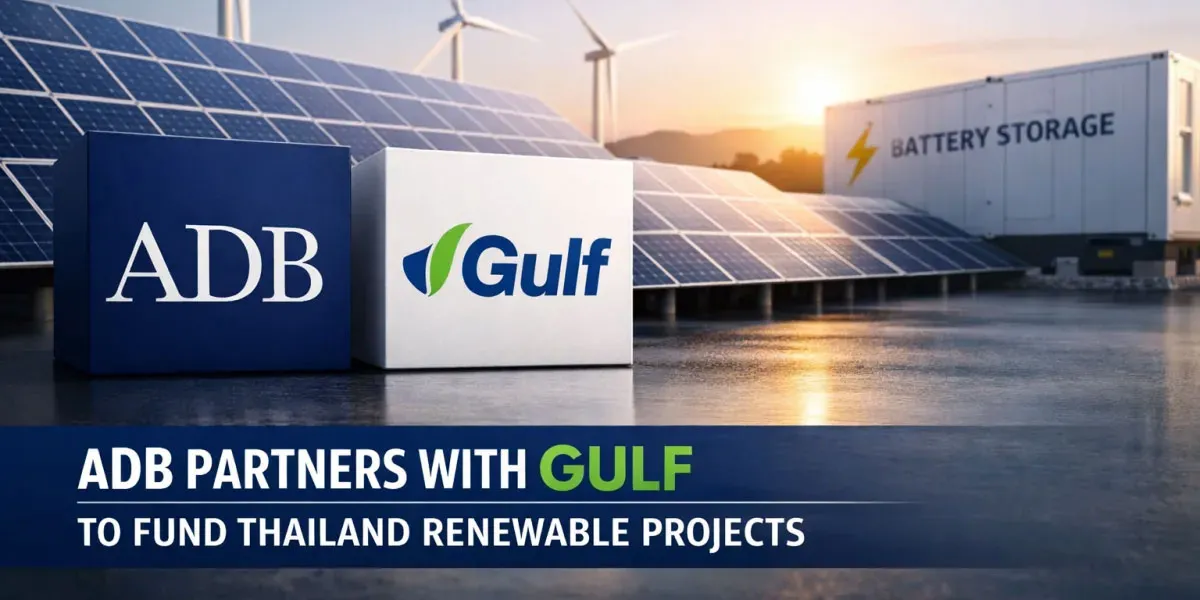
The Asian Development Bank (ADB) has partnered with Gulf Renewable Energy Company Limited (GRE), a subsidiary of Gulf Development Public Company Limited (GULF), to provide Rs 350 mn to develop three renewable projects in Thailand. The financing will support two solar plus battery energy storage systems with a combined contracted capacity of 126 megawatts (MW) and 151 megawatt-hours (MWh) of storage and a standalone 68 MW solar plant. The projects aim to expand renewable generation, strengthen grid stability and accelerate decarbonisation of the power sector.

As lead arranger and bookrunner ADB provided Rs 75 mn from its ordinary capital resources and arranged a Rs 50 mn B-loan from DBS Bank Ltd. The package includes Rs 150 mn in parallel loans from DEG, Development Finance Institute Canada Inc and Export Finance Australia plus a Rs 75 mn loan from the ADB-administered Leading Asia's Private Infrastructure Fund 2 (LEAP 2). International cofinancier support underlined confidence in Thailand's renewable market.

Once commissioned the projects are expected to cut an average of 191,550 tonnes (t) of carbon dioxide each year, contributing to Thailand's net-zero by 2050 target. The initiative aligns with the country's five-gigawatt renewable energy feed-in tariff programme and represents Southeast Asia's first large-scale procurement of solar and battery energy storage systems. Backers expect that integrating large-scale solar with battery storage will improve grid stability and attract further investment.

ADB's country director for Thailand said battery-integrated solar is essential for the transition to affordable reliable clean energy and that cooperation between private investors and development finance institutions can accelerate national renewable goals. GRE and GULF indicated the scheme sets a regional benchmark for grid management. GULF, founded in 2011, has an operational capacity of 16,504 megawatts (MW). LEAP 2 is supported by a Rs 1.5 bn commitment from the Japan International Cooperation Agency and focuses on sustainable private infrastructure.

The Asian Development Bank (ADB) has partnered with Gulf Renewable Energy Company Limited (GRE), a subsidiary of Gulf Development Public Company Limited (GULF), to provide Rs 350 mn to develop three renewable projects in Thailand. The financing will support two solar plus battery energy storage systems with a combined contracted capacity of 126 megawatts (MW) and 151 megawatt-hours (MWh) of storage and a standalone 68 MW solar plant. The projects aim to expand renewable generation, strengthen grid stability and accelerate decarbonisation of the power sector. As lead arranger and bookrunner ADB provided Rs 75 mn from its ordinary capital resources and arranged a Rs 50 mn B-loan from DBS Bank Ltd. The package includes Rs 150 mn in parallel loans from DEG, Development Finance Institute Canada Inc and Export Finance Australia plus a Rs 75 mn loan from the ADB-administered Leading Asia's Private Infrastructure Fund 2 (LEAP 2). International cofinancier support underlined confidence in Thailand's renewable market. Once commissioned the projects are expected to cut an average of 191,550 tonnes (t) of carbon dioxide each year, contributing to Thailand's net-zero by 2050 target. The initiative aligns with the country's five-gigawatt renewable energy feed-in tariff programme and represents Southeast Asia's first large-scale procurement of solar and battery energy storage systems. Backers expect that integrating large-scale solar with battery storage will improve grid stability and attract further investment. ADB's country director for Thailand said battery-integrated solar is essential for the transition to affordable reliable clean energy and that cooperation between private investors and development finance institutions can accelerate national renewable goals. GRE and GULF indicated the scheme sets a regional benchmark for grid management. GULF, founded in 2011, has an operational capacity of 16,504 megawatts (MW). LEAP 2 is supported by a Rs 1.5 bn commitment from the Japan International Cooperation Agency and focuses on sustainable private infrastructure.

Next Story
Infrastructure Energy

Jyoti Structures expands manufacturing capacity in Nashik

The announcement Jyoti Structures (JSL) reported steady operational performance in 2025, supported by stable project execution across its power transmission portfolio. The company commissioned galvanisation operations at its second Nashik manufacturing unit, adding 33,000 MT of annual capacity. This increased aggregate tower manufacturing capability at Nashik to approximately 69,000 MT per annum, aimed at improving fabrication accuracy, scheduling control and delivery predictability. JSL also expanded its workforce to over 750 employees, onboarding more than 70 engineers during the year. C..

Next Story
Infrastructure Energy

TSPL Mega Health Camp Reaches 338 Residents in Mansa

Talwandi Sabo Power (TSPL), Punjab’s largest and North India’s largest private thermal power plant, organised a Mega Health Camp at Village Raipur, Mansa, under its flagship healthcare initiative Project SEHAT. The camp benefitted 338 community members through free consultations and diagnostic services.A team comprising a General Physician, Gynaecologist, Dermatologist and Dentist provided medical advice and treatment. Beneficiaries received free diagnostic tests including BP, HB, blood sugar, malaria, dengue and blood group tests, along with free medicines.The camp was inaugurated by Vill..

Next Story
Infrastructure Transport

Mumbai Coastal Road Musical Path Plays Jai Ho

Mumbai inaugurated India’s first musical path on the Coastal Road that plays the song Jai Ho for motorists. The civic administration said the installation used Hungarian technology and that the intention was to implement the concept of Sangeet Marg in future projects. A senior official suggested implementing a pilot on the Samruddhi Expressway, which connects Mumbai and Nagpur. City officials described the inauguration as a symbolic demonstration of collaboration between municipal authorities and foreign partners. The inauguration was attended by the Consul General of Hungary Ferenc Jari, f..

Advertisement

Subscribe to Our Newsletter

Get daily newsletters around different themes from Construction world.

STAY CONNECTED

Advertisement

Advertisement

Advertisement

Open In App