+
Kavach 4.0 Commissioned on Vadodara–Nagda Section
RAILWAYS & METRO RAIL

Kavach 4.0 Commissioned on Vadodara–Nagda Section

Western Railway commissioned the Kavach 4.0 train protection system (Kavach) on the Vadodara–Nagda section and a Kavach-enabled special train was flagged off from Vadodara station by the General Manager, Shri Pradeep Kumar, on 30 March 2026.

With this commissioning, Kavach has been installed on 559.5 route kilometres out of 693 route kilometres identified on the Mumbai–New Delhi main corridor under Mission Raftaar, covering the majority of the route.

On the Vadodara–Nagda section the system has been commissioned over 224.51 route kilometres, comprising Vadodara to Mangal Mahudi at 122.5 route kilometres and Panchpipliya to Nagda at 102.01 route kilometres, while work on the remaining Mangal Mahudi–Panchpipliya section is in progress and expected to be completed soon with automatic signalling. During the financial year 2025–26 Western Railway commissioned Kavach over 659.5 route kilometres. The Vadodara Division had earlier operationalised the system on the Vadodara–Virar section in January 2026 and deployment has been extended up to Nagda via Godhra.

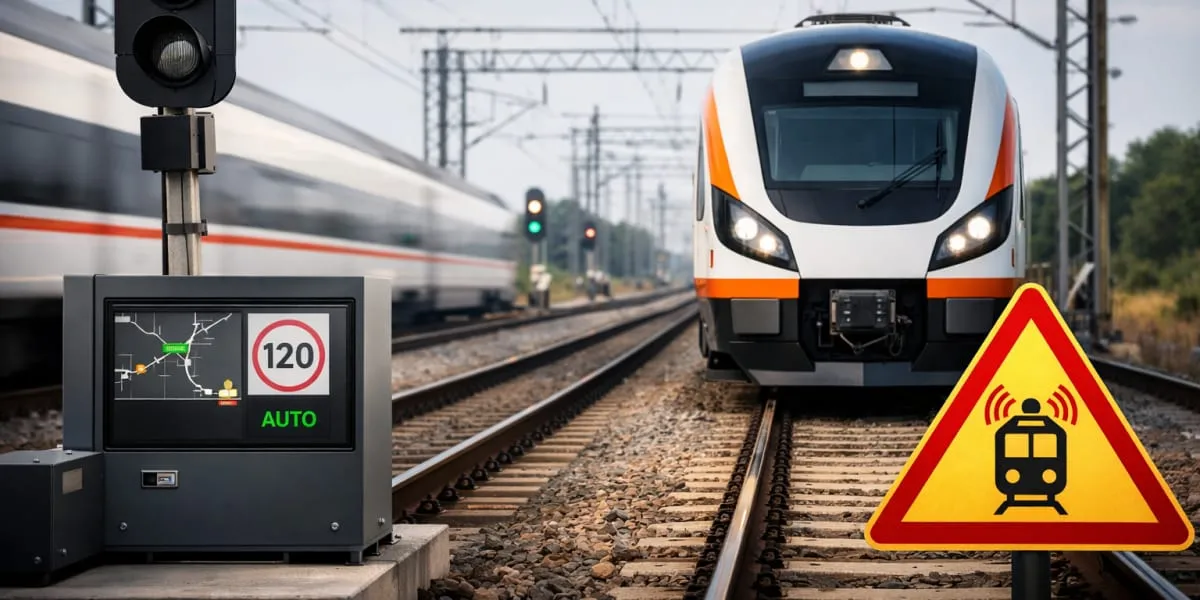
Kavach is an advanced train protection system designed to reduce human error and to act as an additional safety layer to prevent accidents caused by Signal Passing at Danger (SPAD). The project required detailed planning for each station and each absolute and automatic signalling section and involved programming and installing over 6,000 RFID tags along the tracks. Locomotives were equipped with Kavach devices and full trials and testing were completed.

Continuous radio communication was established covering 26 stations and 13 block sections, supported by 39 radio towers and approximately 600 km of optical fibre cable (OFC) laid in both Up and Down directions. Kavach equipment was integrated with existing signalling at stations, block sections and level crossing gates. The system has been fitted to WAP-7, WAG-9 and WAP-5 locomotives, with 364 locomotives on Western Railway already equipped, and Western Railway said Kavach is a more cost-effective option compared to the European Train Control System and reaffirmed its commitment to adopting modern indigenous technologies to build a safe and future-ready railway network.

Western Railway commissioned the Kavach 4.0 train protection system (Kavach) on the Vadodara–Nagda section and a Kavach-enabled special train was flagged off from Vadodara station by the General Manager, Shri Pradeep Kumar, on 30 March 2026. With this commissioning, Kavach has been installed on 559.5 route kilometres out of 693 route kilometres identified on the Mumbai–New Delhi main corridor under Mission Raftaar, covering the majority of the route. On the Vadodara–Nagda section the system has been commissioned over 224.51 route kilometres, comprising Vadodara to Mangal Mahudi at 122.5 route kilometres and Panchpipliya to Nagda at 102.01 route kilometres, while work on the remaining Mangal Mahudi–Panchpipliya section is in progress and expected to be completed soon with automatic signalling. During the financial year 2025–26 Western Railway commissioned Kavach over 659.5 route kilometres. The Vadodara Division had earlier operationalised the system on the Vadodara–Virar section in January 2026 and deployment has been extended up to Nagda via Godhra. Kavach is an advanced train protection system designed to reduce human error and to act as an additional safety layer to prevent accidents caused by Signal Passing at Danger (SPAD). The project required detailed planning for each station and each absolute and automatic signalling section and involved programming and installing over 6,000 RFID tags along the tracks. Locomotives were equipped with Kavach devices and full trials and testing were completed. Continuous radio communication was established covering 26 stations and 13 block sections, supported by 39 radio towers and approximately 600 km of optical fibre cable (OFC) laid in both Up and Down directions. Kavach equipment was integrated with existing signalling at stations, block sections and level crossing gates. The system has been fitted to WAP-7, WAG-9 and WAP-5 locomotives, with 364 locomotives on Western Railway already equipped, and Western Railway said Kavach is a more cost-effective option compared to the European Train Control System and reaffirmed its commitment to adopting modern indigenous technologies to build a safe and future-ready railway network.

Related Stories

Gold Stories

Next Story
Infrastructure Urban

KONE Opens India's First Digital Experience Centre in Pune

KONE, a global elevator and escalator manufacturer, has inaugurated its first Digital Experience Centre (DEC) in India, located in Pune. The facility aims to showcase how artificial intelligence (AI), connectivity and data-driven technologies can enhance customer experiences and improve building operations.The centre was inaugurated by Jussi Herlin, Executive Vice Chair, KONE Corporation; Philippe Delorme, President and CEO, KONE; and Nandan Nilekani, Co-founder and Chairman of the Board, Infosys.Designed as an interactive customer environment, the facility demonstrates digital solutions cover..

Next Story
Infrastructure Urban

CII GreenCo Launches Circularity Guidelines for Indian Industry

The Confederation of Indian Industry (CII) GreenCo Council has launched the CII GreenCo Circularity Guidelines – Pilot Version at the 17th CII GreenCo Waste & Resource Management Summit 2026 in Chennai. The initiative aims to strengthen resource efficiency, waste reduction and circular economy practices across Indian manufacturing and process industries.The guidelines introduce a structured framework with circularity indices covering raw materials, consumables, packaging and other resource inputs. These indicators will help industries assess existing practices, identify opportunities to ..

Next Story
Infrastructure Energy

Global Electronics Association Launches IPC-1783-CO2E Standard

The Global Electronics Association has introduced IPC-1783-CO2E, a new international standard aimed at improving consistency, transparency and comparability in product carbon footprint reporting across the electronics manufacturing industry.The standard, titled International Standard for Data Collection and Reporting of CO2 Equivalent (CO2e) Emissions for the Electronics Manufacturing Supply Chain, provides industry-specific guidance for collecting, estimating and reporting carbon emissions data.With increasing regulatory requirements and customer expectations, electronics manufacturers face c..

Advertisement

Subscribe to Our Newsletter

Get daily newsletters around different themes from Construction world.

STAY CONNECTED

Advertisement

SPECIAL OFFER
QR Code