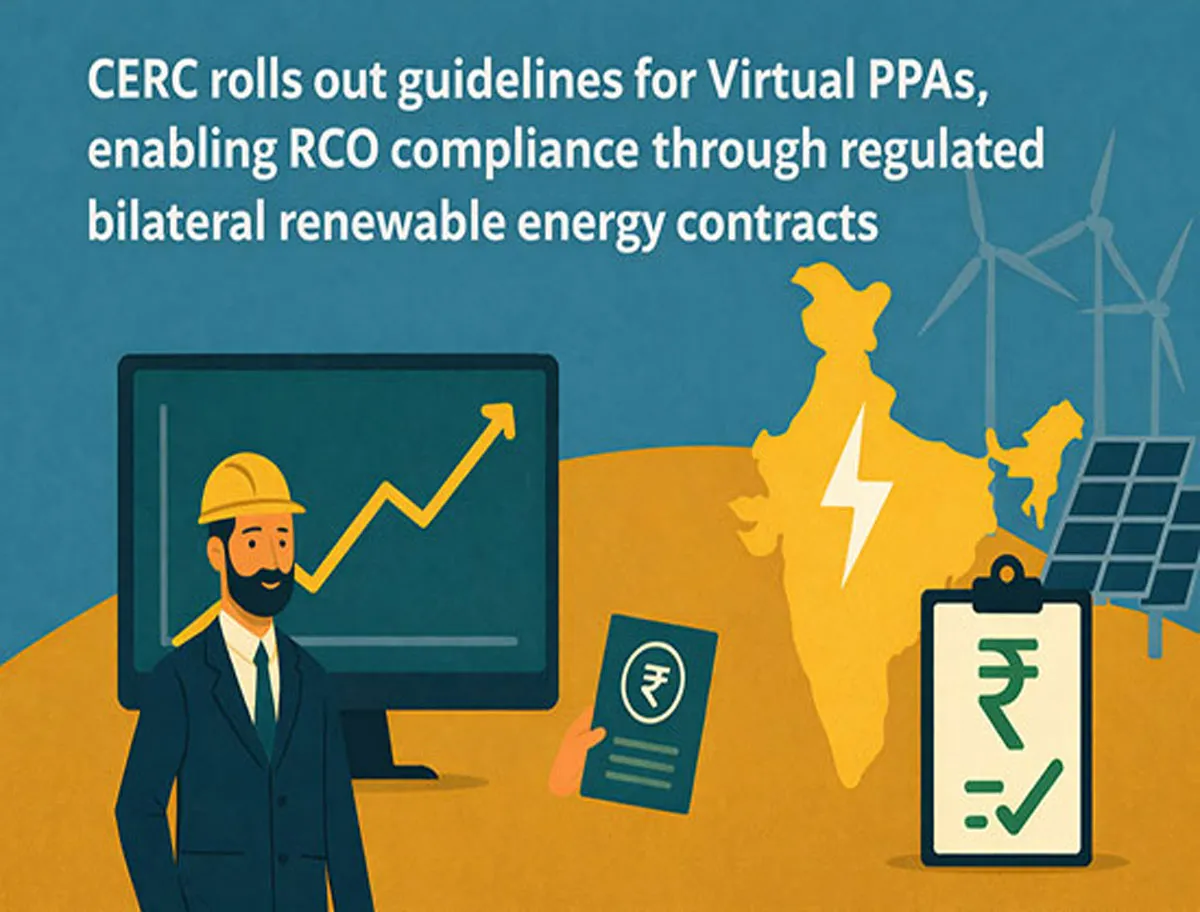
CERC Issues Framework For Virtual Power Purchase Deals
POWER & RENEWABLE ENERGY

CERC Issues Framework For Virtual Power Purchase Deals

The Central Electricity Regulatory Commission has issued detailed guidelines for Virtual Power Purchase Agreements, creating a structured regulatory framework for these over-the-counter renewable energy contracts to help designated consumers meet their Renewable Consumption Obligation targets.

Under the guidelines, VPPAs are classified as non-transferable specific delivery bilateral contracts within CERC’s jurisdiction, following a clarification issued earlier this year by the Securities and Exchange Board of India. The Commission noted that VPPAs have emerged globally as an innovative mechanism allowing large energy consumers, including distribution licensees, open-access users and captive consumers, to supplement physical procurement of renewable power with contract-based instruments aligned with compliance requirements.

The guidelines follow a request from the Ministry of Power to develop a suitable regulatory framework to enable RCO compliance through VPPAs. As per the framework, a VPPA is defined as a non-tradable, non-transferable bilateral OTC contract between a renewable energy generating station and a consumer or designated consumer. Under such an agreement, the buyer guarantees payment of a mutually agreed VPPA strike price for the duration of the contract.

The renewable energy generating station will sell the electricity produced through power exchanges or other authorised modes for purposes other than RPO or RCO compliance. The difference between the VPPA strike price and the settlement price will be settled bilaterally between the contracting parties in line with mutually agreed terms and conditions.

A key feature of the mechanism is that Renewable Energy Certificates issued against the contracted capacity will be transferred to the consumer or designated consumer for RPO or RCO compliance. These certificates will not be tradable and will be extinguished upon use, although surplus certificates may be carried forward for future compliance years. The VPPA must have a minimum tenure of one year, and the contracting parties will remain bound by the agreement for its entire duration.

The guidelines also stipulate that renewable energy generating stations participating in VPPAs must be registered in accordance with the Central Electricity Regulatory Commission (Terms and Conditions for Renewable Energy Certificates for Renewable Energy Generation) Regulations, 2022. In addition, generating stations must submit an undertaking to the REC Registry for the capacity contracted under a VPPA to prevent double counting of the same capacity.

Any disputes arising from VPPA contracts are to be resolved mutually by the contracting parties in accordance with the terms of the agreement, the Commission said.

The Central Electricity Regulatory Commission has issued detailed guidelines for Virtual Power Purchase Agreements, creating a structured regulatory framework for these over-the-counter renewable energy contracts to help designated consumers meet their Renewable Consumption Obligation targets. Under the guidelines, VPPAs are classified as non-transferable specific delivery bilateral contracts within CERC’s jurisdiction, following a clarification issued earlier this year by the Securities and Exchange Board of India. The Commission noted that VPPAs have emerged globally as an innovative mechanism allowing large energy consumers, including distribution licensees, open-access users and captive consumers, to supplement physical procurement of renewable power with contract-based instruments aligned with compliance requirements. The guidelines follow a request from the Ministry of Power to develop a suitable regulatory framework to enable RCO compliance through VPPAs. As per the framework, a VPPA is defined as a non-tradable, non-transferable bilateral OTC contract between a renewable energy generating station and a consumer or designated consumer. Under such an agreement, the buyer guarantees payment of a mutually agreed VPPA strike price for the duration of the contract. The renewable energy generating station will sell the electricity produced through power exchanges or other authorised modes for purposes other than RPO or RCO compliance. The difference between the VPPA strike price and the settlement price will be settled bilaterally between the contracting parties in line with mutually agreed terms and conditions. A key feature of the mechanism is that Renewable Energy Certificates issued against the contracted capacity will be transferred to the consumer or designated consumer for RPO or RCO compliance. These certificates will not be tradable and will be extinguished upon use, although surplus certificates may be carried forward for future compliance years. The VPPA must have a minimum tenure of one year, and the contracting parties will remain bound by the agreement for its entire duration. The guidelines also stipulate that renewable energy generating stations participating in VPPAs must be registered in accordance with the Central Electricity Regulatory Commission (Terms and Conditions for Renewable Energy Certificates for Renewable Energy Generation) Regulations, 2022. In addition, generating stations must submit an undertaking to the REC Registry for the capacity contracted under a VPPA to prevent double counting of the same capacity. Any disputes arising from VPPA contracts are to be resolved mutually by the contracting parties in accordance with the terms of the agreement, the Commission said.

Next Story
Real Estate

India Industrial And Logistics Leasing Hits Record High

Demand for industrial and logistics spaces in India reached an all-time high in 2025, with leasing volumes rising nearly 19 per cent year-on-year to 76.5 million square feet across 24 major cities, according to data from Savills. The real estate consultancy said the sector continued its strong post-pandemic growth trajectory, recording its highest-ever annual absorption during the year, compared with 64.5 million square feet leased in the 2024 calendar year. Manufacturing emerged as the largest occupier, accounting for 29 per cent of total leasing activity, followed closely by third-party log..

Next Story
Infrastructure Transport

Jewar Airport Set For January 2026 Inauguration

Uttar Pradesh Chief Minister Yogi Adityanath has announced that the Noida International Airport at Jewar will be inaugurated in January 2026, marking a major milestone in the state’s aviation expansion. The announcement was made on the concluding day of the Winter Session of the state legislature. Once operational, the facility will become Uttar Pradesh’s fifth international airport and a key aviation hub for northern India. Addressing the House, the chief minister highlighted the rapid expansion of aviation infrastructure in the state since 2017. He noted that prior to this period, Uttar..

Next Story
Infrastructure Transport

Adani Plans Rs 1 Trillion Push In Airport Expansion

Adani Enterprises plans to invest around Rs 1 trillion, or about $11 billion, in its airports infrastructure business over the next five years as it looks to significantly expand its footprint across India. Jeet Adani, Director at Adani Airport Holdings Limited (AAHL), said the group will bid for all 11 airports that the central government plans to lease out to private operators as part of its broader airport privatisation programme. India is accelerating airport privatisation in line with its long-term goal of expanding the country’s airport network to 350–400 facilities by 2047, up from..

Advertisement

Subscribe to Our Newsletter

Get daily newsletters around different themes from Construction world.

STAY CONNECTED

Advertisement

Advertisement

Advertisement

Advertisement

Open In App