+
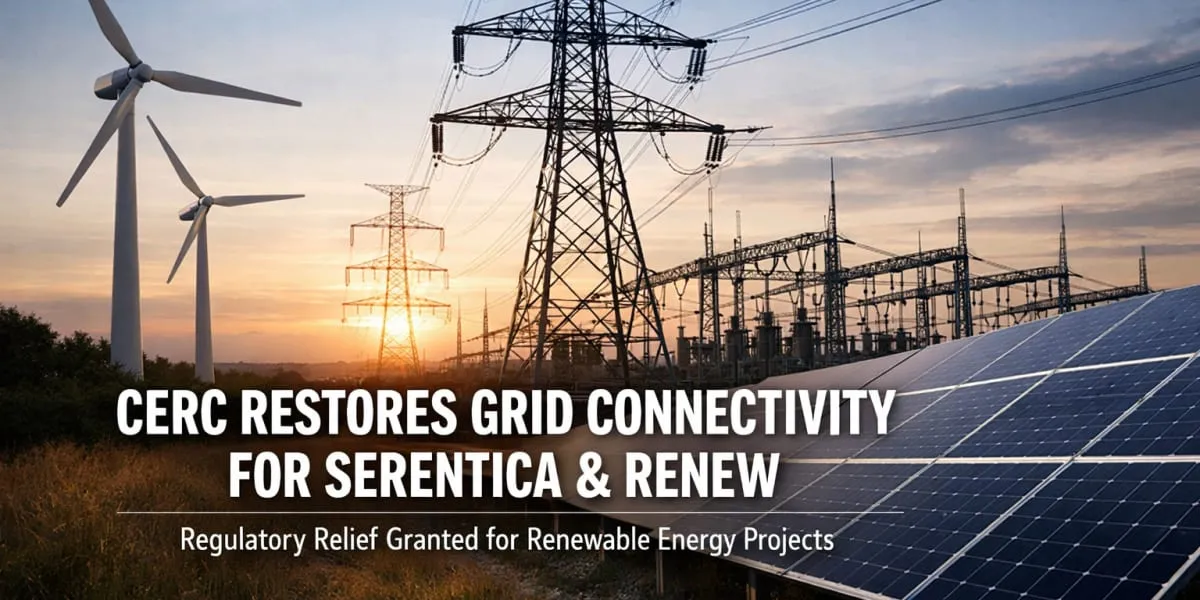
CERC Restores Grid Connectivity for Serentica and ReNew
POWER & RENEWABLE ENERGY

CERC Restores Grid Connectivity for Serentica and ReNew

The Central Electricity Regulatory Commission set aside revocation of grid connectivity for renewable projects by Serentica Renewables India 4 Pvt Ltd and ReNew Green entities and directed payment of compensation for commissioning delays. The Commission emphasised the need to protect transmission infrastructure while ensuring regulatory compliance. Relief was conditional and linked to specified penalties.

The dispute began after the Central Transmission Utility of India Limited revoked connectivity on the ground that projects had not been commissioned within timelines under the General Network Access regulations. The developers contested the action, arguing they were transitioned entities and that the six-month revocation period should be measured from the new connectivity start date granted during transition rather than from the scheduled date of commercial operation (SCOD). They cited uncontrollable factors including unprecedented rainfall that halted construction for more than 100 workdays, right of way issues, farmer protests and clearance delays.

The petitioners said projects were at advanced stages with multiple wind turbine generators erected and substantial capital deployed, noting investments of around Rs 11,870 million (mn) by Serentica and about Rs 26,810 mn by ReNew. CTUIL maintained that transitioned developers became deemed applicants bound by the regulations and that the grant of connectivity did not alter original commissioning timelines. The transmission utility argued it lacked authority to relax statutory provisions and that revocation followed the prescribed procedure when deadlines were missed.

After review CERC found that Regulation 24.6 applies to transitioned entities but identified a gap in the transition process that left the scheduled date of commercial operation undefined and therefore ruled that the SCOD should be equated to the new connectivity start date in such cases. The Commission set aside the revocation notices under its powers but granted conditional relief requiring payment of compensation linked to delays, beginning with charges equivalent to 50 per cent of bank guarantees for the first three months and escalating daily penalties thereafter. The Commission capped delay at 15 months and warned connectivity will be revoked if projects are not commissioned within that timeframe, aiming to safeguard investments.

The Central Electricity Regulatory Commission set aside revocation of grid connectivity for renewable projects by Serentica Renewables India 4 Pvt Ltd and ReNew Green entities and directed payment of compensation for commissioning delays. The Commission emphasised the need to protect transmission infrastructure while ensuring regulatory compliance. Relief was conditional and linked to specified penalties. The dispute began after the Central Transmission Utility of India Limited revoked connectivity on the ground that projects had not been commissioned within timelines under the General Network Access regulations. The developers contested the action, arguing they were transitioned entities and that the six-month revocation period should be measured from the new connectivity start date granted during transition rather than from the scheduled date of commercial operation (SCOD). They cited uncontrollable factors including unprecedented rainfall that halted construction for more than 100 workdays, right of way issues, farmer protests and clearance delays. The petitioners said projects were at advanced stages with multiple wind turbine generators erected and substantial capital deployed, noting investments of around Rs 11,870 million (mn) by Serentica and about Rs 26,810 mn by ReNew. CTUIL maintained that transitioned developers became deemed applicants bound by the regulations and that the grant of connectivity did not alter original commissioning timelines. The transmission utility argued it lacked authority to relax statutory provisions and that revocation followed the prescribed procedure when deadlines were missed. After review CERC found that Regulation 24.6 applies to transitioned entities but identified a gap in the transition process that left the scheduled date of commercial operation undefined and therefore ruled that the SCOD should be equated to the new connectivity start date in such cases. The Commission set aside the revocation notices under its powers but granted conditional relief requiring payment of compensation linked to delays, beginning with charges equivalent to 50 per cent of bank guarantees for the first three months and escalating daily penalties thereafter. The Commission capped delay at 15 months and warned connectivity will be revoked if projects are not commissioned within that timeframe, aiming to safeguard investments.

Next Story
Infrastructure Urban

Implementation Status of Jal Jeevan Mission

Since August 2019 the Government has implemented Jal Jeevan Mission to provide assured potable water through household tap connections in rural India. At the start of the mission only 32.3 million (mn) rural households, representing 16.7 per cent, were reported to have tap water connections. States and union territories have reported that 125.8 mn additional rural households have since been provided with tap connections. As a result, of about 193.6 mn rural households roughly 158.2 mn, or 81.71 per cent, are reported to have tap water supply at home.\n\nThe State, district and village level st..

Next Story
Infrastructure Urban

Jal Jeevan Mission Reaches Eighty One Per Cent Rural Coverage

The Government reported substantial progress under the Jal Jeevan Mission, launched in August 2019 to provide tap water to every rural household. At launch only 32.3 million (mn) rural households had tap connections and states and Union territories reported provision of 125.8 mn additional households by March 2026. Consequently, out of about 193.6 mn rural households around 158.2 mn, or 81.71 per cent, are reported to have tap water at home. The Finance Minister announced extension of the mission until 2028 in the 2025-26 budget speech. The Swachh Bharat Mission Grameen, launched in October 20..

Next Story
Infrastructure Urban

Empowering Local Governance for Sustainable Rural Water Supply

The Ministry of Jal Shakti has aligned the Jal Jeevan Mission (JJM) with the 73rd Amendment to strengthen village level planning and community ownership of water supply. Gram Panchayats, village water and sanitation committees and Pani Samitis are to plan, implement, manage and maintain piped water systems, with gram sabha processes formalising handover and oversight. Implementation support agencies including non government organisations, community based organisations and self help groups have been empanelled to train local committees and promote women participation. Under JJM, the department ..

Advertisement

Subscribe to Our Newsletter

Get daily newsletters around different themes from Construction world.

STAY CONNECTED

Advertisement

Advertisement

Advertisement