+
India Peak Power Demand Rises as Evening Supply Gap Widens
POWER & RENEWABLE ENERGY

India Peak Power Demand Rises as Evening Supply Gap Widens

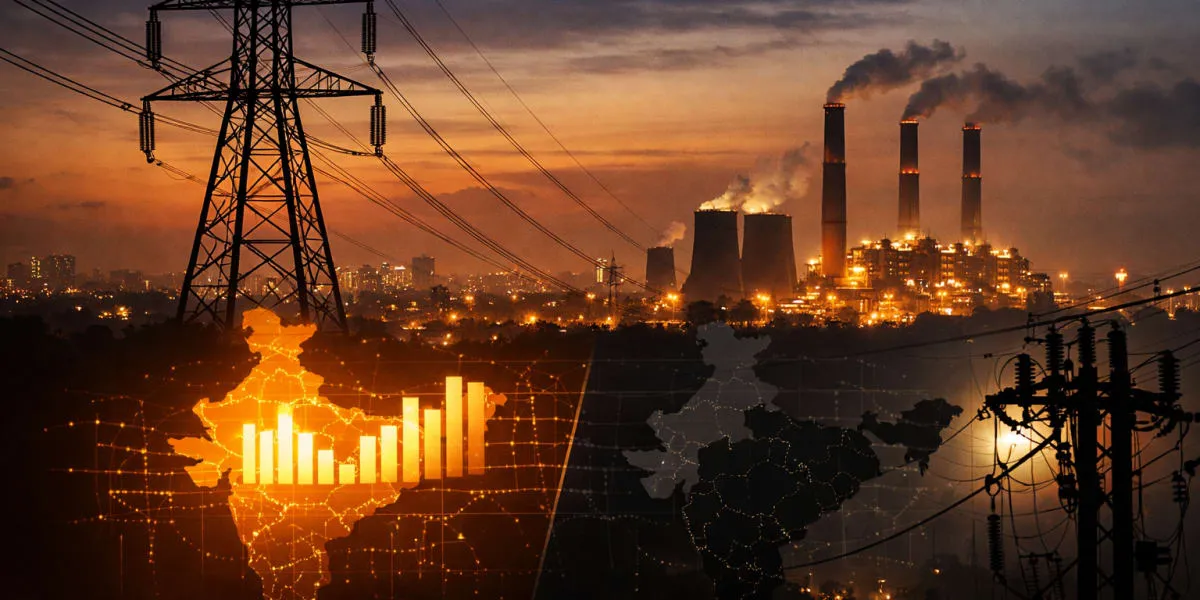
India's peak electricity demand rose about 12 per cent during April to June year?on?year and reached an all?time high of 270.8 GW in May, the government told the Rajya Sabha. The evening supply gap widened to 3,045 MW in June, with non?solar peak demand at 255,172 MW and peak supply met at 252,127 MW.

Northern states accounted for much of the shortfall, with evening peak demand at 95,919 MW against 93,269 MW met, leaving a gap of 2,650 MW. State reports showed Bihar had demand of 8,702 MW with 7,784 MW met, Maharashtra faced 32,193 MW against 31,338 MW supplied and Punjab recorded 12,812 MW demand with 12,352 MW met. The government cited transmission and distribution constraints.

The ministry said installed generation capacity was 548.86 GW as of June 2026, with 324.7 GW added since April 2014. Thermal generation accounted for 72.71 per cent of output in April, 69.90 per cent in May and 68.39 per cent in June, while the renewable share including large hydro rose from 24.13 per cent in April to 28.11 per cent in June.

The response linked higher demand partly to El Nino conditions that increased electricity requirements. It said there was no immediate difficulty in meeting peaks as fossil fuel resources were supplemented by renewables, but added that renewable energy would require storage at an exponential rate over the medium to long term.

Government projections envisage about 39.88 GW of battery storage and 10.95 GW of pumped storage to be added in fiscal years 2027?28 to 2029?30 to support integration of variable supplies. Officials said grid investments and transmission links remain critical to address regional evening shortages and that coordinated state and central measures are needed to manage peak demand and secure supply adequacy.

India's peak electricity demand rose about 12 per cent during April to June year?on?year and reached an all?time high of 270.8 GW in May, the government told the Rajya Sabha. The evening supply gap widened to 3,045 MW in June, with non?solar peak demand at 255,172 MW and peak supply met at 252,127 MW. Northern states accounted for much of the shortfall, with evening peak demand at 95,919 MW against 93,269 MW met, leaving a gap of 2,650 MW. State reports showed Bihar had demand of 8,702 MW with 7,784 MW met, Maharashtra faced 32,193 MW against 31,338 MW supplied and Punjab recorded 12,812 MW demand with 12,352 MW met. The government cited transmission and distribution constraints. The ministry said installed generation capacity was 548.86 GW as of June 2026, with 324.7 GW added since April 2014. Thermal generation accounted for 72.71 per cent of output in April, 69.90 per cent in May and 68.39 per cent in June, while the renewable share including large hydro rose from 24.13 per cent in April to 28.11 per cent in June. The response linked higher demand partly to El Nino conditions that increased electricity requirements. It said there was no immediate difficulty in meeting peaks as fossil fuel resources were supplemented by renewables, but added that renewable energy would require storage at an exponential rate over the medium to long term. Government projections envisage about 39.88 GW of battery storage and 10.95 GW of pumped storage to be added in fiscal years 2027?28 to 2029?30 to support integration of variable supplies. Officials said grid investments and transmission links remain critical to address regional evening shortages and that coordinated state and central measures are needed to manage peak demand and secure supply adequacy.

Related Stories

Gold Stories

Next Story
Infrastructure Urban

KONE Opens India's First Digital Experience Centre in Pune

KONE, a global elevator and escalator manufacturer, has inaugurated its first Digital Experience Centre (DEC) in India, located in Pune. The facility aims to showcase how artificial intelligence (AI), connectivity and data-driven technologies can enhance customer experiences and improve building operations.The centre was inaugurated by Jussi Herlin, Executive Vice Chair, KONE Corporation; Philippe Delorme, President and CEO, KONE; and Nandan Nilekani, Co-founder and Chairman of the Board, Infosys.Designed as an interactive customer environment, the facility demonstrates digital solutions cover..

Next Story
Infrastructure Urban

CII GreenCo Launches Circularity Guidelines for Indian Industry

The Confederation of Indian Industry (CII) GreenCo Council has launched the CII GreenCo Circularity Guidelines – Pilot Version at the 17th CII GreenCo Waste & Resource Management Summit 2026 in Chennai. The initiative aims to strengthen resource efficiency, waste reduction and circular economy practices across Indian manufacturing and process industries.The guidelines introduce a structured framework with circularity indices covering raw materials, consumables, packaging and other resource inputs. These indicators will help industries assess existing practices, identify opportunities to ..

Next Story
Infrastructure Energy

Global Electronics Association Launches IPC-1783-CO2E Standard

The Global Electronics Association has introduced IPC-1783-CO2E, a new international standard aimed at improving consistency, transparency and comparability in product carbon footprint reporting across the electronics manufacturing industry.The standard, titled International Standard for Data Collection and Reporting of CO2 Equivalent (CO2e) Emissions for the Electronics Manufacturing Supply Chain, provides industry-specific guidance for collecting, estimating and reporting carbon emissions data.With increasing regulatory requirements and customer expectations, electronics manufacturers face c..

Advertisement

Subscribe to Our Newsletter

Get daily newsletters around different themes from Construction world.

STAY CONNECTED

Advertisement

SPECIAL OFFER
QR Code