+
Indian Scientists Develop Sun-Powered Self-Charging Supercapacitor
POWER & RENEWABLE ENERGY

Indian Scientists Develop Sun-Powered Self-Charging Supercapacitor

Indian scientists have developed a sunlight-powered, self-charging energy storage device that can both capture and store solar energy within a single integrated system. The innovation, known as a photo-capacitor, marks a significant step towards clean, low-cost and self-sustaining power solutions for portable, wearable and off-grid applications.
The device has been developed by researchers at the Centre for Nano and Soft Matter Sciences (CeNS), an autonomous institute under the Department of Science and Technology. Unlike conventional solar systems that rely on separate units for energy harvesting and storage, the photo-capacitor combines both functions, reducing system complexity, energy losses and overall footprint.
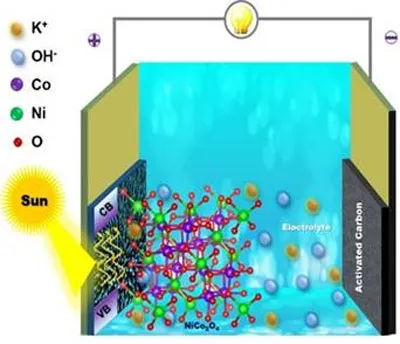
The research team, led by Dr Kavita Pandey, used binder-free nickel–cobalt oxide (NiCo?O?) nanowires grown directly on nickel foam through an in-situ hydrothermal process. The nanowires form a highly porous, conductive three-dimensional network that efficiently absorbs sunlight while simultaneously storing electrical charge.
Under illumination, the NiCo?O? electrode demonstrated a 54 per cent increase in capacitance, rising from 570 to 880 mF cm?² at a current density of 15 mA cm?². The electrode retained about 85 per cent of its capacity even after 10,000 charge–discharge cycles, highlighting its durability for long-term use.
To assess real-world performance, the researchers developed an asymmetric photo-supercapacitor using activated carbon as the negative electrode. The device delivered a stable output of 1.2 volts, maintained 88 per cent capacitance after 1,000 photo-charging cycles, and operated reliably under a wide range of lighting conditions, from indoor illumination to high solar intensity.
The study also included theoretical simulations that explained the material’s high efficiency. Nickel substitution in the cobalt oxide framework narrowed the band gap and induced half-metallic behaviour, enabling faster charge transport and improved conductivity—key advantages for photo-assisted energy storage.
Published in Sustainable Energy & Fuels by the Royal Society of Chemistry, the research introduces a new class of smart, photo-rechargeable energy storage devices. The innovation is expected to support India’s clean energy ambitions by enabling decentralised, grid-independent power systems and reducing reliance on conventional batteries and fossil fuels.

Indian scientists have developed a sunlight-powered, self-charging energy storage device that can both capture and store solar energy within a single integrated system. The innovation, known as a photo-capacitor, marks a significant step towards clean, low-cost and self-sustaining power solutions for portable, wearable and off-grid applications.The device has been developed by researchers at the Centre for Nano and Soft Matter Sciences (CeNS), an autonomous institute under the Department of Science and Technology. Unlike conventional solar systems that rely on separate units for energy harvesting and storage, the photo-capacitor combines both functions, reducing system complexity, energy losses and overall footprint.The research team, led by Dr Kavita Pandey, used binder-free nickel–cobalt oxide (NiCo?O?) nanowires grown directly on nickel foam through an in-situ hydrothermal process. The nanowires form a highly porous, conductive three-dimensional network that efficiently absorbs sunlight while simultaneously storing electrical charge.Under illumination, the NiCo?O? electrode demonstrated a 54 per cent increase in capacitance, rising from 570 to 880 mF cm?² at a current density of 15 mA cm?². The electrode retained about 85 per cent of its capacity even after 10,000 charge–discharge cycles, highlighting its durability for long-term use.To assess real-world performance, the researchers developed an asymmetric photo-supercapacitor using activated carbon as the negative electrode. The device delivered a stable output of 1.2 volts, maintained 88 per cent capacitance after 1,000 photo-charging cycles, and operated reliably under a wide range of lighting conditions, from indoor illumination to high solar intensity.The study also included theoretical simulations that explained the material’s high efficiency. Nickel substitution in the cobalt oxide framework narrowed the band gap and induced half-metallic behaviour, enabling faster charge transport and improved conductivity—key advantages for photo-assisted energy storage.Published in Sustainable Energy & Fuels by the Royal Society of Chemistry, the research introduces a new class of smart, photo-rechargeable energy storage devices. The innovation is expected to support India’s clean energy ambitions by enabling decentralised, grid-independent power systems and reducing reliance on conventional batteries and fossil fuels.

Next Story
Infrastructure Transport

Lucknow Metro East-West Corridor Consultancy Contract Awarded

The Uttar Pradesh Metro Rail Corporation has awarded the first construction-related consultancy contract for the Lucknow Metro East West Corridor to a joint venture of AYESA Ingenieria Arquitectura SAU and AYESA India Pvt Ltd. The firm was declared the lowest bidder for the Detailed Design Consultant contract for Lucknow Metro Line-2 under Phase 1B and the contract was recommended following the financial bid. The contract is valued at Rs 159.0 million (mn), covering design services for the corridor. Lucknow Metro Line-2 envisages the construction of an 11.165 kilometre corridor connecting Cha..

Next Story
Infrastructure Urban

Div Com Kashmir Urges Fast Tracking Of Jhelum Water Transport Project

The Divisional Commissioner of Kashmir has called for the fast-tracking of the Jhelum water transport project, urging district administrations and relevant agencies to accelerate planning and clearances. In a meeting convened at the divisional headquarters, the commissioner instructed officials from irrigation, public health engineering and municipal departments to prioritise the project and coordinate survey and design work. The directive emphasised removal of administrative bottlenecks and close monitoring to ensure timely mobilisation of resources and contractors. Officials were told to in..

Next Story
Infrastructure Urban

Interarch Reports Strong Q3 And Nine Month Results

Interarch Building Solutions Limited reported unaudited results for the third quarter and nine months ended 31 December 2025, recording strong revenue growth driven by execution and a robust order book. Net revenue for the third quarter rose by 43.7 per cent to Rs 5.225 billion (bn), compared with Rs 3.636 bn a year earlier, reflecting heightened demand in pre-engineered building projects. The company’s total order book as at 31 January 2026 stood at Rs 16.85 bn, supporting near-term visibility. EBITDA excluding other income for the quarter increased by 43.2 per cent to Rs 503 million (mn),..

Advertisement

Subscribe to Our Newsletter

Get daily newsletters around different themes from Construction world.

STAY CONNECTED

Advertisement

Advertisement

Advertisement

Open In App