India's Energy Supplies Secure Despite West Asia Conflict
POWER & RENEWABLE ENERGY

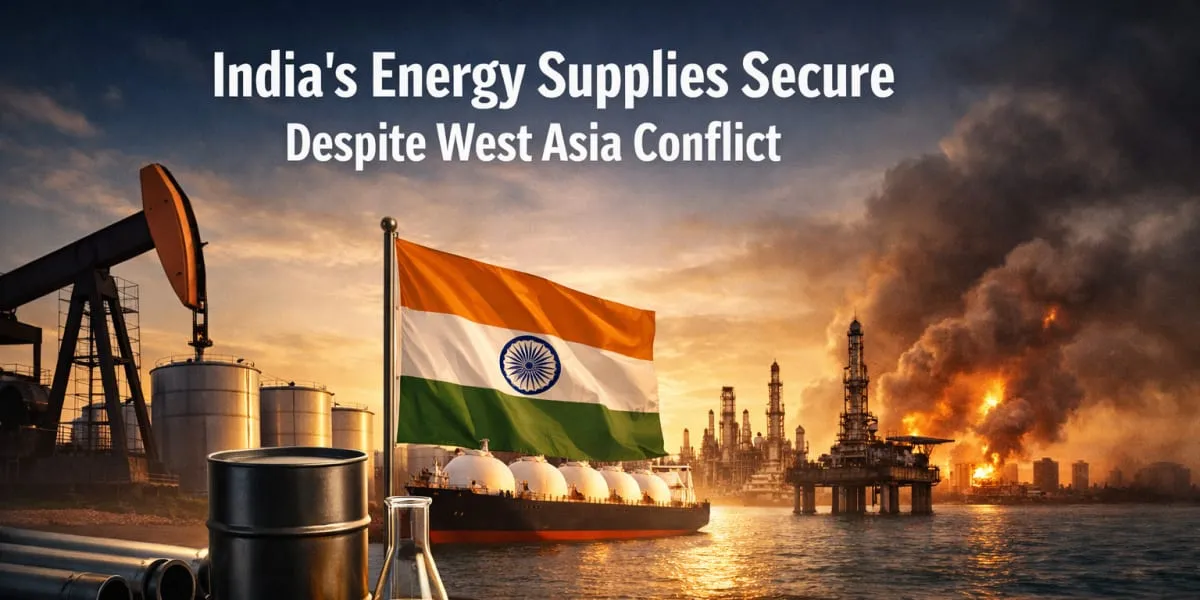
India's Energy Supplies Secure Despite West Asia Conflict

Hardeep Singh Puri, the Minister of Petroleum and Natural Gas, told Parliament that India's energy supplies remained secure despite the conflict in West Asia. He said the resilience reflected diversified import sources and sustained domestic production. The minister added that continuous monitoring of supply chains and engagement with international partners had helped to contain volatility. He noted ongoing assessments of refining throughput and stock management to ensure continuity of supply across regions.

The government highlighted measures including enhanced maritime surveillance, coordination with refiners and adjustments to procurement strategies. It noted the role of strategic petroleum reserves (SPR) in providing a buffer and said storage levels were being managed to smooth supply. Officials were reported to be in regular contact with exporters and shipping operators to mitigate disruptions. State authorities and regulators had been engaged to align distribution plans and to avoid localised shortages.

Market reaction was modest and domestic fuel availability did not show immediate signs of stress, the minister said. He indicated that retail prices continued to reflect global trends but that contingency plans were in place to address sudden spikes in crude costs. The authorities retained the option to release oil from the SPR and to engage in bilateral arrangements with alternative suppliers if necessary. Communications with markets and consumers were being prioritised to prevent panic buying and to maintain confidence.

The minister emphasised that the government continued to prioritise energy security and to monitor developments closely. He said diplomatic channels were active and that diversification of supply partnerships remained central to the strategy. Parliament would receive further updates as the situation evolved and steps would be taken to protect consumers and the economy. Contingency exercises had been undertaken and contractual flexibilities were being reviewed to adapt supply arrangements if disruptions persisted.

Hardeep Singh Puri, the Minister of Petroleum and Natural Gas, told Parliament that India's energy supplies remained secure despite the conflict in West Asia. He said the resilience reflected diversified import sources and sustained domestic production. The minister added that continuous monitoring of supply chains and engagement with international partners had helped to contain volatility. He noted ongoing assessments of refining throughput and stock management to ensure continuity of supply across regions. The government highlighted measures including enhanced maritime surveillance, coordination with refiners and adjustments to procurement strategies. It noted the role of strategic petroleum reserves (SPR) in providing a buffer and said storage levels were being managed to smooth supply. Officials were reported to be in regular contact with exporters and shipping operators to mitigate disruptions. State authorities and regulators had been engaged to align distribution plans and to avoid localised shortages. Market reaction was modest and domestic fuel availability did not show immediate signs of stress, the minister said. He indicated that retail prices continued to reflect global trends but that contingency plans were in place to address sudden spikes in crude costs. The authorities retained the option to release oil from the SPR and to engage in bilateral arrangements with alternative suppliers if necessary. Communications with markets and consumers were being prioritised to prevent panic buying and to maintain confidence. The minister emphasised that the government continued to prioritise energy security and to monitor developments closely. He said diplomatic channels were active and that diversification of supply partnerships remained central to the strategy. Parliament would receive further updates as the situation evolved and steps would be taken to protect consumers and the economy. Contingency exercises had been undertaken and contractual flexibilities were being reviewed to adapt supply arrangements if disruptions persisted.

Next Story
Infrastructure Urban

MIDC and Ramky Unit Sign Concession for Life Sciences Park

Maharashtra Industrial Development Corporation has signed a concession agreement with Maha Integrated Life Sciences City Limited (MILeS City), a wholly owned subsidiary of Ramky Infrastructure Limited (RIL), to develop a high-tech pharmaceutical park at Dighi Port Industrial Area in Raigad. The project will follow a public-private partnership under a DBFOT model and has an estimated cost of Rs 30 billion (Rs 30 bn). The concession will run for 95 years, including a five-year construction phase, with MILeS City responsible for development and management. The development will occupy approximatel..

Next Story
Real Estate

BuzzWorks Leases Hyderabad Office to MyComplianceOffice

Brigade Group’s managed workspace provider BuzzWorks has leased 550 seats at Mindspace Business Park in Hyderabad to Dublin based MyComplianceOffice, in what is the company’s largest office in India. With this signing, BuzzWorks' total leased office space in Hyderabad stands at zero point one one million (mn) square feet. The new premises will house core functions including product engineering, product management, customer success and global operations. Artificial intelligence enabled compliance technology initiatives will also be part of the local delivery model. BuzzWorks will provide wo..

Next Story
Infrastructure Transport

Jindal Stainless Flags Operational Strain From Middle East Crisis

Jindal Stainless warned that the Middle East war crisis has affected its operations because of dependence on industrial gases such as propane and LPG and on natural gas. The scrap-based production route used by the stainless steel maker does not generate blast furnace or coke oven gases internally, unlike the conventional steel industry. Several plant processes have been adversely impacted and production is being run at rationalised capacity. Disruptions in global shipping routes have resulted in vessel diversions, longer transit times and cargo delays, adding pressure to supply chains and to ..

Advertisement

Subscribe to Our Newsletter

Get daily newsletters around different themes from Construction world.

STAY CONNECTED

Advertisement

Advertisement

Advertisement