India Ranks Third in Installed Renewable Energy Capacity
POWER & RENEWABLE ENERGY

India Ranks Third in Installed Renewable Energy Capacity

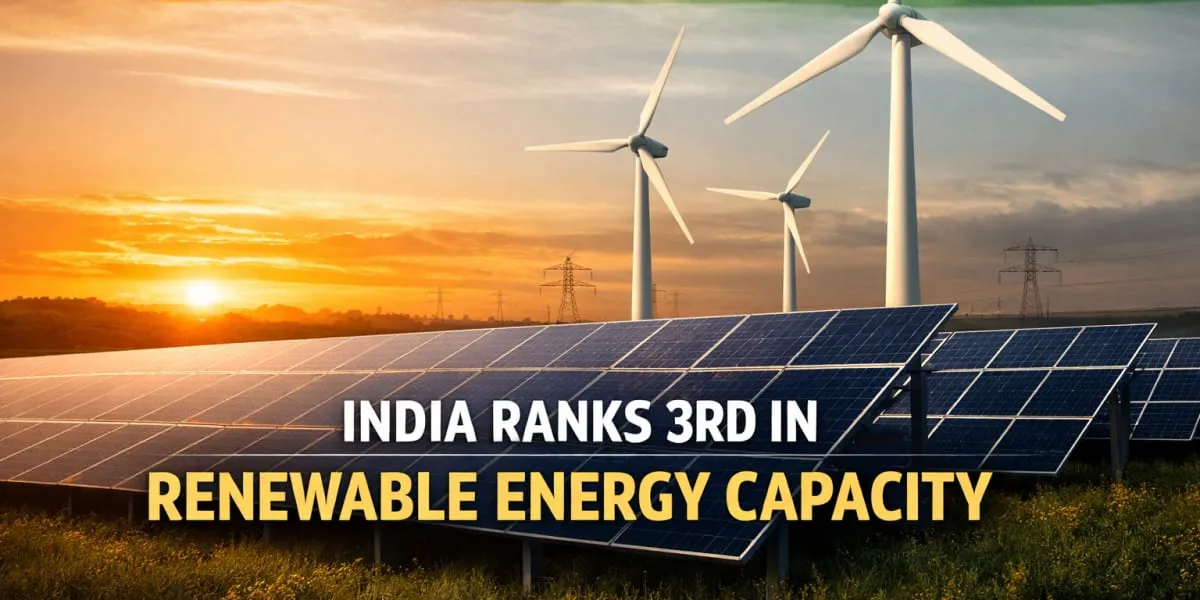
India ranks third globally in installed renewable energy capacity, according to a report by Morgan Stanley and data from the Ministry of New and Renewable Energy. The report said the transition would reduce external dependence but that success would depend on how quickly the country localises critical segments such as solar cells, wafers and polysilicon. Officials noted that solar and wind additions have driven most recent growth. The Morgan Stanley analysis also emphasised the need to address manufacturing bottlenecks to sustain momentum.

Ministry data showed domestic solar module capacity nearly doubled from 38 gigawatt (GW) in March 2024 to 74 GW in March 2025, while solar cell capacity rose from nine GW to 25 GW over the same period. The increase in domestic manufacturing has improved supply chain resilience and supported larger deployments across states. Analysts said the capacity gains reflect policy support and market demand.

Despite the gains, the report observed a heavy reliance on imports for key upstream components. In the financial year 2025 India imported around 35 million (mn) solar modules valued at about 1.6 billion (bn) US dollars, with an estimated 60 to 80 per cent procured from China. These figures underline the gap between module assembly and upstream material production and the challenge of moving up the value chain. The report recommended accelerating localisation to capture value and reduce vulnerability to global supply disruptions.

Overall non-fossil fuel capacity has crossed 50 per cent of total installed capacity, reaching 262.7 GW, according to the ministry. Solar and wind account for the bulk of recent additions and continue to shape the power mix as thermal capacity adjusts. Policymakers and industry participants were said to be focused on scaling manufacturing, addressing logistics and improving financing to sustain the energy transition. Policy efforts are concentrated on incentives, technology transfer and investment in domestic supply chains to reduce import dependence.

India ranks third globally in installed renewable energy capacity, according to a report by Morgan Stanley and data from the Ministry of New and Renewable Energy. The report said the transition would reduce external dependence but that success would depend on how quickly the country localises critical segments such as solar cells, wafers and polysilicon. Officials noted that solar and wind additions have driven most recent growth. The Morgan Stanley analysis also emphasised the need to address manufacturing bottlenecks to sustain momentum. Ministry data showed domestic solar module capacity nearly doubled from 38 gigawatt (GW) in March 2024 to 74 GW in March 2025, while solar cell capacity rose from nine GW to 25 GW over the same period. The increase in domestic manufacturing has improved supply chain resilience and supported larger deployments across states. Analysts said the capacity gains reflect policy support and market demand. Despite the gains, the report observed a heavy reliance on imports for key upstream components. In the financial year 2025 India imported around 35 million (mn) solar modules valued at about 1.6 billion (bn) US dollars, with an estimated 60 to 80 per cent procured from China. These figures underline the gap between module assembly and upstream material production and the challenge of moving up the value chain. The report recommended accelerating localisation to capture value and reduce vulnerability to global supply disruptions. Overall non-fossil fuel capacity has crossed 50 per cent of total installed capacity, reaching 262.7 GW, according to the ministry. Solar and wind account for the bulk of recent additions and continue to shape the power mix as thermal capacity adjusts. Policymakers and industry participants were said to be focused on scaling manufacturing, addressing logistics and improving financing to sustain the energy transition. Policy efforts are concentrated on incentives, technology transfer and investment in domestic supply chains to reduce import dependence.

Next Story
Infrastructure Transport

Pune Division to Remove All Diamond Crossings by Year-End

The Pune railway division has announced plans to remove all 16 diamond crossings by the end of 2026 as part of a major yard remodelling project following the derailment of a Vande Bharat Express at Pune Junction on April 27. Railway authorities said the replacements aim to improve safety and streamline train operations across the busy station. The decision followed a Central Railway finding that the accident involved a non-standard diamond crossing and highlighted the need for replacement. Regular maintenance of existing crossings will continue until the replacement work is completed. Official..

Next Story
Infrastructure Urban

Goa Declares 80 Million Square Metres No Development Zone

The Goa state government has declared 80 million square metres (mn) of land a no development zone, designating the area as protected from new construction. The notification reclassifies tracts across the state under a no development category for planning and regulatory purposes. The declaration signals a formal halt to new building permits within the defined zone. Authorities indicated that maps will be issued to show broad boundaries while detailed surveys will refine precise limits. The move transfers responsibility for enforcement to local planning authorities and relevant departments, whic..

Next Story
Infrastructure Urban

Micro Mitti To Invest Rs Three Billion In Indore Project

Micro Mitti has announced an investment of Rs three billion (Rs 3 bn) to develop a commercial project in Indore. The company said the allocation marks a significant commitment to the city's real estate sector and will target commercial space demand. The announcement follows the firm's stated strategy to expand its asset base outside its existing markets. Company executives outlined the plan in a corporate release and provided limited additional details. The commercial project is intended to serve office, retail and related uses in response to demand from businesses and consumers in the region...

Advertisement

Subscribe to Our Newsletter

Get daily newsletters around different themes from Construction world.

STAY CONNECTED

Advertisement

Advertisement

Advertisement