+
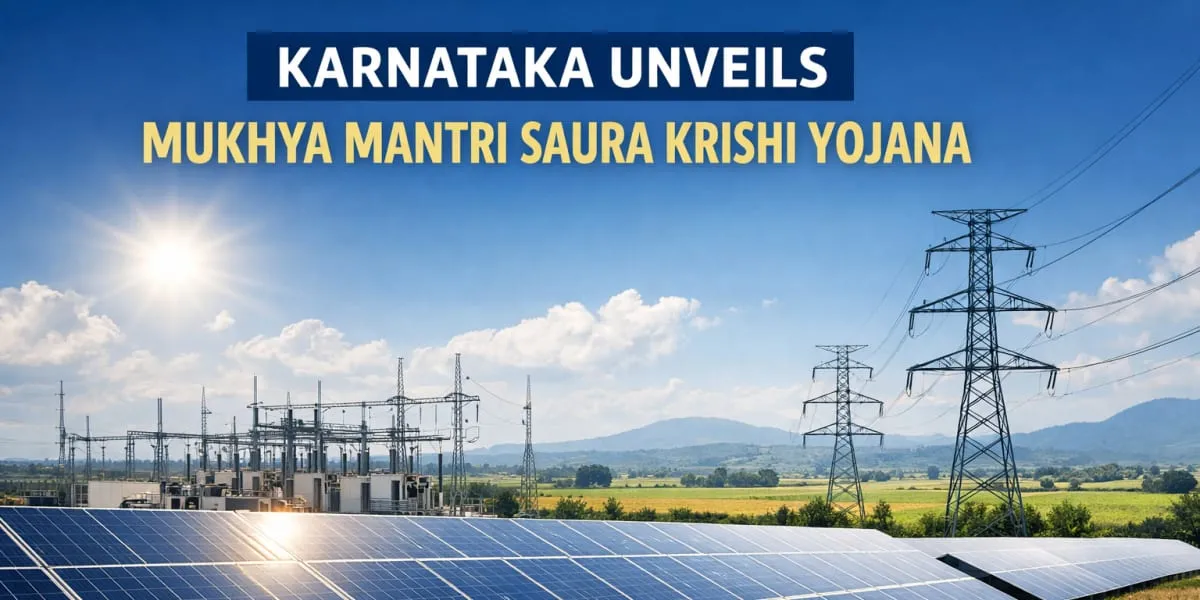
Karnataka Unveils Mukhya Mantri Saura Krishi Yojana
POWER & RENEWABLE ENERGY

Karnataka Unveils Mukhya Mantri Saura Krishi Yojana

The state government announced the Mukhya Mantri Saura Krishi Yojana to commission solar power plants with a capacity of 3,000 megawatt (MW) in Karnataka Power Transmission Corporation (KPTCL) sub-centres under the Renewable Energy service company (RESCO) model. The Chief Minister Siddaramaiah announced that the scheme would be implemented at an estimated cost of Rs 105 bn. The scheme was presented as a state-level adaptation of a central initiative to expand solar capacity close to agricultural feeders.

The announcement was described as similar to the Pradhan Mantri Kisan Urja Suraksha evam Utthaan Mahabhiyan Component-C scheme, often referred to as PM Kusum-C, which provides subsidies for the installation of solar units near agricultural electricity feeders. Officials indicated that the RESCO approach would allow private developers to set up and operate the plants while supplying power to local feeders. The aim was stated to be greater use of distributed solar generation to stabilise rural power supply.

The government also earmarked Rs 34 bn to establish Battery Energy Storage Systems (BESS) that are considered crucial to boost the use of renewable energy. It was reported that BESS installations would be developed at the Huliyur, Pavagada and Kushtagi substations to manage intermittency and support grid integration.

Officials suggested the combined policy would reduce dependence on conventional sources during peak demand and enable better utilisation of daytime solar generation for agricultural needs. The programme was expected to lower line losses and improve supply reliability on farm feeders by injecting distributed solar into the local transmission network. The state budget allocation was presented as a strategic investment in the transition to cleaner power.

The plan was described as leveraging KPTCL infrastructure and state funding to accelerate deployment without imposing immediate capital burden on farmers. Authorities indicated that detailed implementation timelines and procurement modalities would be announced by the power department in due course.

The state government announced the Mukhya Mantri Saura Krishi Yojana to commission solar power plants with a capacity of 3,000 megawatt (MW) in Karnataka Power Transmission Corporation (KPTCL) sub-centres under the Renewable Energy service company (RESCO) model. The Chief Minister Siddaramaiah announced that the scheme would be implemented at an estimated cost of Rs 105 bn. The scheme was presented as a state-level adaptation of a central initiative to expand solar capacity close to agricultural feeders. The announcement was described as similar to the Pradhan Mantri Kisan Urja Suraksha evam Utthaan Mahabhiyan Component-C scheme, often referred to as PM Kusum-C, which provides subsidies for the installation of solar units near agricultural electricity feeders. Officials indicated that the RESCO approach would allow private developers to set up and operate the plants while supplying power to local feeders. The aim was stated to be greater use of distributed solar generation to stabilise rural power supply. The government also earmarked Rs 34 bn to establish Battery Energy Storage Systems (BESS) that are considered crucial to boost the use of renewable energy. It was reported that BESS installations would be developed at the Huliyur, Pavagada and Kushtagi substations to manage intermittency and support grid integration. Officials suggested the combined policy would reduce dependence on conventional sources during peak demand and enable better utilisation of daytime solar generation for agricultural needs. The programme was expected to lower line losses and improve supply reliability on farm feeders by injecting distributed solar into the local transmission network. The state budget allocation was presented as a strategic investment in the transition to cleaner power. The plan was described as leveraging KPTCL infrastructure and state funding to accelerate deployment without imposing immediate capital burden on farmers. Authorities indicated that detailed implementation timelines and procurement modalities would be announced by the power department in due course.

Next Story
Infrastructure Urban

Implementation Status of Jal Jeevan Mission

Since August 2019 the Government has implemented Jal Jeevan Mission to provide assured potable water through household tap connections in rural India. At the start of the mission only 32.3 million (mn) rural households, representing 16.7 per cent, were reported to have tap water connections. States and union territories have reported that 125.8 mn additional rural households have since been provided with tap connections. As a result, of about 193.6 mn rural households roughly 158.2 mn, or 81.71 per cent, are reported to have tap water supply at home.\n\nThe State, district and village level st..

Next Story
Infrastructure Urban

Jal Jeevan Mission Reaches Eighty One Per Cent Rural Coverage

The Government reported substantial progress under the Jal Jeevan Mission, launched in August 2019 to provide tap water to every rural household. At launch only 32.3 million (mn) rural households had tap connections and states and Union territories reported provision of 125.8 mn additional households by March 2026. Consequently, out of about 193.6 mn rural households around 158.2 mn, or 81.71 per cent, are reported to have tap water at home. The Finance Minister announced extension of the mission until 2028 in the 2025-26 budget speech. The Swachh Bharat Mission Grameen, launched in October 20..

Next Story
Infrastructure Urban

Empowering Local Governance for Sustainable Rural Water Supply

The Ministry of Jal Shakti has aligned the Jal Jeevan Mission (JJM) with the 73rd Amendment to strengthen village level planning and community ownership of water supply. Gram Panchayats, village water and sanitation committees and Pani Samitis are to plan, implement, manage and maintain piped water systems, with gram sabha processes formalising handover and oversight. Implementation support agencies including non government organisations, community based organisations and self help groups have been empanelled to train local committees and promote women participation. Under JJM, the department ..

Advertisement

Subscribe to Our Newsletter

Get daily newsletters around different themes from Construction world.

STAY CONNECTED

Advertisement

Advertisement

Advertisement