+
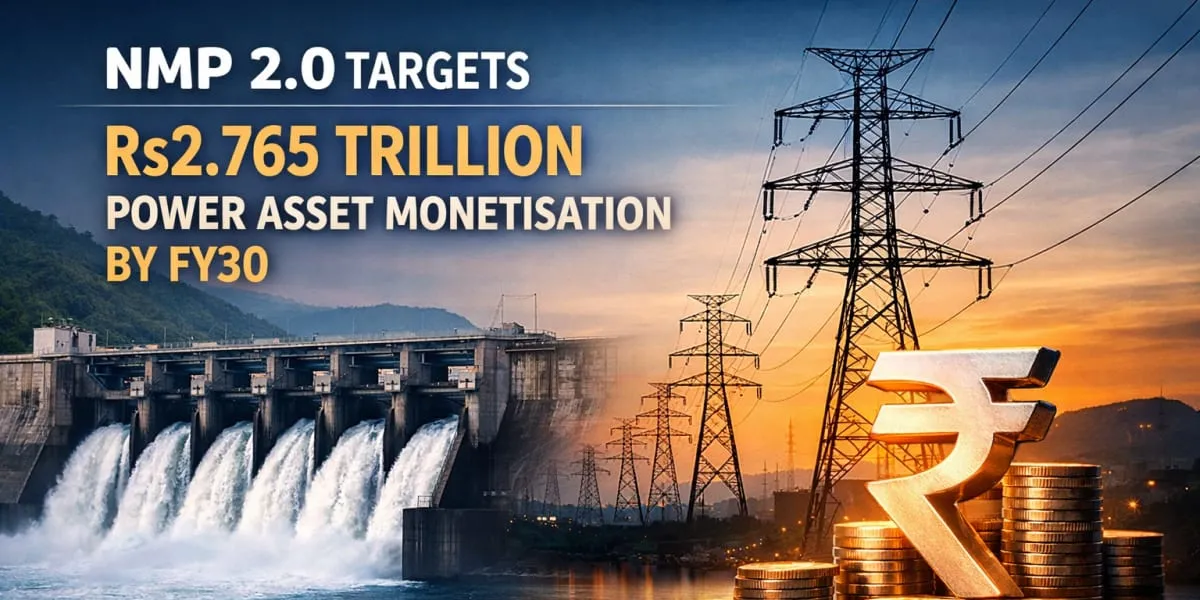
NMP 2.0 Targets Rs2.765 Trillion (tn) Power Asset Monetisation By FY30
POWER & RENEWABLE ENERGY

NMP 2.0 Targets Rs2.765 Trillion (tn) Power Asset Monetisation By FY30

Niti Aayog has released the National Monetization Pipeline 2.0 setting a target of Rs2,765 billion (bn) for power sector asset monetisation by fiscal year 2030. The pipeline also sets a target of Rs499 billion (bn) for fiscal year 2026. The total cash flow expected from private investment in power projects by fiscal year 2030 has been set at Rs2,427.88 billion (bn).

The power sector asset classes in the pipeline comprise eight operational hydro assets owned by NHPC and SJVN, transmission assets of Power Grid Corporation of India Limited (PGCIL), inter-state transmission lines (ISTL) and partial equity dilution of step down subsidiaries of public sector undertakings (PSUs). The eight hydro assets are proposed to be monetised through securitisation of future cash flows by the relevant PSU. PGCIL intends to monetise transmission assets through securitisation of annuity revenues. ISTL projects will be awarded on a build own operate transfer model through tariff based competitive bidding and the investments made in these partnership projects will be counted towards monetisation.

The pipeline envisages partial equity divestment in step down subsidiaries of power PSUs as an additional route to unlock capital. Monetisation value for ISTL and partnership projects will be measured by the investments made by private partners under the agreed models. The approach preserves government ownership while generating revenue that can be recycled to create new infrastructure.

Asset monetisation is presented as an alternative financing mechanism to leverage existing or under utilised infrastructure assets to raise fresh capital without adding fiscal pressure. The released pipeline aims to channel private funds into the energy sector to support capacity expansion and improve asset utilisation. Niti Aayog expects the additional capital unlocked to be reinvested in asset creation over the remainder of the decade.

Niti Aayog has released the National Monetization Pipeline 2.0 setting a target of Rs2,765 billion (bn) for power sector asset monetisation by fiscal year 2030. The pipeline also sets a target of Rs499 billion (bn) for fiscal year 2026. The total cash flow expected from private investment in power projects by fiscal year 2030 has been set at Rs2,427.88 billion (bn). The power sector asset classes in the pipeline comprise eight operational hydro assets owned by NHPC and SJVN, transmission assets of Power Grid Corporation of India Limited (PGCIL), inter-state transmission lines (ISTL) and partial equity dilution of step down subsidiaries of public sector undertakings (PSUs). The eight hydro assets are proposed to be monetised through securitisation of future cash flows by the relevant PSU. PGCIL intends to monetise transmission assets through securitisation of annuity revenues. ISTL projects will be awarded on a build own operate transfer model through tariff based competitive bidding and the investments made in these partnership projects will be counted towards monetisation. The pipeline envisages partial equity divestment in step down subsidiaries of power PSUs as an additional route to unlock capital. Monetisation value for ISTL and partnership projects will be measured by the investments made by private partners under the agreed models. The approach preserves government ownership while generating revenue that can be recycled to create new infrastructure. Asset monetisation is presented as an alternative financing mechanism to leverage existing or under utilised infrastructure assets to raise fresh capital without adding fiscal pressure. The released pipeline aims to channel private funds into the energy sector to support capacity expansion and improve asset utilisation. Niti Aayog expects the additional capital unlocked to be reinvested in asset creation over the remainder of the decade.

Next Story
Infrastructure Urban

We’ve cut 50,000 tonnes of carbon emmissions since 2019

MatchLog is challenging a decades-old logistics norm and empty container miles by directly matching import flows with export demand. Indeed, the platform is unlocking measurable cost savings, cutting emissions and driving structural change in landside operations. Dhruv Taneja, Founder and Global CEO, outlines the quantified impact, adoption  journey and the evolving future of container reuse in an exclusive interview with Construction World. MatchLog has partnered with carriers such as Maersk, ONE and HMM in India. Could you share quantified outcomes from one specific corri..

Next Story
Infrastructure Transport

Airports: Capacity is Key

A lotus-inspired terminal design in Navi Mumbai International Airport. A terminal in a garden in Bengaluru’s Kempegowda International Airport. A peacock-inspired canopy in Chhatrapati Shivaji Maharaj International Airport. A nature-inspired terminal in Guwahati’s Lokpriya Gopinath Bordoloi International Airport.Truly, “India’s airports are no longer constrained by architectural ambition,” avers Ravikanth Mididhodi, Chief Technical Officer, J&F, a German-based engineering firm with over 25 years of global legacy in delivering advanced engineering and BIM services for air..

Next Story
Real Estate

In 2025, Amaravati attracted ₹ 28,075 crore in investments

In an exclusive interview with Construction World, Kanna Babu, IAS, Commissioner, Andhra Pradesh Capital Region Development Authority (APCRDA), reveals how Amaravati is entering a decisive new phase of capital city development. With 36 MoUs worth ₹ 45,589 crore, a ₹ 58,000 crore tender pipeline, and rising institutional investments, he explains the strategic execution, infrastructure rollout, and governance framework driving Amaravati’s emergence as a structured, investment-ready, and future-focused capital.APCRDA has recently secured major financial tie-ups, including loans from NA..

Advertisement

Subscribe to Our Newsletter

Get daily newsletters around different themes from Construction world.

STAY CONNECTED

Advertisement

Advertisement

Advertisement

Open In App