+
Stealth Solar CME Triggers Intense Geomagnetic Storm: Study
POWER & RENEWABLE ENERGY

Stealth Solar CME Triggers Intense Geomagnetic Storm: Study

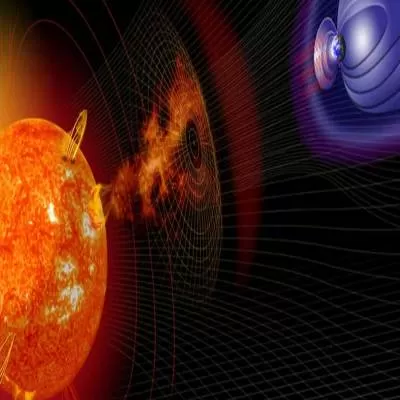
Astronomers have shown that even weak and nearly invisible solar eruptions can trigger intense geomagnetic storms on Earth, complicating space weather forecasting. The findings are based on a detailed investigation of a stealth Coronal Mass Ejection (CME) that originated from the Sun in March 2023 and caused a strong geomagnetic storm around three days later.
Unlike typical CMEs, which are accompanied by X-ray flares or radio bursts, this event showed no obvious warning signs on the solar disk. Such ‘stealth CMEs’ account for nearly 10 per cent of intense geomagnetic storms, making them particularly difficult to detect with existing observation systems.
The study was carried out by scientists at Indian Institute of Astrophysics, an autonomous institute under the Department of Science and Technology. According to lead author P Vemareddy, these weak eruptions leave no detectable signatures near the Sun, yet can evolve into disruptive space weather events by the time they reach Earth.
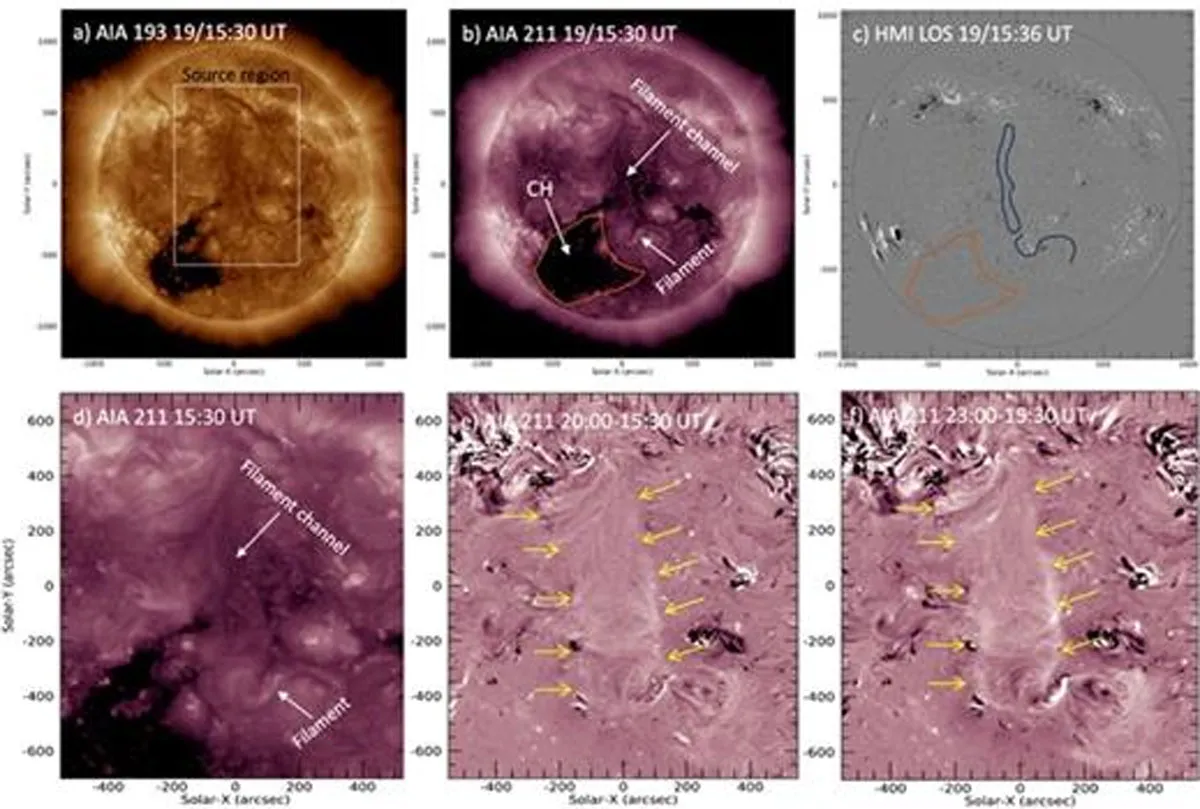
Using data from multiple spacecraft including NASA’s Solar Dynamics Observatory, Solar Orbiter, STEREO-A and WIND, the researchers traced the CME’s journey through a nearby coronal hole—an open region of the Sun’s magnetic field that allows high-speed solar wind to escape. The presence of this coronal hole is believed to have helped the CME propagate efficiently from the Sun to Earth, rather than dissipating earlier.
The interplanetary CME was observed without a clear shock front but showed expanding magnetic cloud structures, increasing radial size and enhanced plasma density. These features, combined with a southward magnetic field component, played a critical role in driving the intense geomagnetic storm.
The team also modelled geomagnetic storm intensity using solar wind velocity, density and magnetic field parameters, finding strong agreement with observed geomagnetic indices. The results highlight how subtle solar events can evolve dynamically during propagation, posing significant challenges for predicting space weather impacts on satellites, communications and power grids.
The research, co-authored by K Selva Bharathi, was published in The Astrophysical Journal, strengthening understanding of how stealth CMEs influence near-Earth space and underscoring the need for improved solar monitoring and forecasting capabilities.  

Astronomers have shown that even weak and nearly invisible solar eruptions can trigger intense geomagnetic storms on Earth, complicating space weather forecasting. The findings are based on a detailed investigation of a stealth Coronal Mass Ejection (CME) that originated from the Sun in March 2023 and caused a strong geomagnetic storm around three days later.Unlike typical CMEs, which are accompanied by X-ray flares or radio bursts, this event showed no obvious warning signs on the solar disk. Such ‘stealth CMEs’ account for nearly 10 per cent of intense geomagnetic storms, making them particularly difficult to detect with existing observation systems.The study was carried out by scientists at Indian Institute of Astrophysics, an autonomous institute under the Department of Science and Technology. According to lead author P Vemareddy, these weak eruptions leave no detectable signatures near the Sun, yet can evolve into disruptive space weather events by the time they reach Earth.Using data from multiple spacecraft including NASA’s Solar Dynamics Observatory, Solar Orbiter, STEREO-A and WIND, the researchers traced the CME’s journey through a nearby coronal hole—an open region of the Sun’s magnetic field that allows high-speed solar wind to escape. The presence of this coronal hole is believed to have helped the CME propagate efficiently from the Sun to Earth, rather than dissipating earlier.The interplanetary CME was observed without a clear shock front but showed expanding magnetic cloud structures, increasing radial size and enhanced plasma density. These features, combined with a southward magnetic field component, played a critical role in driving the intense geomagnetic storm.The team also modelled geomagnetic storm intensity using solar wind velocity, density and magnetic field parameters, finding strong agreement with observed geomagnetic indices. The results highlight how subtle solar events can evolve dynamically during propagation, posing significant challenges for predicting space weather impacts on satellites, communications and power grids.The research, co-authored by K Selva Bharathi, was published in The Astrophysical Journal, strengthening understanding of how stealth CMEs influence near-Earth space and underscoring the need for improved solar monitoring and forecasting capabilities.  

Next Story
Infrastructure Transport

Lucknow Metro East-West Corridor Consultancy Contract Awarded

The Uttar Pradesh Metro Rail Corporation has awarded the first construction-related consultancy contract for the Lucknow Metro East West Corridor to a joint venture of AYESA Ingenieria Arquitectura SAU and AYESA India Pvt Ltd. The firm was declared the lowest bidder for the Detailed Design Consultant contract for Lucknow Metro Line-2 under Phase 1B and the contract was recommended following the financial bid. The contract is valued at Rs 159.0 million (mn), covering design services for the corridor. Lucknow Metro Line-2 envisages the construction of an 11.165 kilometre corridor connecting Cha..

Next Story
Infrastructure Urban

Div Com Kashmir Urges Fast Tracking Of Jhelum Water Transport Project

The Divisional Commissioner of Kashmir has called for the fast-tracking of the Jhelum water transport project, urging district administrations and relevant agencies to accelerate planning and clearances. In a meeting convened at the divisional headquarters, the commissioner instructed officials from irrigation, public health engineering and municipal departments to prioritise the project and coordinate survey and design work. The directive emphasised removal of administrative bottlenecks and close monitoring to ensure timely mobilisation of resources and contractors. Officials were told to in..

Next Story
Infrastructure Urban

Interarch Reports Strong Q3 And Nine Month Results

Interarch Building Solutions Limited reported unaudited results for the third quarter and nine months ended 31 December 2025, recording strong revenue growth driven by execution and a robust order book. Net revenue for the third quarter rose by 43.7 per cent to Rs 5.225 billion (bn), compared with Rs 3.636 bn a year earlier, reflecting heightened demand in pre-engineered building projects. The company’s total order book as at 31 January 2026 stood at Rs 16.85 bn, supporting near-term visibility. EBITDA excluding other income for the quarter increased by 43.2 per cent to Rs 503 million (mn),..

Advertisement

Subscribe to Our Newsletter

Get daily newsletters around different themes from Construction world.

STAY CONNECTED

Advertisement

Advertisement

Advertisement

Open In App