+
Tata Power And University Of Warwick Form Strategic Energy Alliance
POWER & RENEWABLE ENERGY

Tata Power And University Of Warwick Form Strategic Energy Alliance

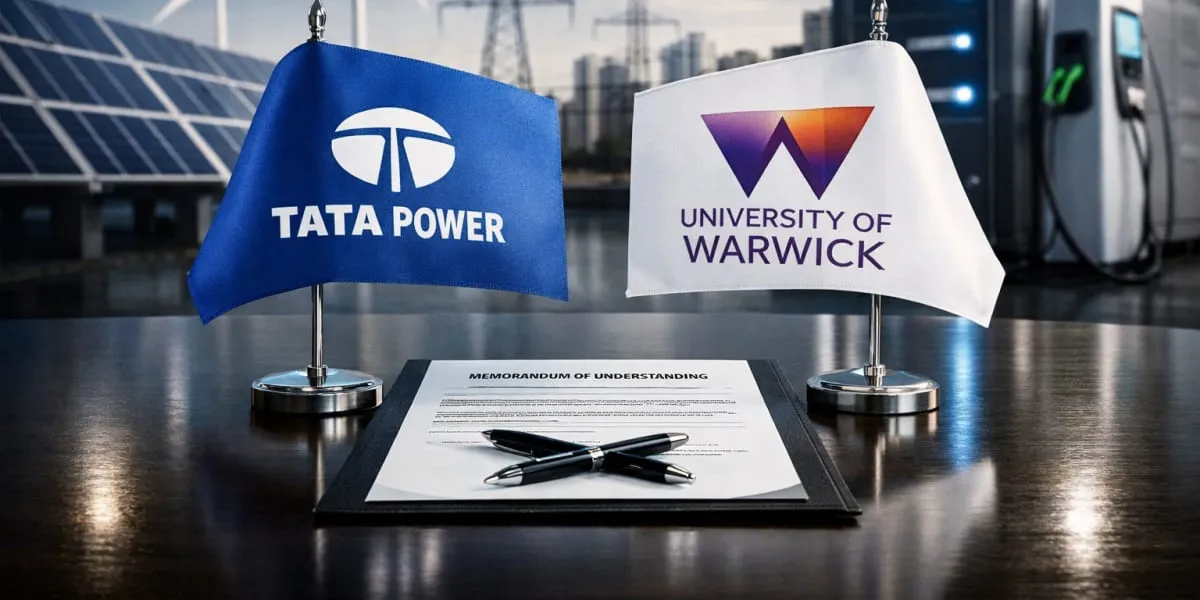
On February 25, 2026, the University of Warwick signed a memorandum of understanding with The Tata Power Company Limited to deliver research and innovation across grid modernisation, fast charging, power storage, industrial decarbonisation, digital energy systems, optimisation and advanced manufacturing. The agreement was presented as a strategic alliance intended to strengthen long-term research capability, talent development and global academic engagement aligned with Tata Power's strategic priorities.

The collaboration will explore industry-aligned executive education programmes, capability development initiatives, exchange opportunities, technical workshops and joint case study development, building on decades of expertise at Warwick Manufacturing Group and the School of Engineering. The university indicated a renewed institutional focus on energy systems to support partners in decarbonisation, including shifts from fossil fuels to electrification, grid innovation, advanced power storage and a system-level approach. These activities were framed as measures to translate academic excellence into industrial impact.

Tata Power framed the partnership as accelerating its ambition to transform India's energy landscape and to empower a billion lives through sustainable and affordable energy solutions, anchored in decarbonisation, reliability and long-term sustainability. The company reported ownership of a diversified portfolio of 16.3 gigawatt (GW) and of 7.5 gigawatt of clean energy generation, representing 46 per cent of its total capacity, and stated a commitment to achieve net zero by 2045. The firm noted that it serves about 13 million (mn) customers nationwide.

Warwick Manufacturing Group emphasised its applied research legacy and systems-level capability, citing past work with large-scale energy users, such as ports and airports, to map investment and return for decarbonisation projects. The School of Engineering highlighted research on advanced control and artificial intelligence for future power systems, integrating renewables, particularly wind, with energy storage and hydrogen technologies, and signalled intent to translate these capabilities into scalable industrial pathways. The agreement was presented as timely given recent enhancements in UK–India research engagement and trade arrangements.

On February 25, 2026, the University of Warwick signed a memorandum of understanding with The Tata Power Company Limited to deliver research and innovation across grid modernisation, fast charging, power storage, industrial decarbonisation, digital energy systems, optimisation and advanced manufacturing. The agreement was presented as a strategic alliance intended to strengthen long-term research capability, talent development and global academic engagement aligned with Tata Power's strategic priorities. The collaboration will explore industry-aligned executive education programmes, capability development initiatives, exchange opportunities, technical workshops and joint case study development, building on decades of expertise at Warwick Manufacturing Group and the School of Engineering. The university indicated a renewed institutional focus on energy systems to support partners in decarbonisation, including shifts from fossil fuels to electrification, grid innovation, advanced power storage and a system-level approach. These activities were framed as measures to translate academic excellence into industrial impact. Tata Power framed the partnership as accelerating its ambition to transform India's energy landscape and to empower a billion lives through sustainable and affordable energy solutions, anchored in decarbonisation, reliability and long-term sustainability. The company reported ownership of a diversified portfolio of 16.3 gigawatt (GW) and of 7.5 gigawatt of clean energy generation, representing 46 per cent of its total capacity, and stated a commitment to achieve net zero by 2045. The firm noted that it serves about 13 million (mn) customers nationwide. Warwick Manufacturing Group emphasised its applied research legacy and systems-level capability, citing past work with large-scale energy users, such as ports and airports, to map investment and return for decarbonisation projects. The School of Engineering highlighted research on advanced control and artificial intelligence for future power systems, integrating renewables, particularly wind, with energy storage and hydrogen technologies, and signalled intent to translate these capabilities into scalable industrial pathways. The agreement was presented as timely given recent enhancements in UK–India research engagement and trade arrangements.

Next Story
Infrastructure Urban

Implementation Status of Jal Jeevan Mission

Since August 2019 the Government has implemented Jal Jeevan Mission to provide assured potable water through household tap connections in rural India. At the start of the mission only 32.3 million (mn) rural households, representing 16.7 per cent, were reported to have tap water connections. States and union territories have reported that 125.8 mn additional rural households have since been provided with tap connections. As a result, of about 193.6 mn rural households roughly 158.2 mn, or 81.71 per cent, are reported to have tap water supply at home.\n\nThe State, district and village level st..

Next Story
Infrastructure Urban

Jal Jeevan Mission Reaches Eighty One Per Cent Rural Coverage

The Government reported substantial progress under the Jal Jeevan Mission, launched in August 2019 to provide tap water to every rural household. At launch only 32.3 million (mn) rural households had tap connections and states and Union territories reported provision of 125.8 mn additional households by March 2026. Consequently, out of about 193.6 mn rural households around 158.2 mn, or 81.71 per cent, are reported to have tap water at home. The Finance Minister announced extension of the mission until 2028 in the 2025-26 budget speech. The Swachh Bharat Mission Grameen, launched in October 20..

Next Story
Infrastructure Urban

Empowering Local Governance for Sustainable Rural Water Supply

The Ministry of Jal Shakti has aligned the Jal Jeevan Mission (JJM) with the 73rd Amendment to strengthen village level planning and community ownership of water supply. Gram Panchayats, village water and sanitation committees and Pani Samitis are to plan, implement, manage and maintain piped water systems, with gram sabha processes formalising handover and oversight. Implementation support agencies including non government organisations, community based organisations and self help groups have been empanelled to train local committees and promote women participation. Under JJM, the department ..

Advertisement

Subscribe to Our Newsletter

Get daily newsletters around different themes from Construction world.

STAY CONNECTED

Advertisement

Advertisement

Advertisement