Tata Power and University of Warwick Form Strategic Energy Alliance
POWER & RENEWABLE ENERGY

Tata Power and University of Warwick Form Strategic Energy Alliance

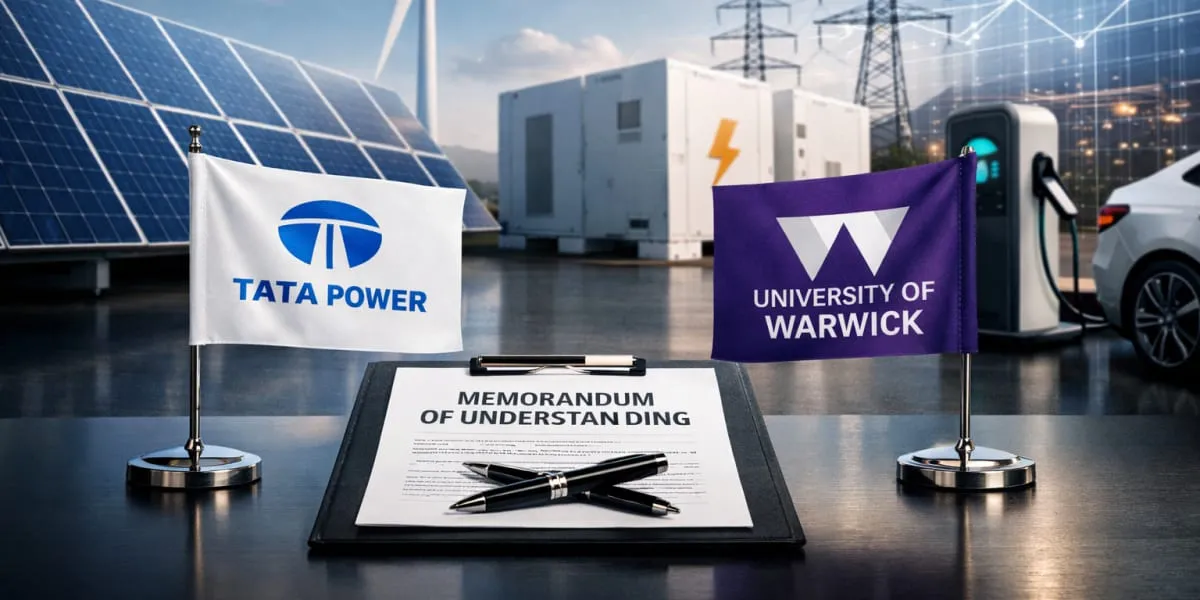
The Tata Power Company Limited and the University of Warwick have signed a memorandum of understanding to collaborate on research and innovation in new energy systems. The agreement will direct joint work on grid modernisation, fast charging, advanced power storage, industrial decarbonisation, digital energy systems and optimisation, and will explore advanced manufacturing approaches. The partnership will also consider industry aligned executive education, capability development, exchanges, technical workshops and joint case study development to strengthen long term research capability.

The collaboration builds on expertise within Warwick Manufacturing Group, one of the university's largest academic departments, and the School of Engineering, which has announced a renewed focus on energy systems. The university will apply research across semiconductors, components, power electronics, machines and drives to support a shift from fossil fuels to electrification, grid innovation and system level storage solutions. Systems level thinking will inform work with large scale energy users to provide investment road maps and demonstrator projects.

The university emphasises the application of artificial intelligence enabled modelling and control techniques to enhance system stability, resilience and efficiency across national, regional and microgrid scale infrastructures, integrating renewables — particularly wind — alongside energy storage and hydrogen technologies. Warwick leadership described the timing as opportune given a free trade agreement between the UK and India and noted longstanding research relationships with Indian industry, including the Tata Group, which have been recognised by awards for partnership. Existing programmes in circular materials, battery innovation and industrial decarbonisation will contribute to industrial and societal impact.

Tata Power will leverage the collaboration to accelerate its consumer centric green energy ambitions and decarbonisation pathway, aligning research with operational priorities. The company reports a diversified portfolio of 16.3 gigawatt (GW) and seven point five GW of clean energy, constituting 46 per cent of total capacity, and is committed to achieving Net Zero by 2045 while serving 13 million (mn) customers. The partners expect the alliance to support talent development, global academic engagement and scalable industrial solutions to advance a sustainable energy transition.

The Tata Power Company Limited and the University of Warwick have signed a memorandum of understanding to collaborate on research and innovation in new energy systems. The agreement will direct joint work on grid modernisation, fast charging, advanced power storage, industrial decarbonisation, digital energy systems and optimisation, and will explore advanced manufacturing approaches. The partnership will also consider industry aligned executive education, capability development, exchanges, technical workshops and joint case study development to strengthen long term research capability. The collaboration builds on expertise within Warwick Manufacturing Group, one of the university's largest academic departments, and the School of Engineering, which has announced a renewed focus on energy systems. The university will apply research across semiconductors, components, power electronics, machines and drives to support a shift from fossil fuels to electrification, grid innovation and system level storage solutions. Systems level thinking will inform work with large scale energy users to provide investment road maps and demonstrator projects. The university emphasises the application of artificial intelligence enabled modelling and control techniques to enhance system stability, resilience and efficiency across national, regional and microgrid scale infrastructures, integrating renewables — particularly wind — alongside energy storage and hydrogen technologies. Warwick leadership described the timing as opportune given a free trade agreement between the UK and India and noted longstanding research relationships with Indian industry, including the Tata Group, which have been recognised by awards for partnership. Existing programmes in circular materials, battery innovation and industrial decarbonisation will contribute to industrial and societal impact. Tata Power will leverage the collaboration to accelerate its consumer centric green energy ambitions and decarbonisation pathway, aligning research with operational priorities. The company reports a diversified portfolio of 16.3 gigawatt (GW) and seven point five GW of clean energy, constituting 46 per cent of total capacity, and is committed to achieving Net Zero by 2045 while serving 13 million (mn) customers. The partners expect the alliance to support talent development, global academic engagement and scalable industrial solutions to advance a sustainable energy transition.

Next Story
Infrastructure Transport

AFCONS & Navayuga set world records with Missing Link Expressway

Maharashtra’s most ambitious greenfield bypass — a 13.3-km alignment carrying twin record-setting tunnels and India’s tallest cable-stayed road bridge — was thrown open to traffic on Maharashtra Day, finally completing the Mumbai–Pune Expressway after a 23-year wait. CW reports…The 650-m cable-stayed bridge over Tiger Valley at sunset — the package executed by Afcons Infrastructure Ltd carries 182-m pylons, the tallest on any Indian road bridge.On 1 May 2026, Chief Minister Devendra Fadnavis, flanked by Deputy Chief Ministers Eknath Shinde and Sunetra Pawar (representing the late..

Next Story
Infrastructure Transport

Mumbai–Pune Missing Link boosts realty prospects

The recently opened ‘missing link’ on the Mumbai–Pune Expressway is set to significantly transform connectivity between the two cities by reducing travel time and bypassing the challenging ghat section. The new alignment, featuring tunnels and viaducts, is designed to improve safety, ease congestion and ensure a smoother, faster commute for both passenger and commercial traffic.With improved travel efficiency, the corridor is expected to strengthen intercity movement, encouraging more frequent travel for work, leisure and logistics. This enhanced accessibility is likely to benefit real e..

Next Story
Infrastructure Urban

How Hormuz is Hijacking Indian Highways

At the recently held RAHSTA Round Table on 29th April in Pune, and earlier during our webinars for Cement Expo by Indian Cement Review and by FIRST Construction Council on manufacturing construction equipment for the world, one thread lay common: the industry is being subjected to a cost-push chain reaction moving from crude oil → freight/insurance → steel, cement fuel, bitumen, polymers, packaging, logistics and finally project margins. Indeed, the West Asia crisis caused by the war and the Hormuz Strait blockade, which does not directly concern us, has turned around and hit us. If the wa..

Advertisement

Subscribe to Our Newsletter

Get daily newsletters around different themes from Construction world.

STAY CONNECTED

Advertisement

Advertisement

Advertisement