+
Varanasi to Roll Out 15 Smart Bus Shelters with EV Charging
POWER & RENEWABLE ENERGY

Varanasi to Roll Out 15 Smart Bus Shelters with EV Charging

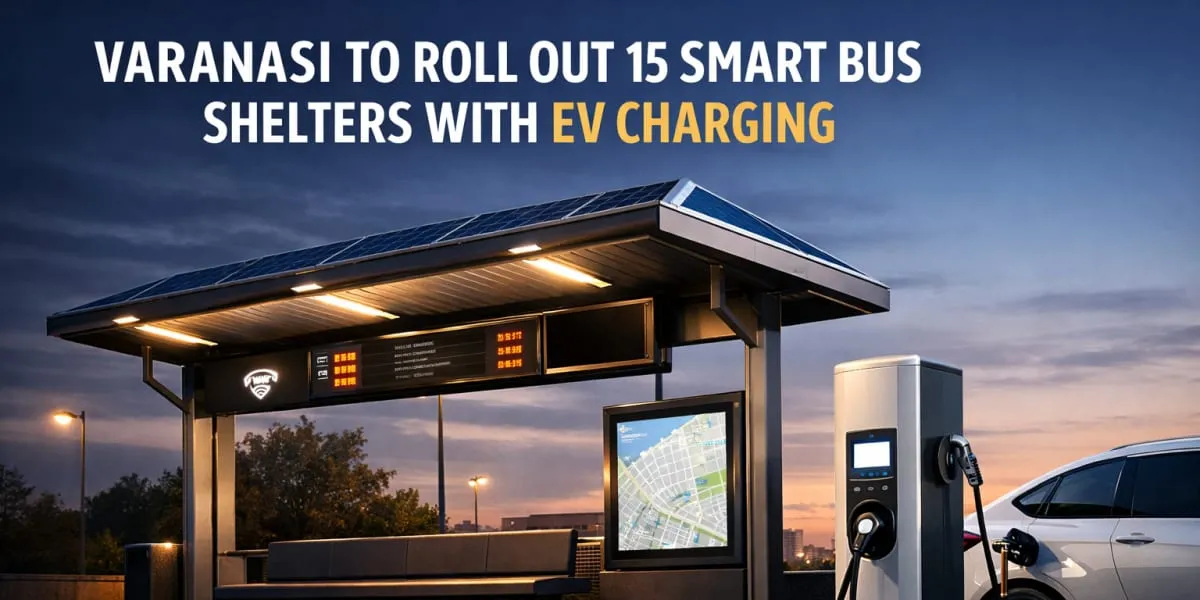
The Uttar Pradesh government has approved the development of 15 smart bus shelters across Varanasi, aimed at upgrading commuter infrastructure and supporting sustainable urban mobility. The project will combine passenger amenities with digital services and renewable energy to improve everyday travel. Officials said the initiative marks a further step in the city's urban modernisation programme.

The shelters will feature electric vehicle (EV) charging stations, free Wi-Fi connectivity, mobile charging points and digital information displays, alongside comfortable seating and drinking water facilities. Real-time display boards will provide bus arrival and departure information as well as updates on date, time and weather to help commuters plan journeys more efficiently. Public toilets will be provided on a user-fee basis while navigation maps will support tourists and residents.

Passenger safety provisions will include closed-circuit television (CCTV) surveillance, enhanced lighting for night-time use and an emergency communication system to enable quicker responses during unforeseen situations. The infrastructure is being designed to ensure easy access for senior citizens and persons with disabilities through wheelchair-friendly features and barrier-free movement. Officials described the shelters as integrated public utility hubs rather than basic waiting points.

Solar power will be used to meet part of the shelters' electricity requirements, reducing operational costs and supporting environmentally responsible infrastructure. Advertising panels and digital display spaces will be installed to generate revenue, while income from EV charging stations and retail kiosks is expected to contribute to maintenance and operational expenses. The model aims to be largely self-sustaining.

The 15 shelters have been planned for strategic sites across the city, including Englishia Line, Kachahari Crossing, Lahartara, Ravindrapuri, Maidagin, Bhelupur, Sarnath, Ramnagar, Banaras Station Road, Namo Ghat Road and Sigra. Their placement seeks to improve connectivity across residential, commercial and tourist zones and to strengthen last-mile links. Once completed the shelters are expected to redefine the daily commuting experience by offering a cleaner, safer and digitally connected environment for thousands of passengers.

The Uttar Pradesh government has approved the development of 15 smart bus shelters across Varanasi, aimed at upgrading commuter infrastructure and supporting sustainable urban mobility. The project will combine passenger amenities with digital services and renewable energy to improve everyday travel. Officials said the initiative marks a further step in the city's urban modernisation programme. The shelters will feature electric vehicle (EV) charging stations, free Wi-Fi connectivity, mobile charging points and digital information displays, alongside comfortable seating and drinking water facilities. Real-time display boards will provide bus arrival and departure information as well as updates on date, time and weather to help commuters plan journeys more efficiently. Public toilets will be provided on a user-fee basis while navigation maps will support tourists and residents. Passenger safety provisions will include closed-circuit television (CCTV) surveillance, enhanced lighting for night-time use and an emergency communication system to enable quicker responses during unforeseen situations. The infrastructure is being designed to ensure easy access for senior citizens and persons with disabilities through wheelchair-friendly features and barrier-free movement. Officials described the shelters as integrated public utility hubs rather than basic waiting points. Solar power will be used to meet part of the shelters' electricity requirements, reducing operational costs and supporting environmentally responsible infrastructure. Advertising panels and digital display spaces will be installed to generate revenue, while income from EV charging stations and retail kiosks is expected to contribute to maintenance and operational expenses. The model aims to be largely self-sustaining. The 15 shelters have been planned for strategic sites across the city, including Englishia Line, Kachahari Crossing, Lahartara, Ravindrapuri, Maidagin, Bhelupur, Sarnath, Ramnagar, Banaras Station Road, Namo Ghat Road and Sigra. Their placement seeks to improve connectivity across residential, commercial and tourist zones and to strengthen last-mile links. Once completed the shelters are expected to redefine the daily commuting experience by offering a cleaner, safer and digitally connected environment for thousands of passengers.

Related Stories

Gold Stories

Next Story
Real Estate

BMC OC Amnesty Scheme Requires Key Approvals from Mumbai Societies

The Brihanmumbai Municipal Corporation (BMC) has clarified that housing societies applying under its Occupation Certificate (OC) amnesty scheme must possess key approvals linked to the original construction. The requirements include a valid Intimation of Disapproval (IOD), an approved building plan and a Commencement Certificate (CC), along with a No Objection Certificate (NOC) from the developer or original construction applicant. The Standard Operating Procedure (SOP) makes clear that the absence of an OC alone will not qualify a building for relief. Societies must establish that their build..

Next Story
Real Estate

Gurugram Emerges as Luxury Senior Living Hub

Gurugram is emerging as a potential hub for luxury senior living, supported by available land, healthcare infrastructure, connectivity and a concentration of affluent professionals, high-net-worth individuals and non-resident Indians. These factors could give the city an advantage over land-constrained metros such as Mumbai. A report by the Association of Senior Living India (ASLI) and JLL estimates that India’s organised senior living market could represent a $10.1 bn opportunity by 2030. The sector had about 25,050 organised units as of June 2026, while penetration stood at only 1.5 per ce..

Next Story
Real Estate

Corrosion Costs India’s Infrastructure Rs. 142 bn Annually

Corrosion costs India an estimated Rs. 1.42 tn annually, equivalent to 4.3 per cent of gross domestic product, according to a report by the Confederation of Indian Industry and the National Research Institute. Infrastructure accounts for Rs. 142 bn of the annual burden, making it the sector with the largest absolute cost among those examined. The report, presented at the CII Annual Infrastructure Summit 2026, said the infrastructure-sector cost equals about 2.9 per cent of the sector’s gross domestic product. It estimated that effective measures could generate maximum savings of Rs. 495.8 bn..

Advertisement

Subscribe to Our Newsletter

Get daily newsletters around different themes from Construction world.

STAY CONNECTED

Advertisement

SPECIAL OFFER
QR Code