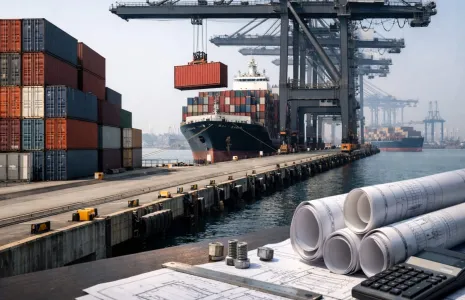
VOC Port Cuts Net Carbon Emissions By 45 Per Cent
POWER & RENEWABLE ENERGY

VOC Port Cuts Net Carbon Emissions By 45 Per Cent

VOC Port has reduced its net carbon emissions by 45 per cent, the Union minister for ports, shipping and waterways said when the port released its first sustainability report. The report said renewable energy now offsets nearly 94 per cent of the port's energy consumption equivalent and highlighted pioneering efforts in renewable generation, electrification and green hydrogen development. It further noted that India's first green hydrogen pilot project at a major port has been commissioned as part of the transition. The port received recognition as a Scope-2 Emission Free Port, a certification that the release said validates its decarbonisation measures and underlines its credentials among India's green ports. The report set out the steps taken to cut emissions and transition to low-carbon operations, including investments in renewable power and new technology platforms to improve efficiency. These measures were presented as strengthening the port's strategic position in sustainable maritime logistics. The minister also unveiled a series of sustainable initiatives, including a memorandum of understanding with Gati Shakti Vishwavidyalaya in Vadodara and the start of the Vidya Pravesh programme for the 2026–27 academic year at the newly established Kendriya Vidyalaya at the VOC Port Authority. The chairperson of the port authority said the MoU would create opportunities for research and skill development in maritime logistics and that an internal platform called PortGPT would bring generative artificial intelligence to daily operations. The release framed the opening of the school and the sustainability report as evidence of the port's commitment to its employees, the local community and the environment.\n\nVO Chidambaranar Port, commonly known as VOC Port, is located at Tuticorin in southern Tamil Nadu and is one of India's major seaports with trade links dating back to 123 AD. It has an annual cargo handling capacity of 82 million tonnes per annum (MTPA); hereafter, the measure is expressed as 82 million tonnes per annum. The report and accompanying announcements were set out as milestones in the port's move towards cleaner, future?ready infrastructure.

"Join industry leaders at RAHSTA Expo, India's premier platform for roads, highways and traffic infrastructure. Register now to explore innovations, network with experts and shape the future of mobility."

VOC Port has reduced its net carbon emissions by 45 per cent, the Union minister for ports, shipping and waterways said when the port released its first sustainability report. The report said renewable energy now offsets nearly 94 per cent of the port's energy consumption equivalent and highlighted pioneering efforts in renewable generation, electrification and green hydrogen development. It further noted that India's first green hydrogen pilot project at a major port has been commissioned as part of the transition. The port received recognition as a Scope-2 Emission Free Port, a certification that the release said validates its decarbonisation measures and underlines its credentials among India's green ports. The report set out the steps taken to cut emissions and transition to low-carbon operations, including investments in renewable power and new technology platforms to improve efficiency. These measures were presented as strengthening the port's strategic position in sustainable maritime logistics. The minister also unveiled a series of sustainable initiatives, including a memorandum of understanding with Gati Shakti Vishwavidyalaya in Vadodara and the start of the Vidya Pravesh programme for the 2026–27 academic year at the newly established Kendriya Vidyalaya at the VOC Port Authority. The chairperson of the port authority said the MoU would create opportunities for research and skill development in maritime logistics and that an internal platform called PortGPT would bring generative artificial intelligence to daily operations. The release framed the opening of the school and the sustainability report as evidence of the port's commitment to its employees, the local community and the environment.\n\nVO Chidambaranar Port, commonly known as VOC Port, is located at Tuticorin in southern Tamil Nadu and is one of India's major seaports with trade links dating back to 123 AD. It has an annual cargo handling capacity of 82 million tonnes per annum (MTPA); hereafter, the measure is expressed as 82 million tonnes per annum. The report and accompanying announcements were set out as milestones in the port's move towards cleaner, future?ready infrastructure.

Next Story
Infrastructure Transport

Third Railway Line Between Tatanagar And Adityapur Likely By September

The third railway line between Tatanagar and Adityapur is expected to be commissioned by September as work on the corridor advances, according to railway sources. The project to add a fourth line on the busy route is progressing and has been allocated Rs 50.89 billion (bn) in funding. The allocation underscores the focus on increasing capacity and easing congestion on the corridor. Relevant timetables are being adjusted to integrate the new capacity into regular operations. Construction activity has involved track laying, formation work and signalling upgrades along strategic stretches, with m..

Next Story
Infrastructure Transport

Indian Railways Approves Rs 2.7 bn Kavach Rollout in Odisha

Indian Railways has approved a Rs 2.7 billion (Rs 2.7 bn) plan to install the Kavach train collision avoidance system on 631 route kilometres in the East Coast Railway zone. The Ministry of Railways said the work will form part of a wider Kavach deployment programme that relies on an LTE based communication backbone rather than a standalone installation. The approval marks the latest stage in the steady expansion of the indigenous safety technology across the national network. The decision aims to enhance safety and reliability on corridors serving Odisha and adjoining areas. The project will ..

Next Story
Infrastructure Transport

Indian Railways Accelerates Modernisation Drive

Indian Railways utilised nearly 30 per cent of its capital expenditure budget for FY2026-27 within the first two months of the financial year, spending more than Rs 840 billion (bn) in April and May against a planned outlay of Rs 2.93 trillion (tn) for the year. The Union Budget allocated Rs 2.93 tn in total capex, comprising Rs 2.81 tn through gross budgetary support and Rs 120 bn from extra-budgetary resources. The early absorption indicates robust project execution and an aggressive infrastructure push. A significant share of the spending is being channelled towards track infrastructure, in..

Advertisement

Subscribe to Our Newsletter

Get daily newsletters around different themes from Construction world.

STAY CONNECTED

Advertisement

Advertisement

Advertisement