+
Waaree Raises Rs 10bn for Battery Manufacturing Push
POWER & RENEWABLE ENERGY

Waaree Raises Rs 10bn for Battery Manufacturing Push

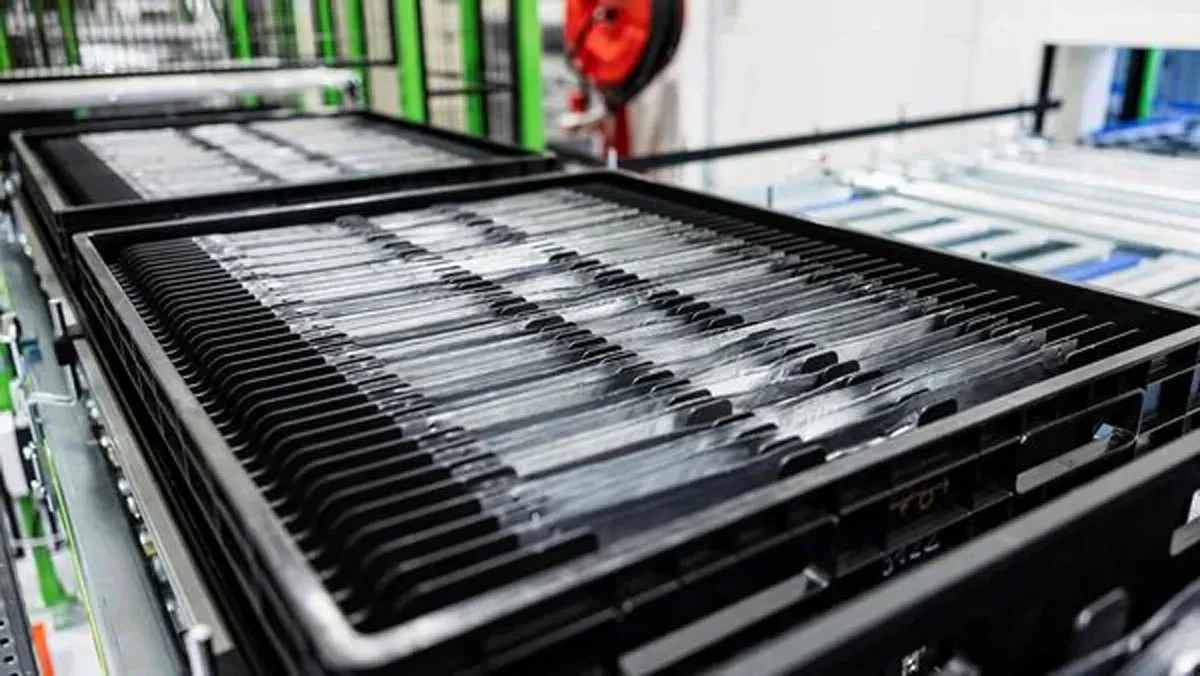
Waaree Energy Storage Services Pvt. Ltd, a subsidiary of Waaree Energies Ltd, has raised Rs 10.03 billion as part of a planned capital expenditure of Rs 100 billion to set up a 20 gigawatt-hour lithium-ion cell and battery pack manufacturing facility.

The company said the funding will help accelerate commissioning of the 20 GWh cell and battery pack plant, strengthen domestic supply chains and support the expansion of India’s energy storage capacity. Ankit Doshi, Director at Waaree Energy Storage Services, said the initiative will also boost local manufacturing, employment and technological innovation in the energy storage sector.

Once operational, the facility will manufacture batteries and battery packs for grid-scale energy storage systems as well as electric vehicles. Waaree said the investment positions the group as an integrated energy transition player, with capabilities spanning solar modules, inverters, batteries, energy storage systems and emerging clean energy technologies.

India currently relies entirely on imports for lithium-ion batteries, with imports of cells rising to about $3 billion in 2024–25 from $1.8 billion in 2021–22. Meanwhile, the country’s energy storage demand is projected to surge to nearly three terawatt-hours, or more than 3,000 GWh, by 2047, compared with an existing capacity of around 490 MWh.

According to the India Energy Storage Alliance, tendering for battery energy storage systems has increased sharply, from 4 GWh in 2023 to 60 GWh in 2025. At least 10 states, including Assam, Maharashtra, Andhra Pradesh and Madhya Pradesh, have announced policy measures or capacity targets for battery energy storage.

The rapid growth in the sector comes even as the government’s plan to incentivise 10 GWh of energy storage capacity under the Rs 181 billion production-linked incentive scheme for advanced chemistry cells remains unawarded. Under the 2021 scheme, 40 GWh out of the approved 50 GWh has been awarded to three manufacturers.

A joint report by Federation of Indian Chambers of Commerce and Industry and EY noted that investments in energy storage have risen from 1 per cent of deal volume in 2017 to 9 per cent by 2024, with lithium-ion batteries dominating. The report said integrating battery storage with renewable energy projects is critical for grid stability, enabling functions such as frequency regulation, voltage support, peak shaving and time-shifting to address intermittency in solar and wind generation.

Waaree Energy Storage Services Pvt. Ltd, a subsidiary of Waaree Energies Ltd, has raised Rs 10.03 billion as part of a planned capital expenditure of Rs 100 billion to set up a 20 gigawatt-hour lithium-ion cell and battery pack manufacturing facility. The company said the funding will help accelerate commissioning of the 20 GWh cell and battery pack plant, strengthen domestic supply chains and support the expansion of India’s energy storage capacity. Ankit Doshi, Director at Waaree Energy Storage Services, said the initiative will also boost local manufacturing, employment and technological innovation in the energy storage sector. Once operational, the facility will manufacture batteries and battery packs for grid-scale energy storage systems as well as electric vehicles. Waaree said the investment positions the group as an integrated energy transition player, with capabilities spanning solar modules, inverters, batteries, energy storage systems and emerging clean energy technologies. India currently relies entirely on imports for lithium-ion batteries, with imports of cells rising to about $3 billion in 2024–25 from $1.8 billion in 2021–22. Meanwhile, the country’s energy storage demand is projected to surge to nearly three terawatt-hours, or more than 3,000 GWh, by 2047, compared with an existing capacity of around 490 MWh. According to the India Energy Storage Alliance, tendering for battery energy storage systems has increased sharply, from 4 GWh in 2023 to 60 GWh in 2025. At least 10 states, including Assam, Maharashtra, Andhra Pradesh and Madhya Pradesh, have announced policy measures or capacity targets for battery energy storage. The rapid growth in the sector comes even as the government’s plan to incentivise 10 GWh of energy storage capacity under the Rs 181 billion production-linked incentive scheme for advanced chemistry cells remains unawarded. Under the 2021 scheme, 40 GWh out of the approved 50 GWh has been awarded to three manufacturers. A joint report by Federation of Indian Chambers of Commerce and Industry and EY noted that investments in energy storage have risen from 1 per cent of deal volume in 2017 to 9 per cent by 2024, with lithium-ion batteries dominating. The report said integrating battery storage with renewable energy projects is critical for grid stability, enabling functions such as frequency regulation, voltage support, peak shaving and time-shifting to address intermittency in solar and wind generation.

Next Story
Infrastructure Transport

Second Mountain Tunnel Breakthrough in Palghar Advances High Speed Rail

The Mumbai-Ahmedabad high speed rail (MAHSR) project reached a milestone with the breakthrough of a mountain tunnel in Palghar, Maharashtra. Mountain tunnel MT-six measures 454 metres long and 14.4 metres wide and will accommodate up and down tracks. The breakthrough follows MT-five near Saphale on second January 2026 and the MT-six excavation was completed from both ends using the New Austrian Tunnelling Method. The ministry reported that the tunnelling was completed within 12 months. The New Austrian Tunnelling Method is favoured for its flexibility in complex geology and irregular tunnel s..

Next Story
Infrastructure Transport

Modi Government Pushes Atmanirbhar Container Drive With BCSL MoU

The Union Government advanced a plan to create an integrated, domestically anchored container ecosystem with the signing of a Memorandum of Understanding to establish the Bharat Container Shipping Line (BCSL). The MoU was signed by key agencies including the Shipping Corporation of India and Container Corporation of India alongside major port authorities and Sagarmala Finance Corporation Limited under the Ministry of Ports, Shipping and Waterways, in the presence of senior ministers. The initiative aligns with the Container Manufacturing Assistance Scheme announced in the Union Budget 2026–2..

Next Story
Infrastructure Urban

Ministry Reports Gains In Mobility For Marginalised Communities

The Ministry of Social Justice and Empowerment is implementing skill development, education and rehabilitation schemes to promote socio-economic mobility and sustainable livelihoods for marginalised and disadvantaged communities across the country. Programmes target Scheduled Castes, Other Backward Classes, Economically Weaker Sections, De-notified Tribes and Safai Karamcharis through specialised implementing corporations and empanelled training institutes. Pradhan Mantri Dakshata Aur Kushalta Sampann Hitgrahi Yojana, or PM-DAKSH, provided skill training and placement support through the Nati..

Advertisement

Subscribe to Our Newsletter

Get daily newsletters around different themes from Construction world.

STAY CONNECTED

Advertisement

Advertisement

Advertisement

Open In App