Bengaluru-based Control One AI, a robotics company founded in 2023, aims to enhance existing equipment with AI and vision systems, making it more intelligent and adaptable. Targeting warehouses, mining and construction over the next three years, it intends to power at least 1,000 machines globally and develop its AI models for the US, Europe, Middle East and Africa [EMEA] and Indian markets, says Pranavan, Founder and CEO, Control One (a vision-to-action AI model), in conversation with R SRINIVASAN. Excerpts:
Please share your journey since inception.
Official research began in November 2022 and the company was incorporated by March 2023. At that point, we were actively exploring the market and trying to understand the current state of robotics. Robotics has made significant advancements in technology, sensors and overall capabilities but it still occupies only a small niche in production and material handling processes. Despite its potential, it has not achieved widespread adoption
in mainstream industries in the entire production or material movement line.
We wanted to understand the reasons behind this limited adoption. We found most robots in the market are preprogrammed with limited intelligence. Once programmed, they excel at repetitive tasks but struggle in dynamic tasks or environments where flexibility is needed. In a real-world warehouse or manufacturing line, things aren’t that precise or repetitive. Real-world scenarios require machines that can adapt to changing conditions. Traditional robots simply aren’t up to the task because they can’t handle unpredictability – they can only repeat what they’ve been programmed to do in static settings.
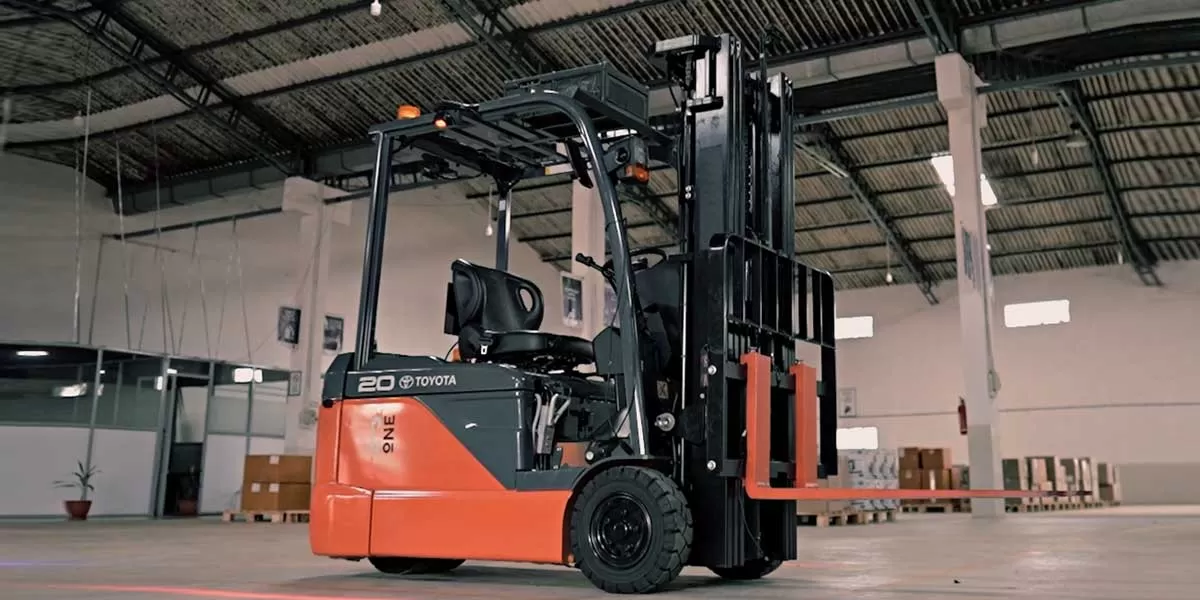
We leveraged the benefit of AI chips to make machines and robots smarter and upgraded the existing equipment. For instance, technically, forklifts have become more refined over the years and the maintenance is much more predictive. We thought we’ll give eyes, ears and brains to the equipment rather than building our own equipment. This is where Control One AI came in. We believed giving intelligence to existing machines would be a more reliable solution. Also, given the advancements in AI and vision systems and to provide existing machines with the intelligence required to operate autonomously in dynamic environments, we thought investing in a vision system would be a more scalable option as it is a key sensory input.
This vision-based system allows our robots in the warehouse sector to adapt to real-world conditions such as picking up a pallet that is slightly out of place or turned at an angle. A regular pre-programmed robot may not pick up these pallets while our vision-based, AI-driven system can handle dynamic environments and perform precise pickups even with pallets in different positions. Even if the pallet is turned around by up to 30°, our system
will notice the depth, reverse and perform a precise pickup – something regular pre-programmed systems cannot do. Further,
our machine knows the difference between a human obstacle, cardboard boxes or other vehicles, drastically improving safety
by detecting and avoiding
human beings.
Why is the ‘One’ underlined in the company’s logo?
It signifies the binary code (1 and 0) and emphasises that we are a digital-first, AI-focused company.
How many cameras or sensors does a forklift require to do the job? In what other sectors can your equipment work and what equipment will it require?
As ours is a vision-first technology, on a forklift we currently use six cameras for detection
and navigation; four on top for a 360° view and two in front within the forks, for a precise pickup. We also have a LIDAR system for safety, to ensure that our machines are safe to work alongside people. While our initial focus is on forklifts and other slow-moving vehicles, our technology can be adapted for various applications, including mining and construction equipment. We are exploring partnerships with such companies, especially in regions like the UAE where remote operation and automation of construction equipment will be in high demand in future. For that we need more cameras and processing will have to be much more powerful as it will be performing multiple tasks. Warehouse equipment only has to detect and move pallets but construction, mining or other equipment will involve much higher vision processing so we need more powerful chips and more cameras because if you pick up a standard JCB, you need at least eight to 12 cameras to tell the machine what it needs to do.
How does your forklift
solution work?
It varies based on the company and task. For example, in a warehouse, the task will be generated through the warehouse management system software. Or it will start doing the job after a simple voice command input fed into the One AI, such as, “Go to the inbound area, pick up all the materials and put it in the outbound.” The person then has to monitor it and help the AI whenever it needs instructions; the system
will interact with the person and do its job.
How does the AI agent
handle muffled voices or pronunciation issues?
We use the automatic speech recognition (ASR) model, which is highly capable of converting various forms of audio speech into text with precision. We are also integrating an efficient and proven voice detection model to ensure that works in a noisy environment with active noise cancellation (ANC).
Is there some kind of a
backup system?
AI cannot handle everything end to end. It needs a human interface to help get things done. Our system is a powerful human-machine combination. That’s why we chose fail-safe LIDAR, which is designed in such a manner that even if our AI or computer fails, this system will independently bring the mission to a halt if it goes near some objects as per European safety standardisation. Also, we removed the human from the equipment to an air-conditioned room to make the environment totally human-free where the machine can work without any trouble.
What other cutting-edge techniques, apart from AI and IOT, does the company employ?
Swarm intelligence for multiple agent movement, vision to Action AI model, software defined vehicle management system and human in the loop.
Please elaborate upon the initial funding from tech industry leaders, including Helen Greiner (co-founder of iRobot, USA), Kunal Shah (founder of CRED) and senior executives from Tesla, Walmart and General Electric.
Last year, we raised $ 350,000 and this year we raised more than double that amount. We were fortunate to connect with tech industry leaders who shared our vision. Why does every home not have a robot? Why is every industry not working with a robot and helping people do their jobs much better? In our quest for answers to these questions, we came across many people from industry to understand what’s happening and the investors saw the people we met for advice and brainstorming. Recognising the potential, these investors became instrumental in supporting our early-stage development and that’s how the funding happened.
Please suggest what funding and other measures from the Government would be beneficial.
Access to government-backed VC funds for early-stage investment; government-sponsored incubators for mentorship, infrastructure and industry connections; assistance with patent filing, which ensures the protection of all innovations; streamlined regulations; and public-sector demand will create market opportunities for this kind
of solution.
While such a solution will maximise productivity and
safety, what about job losses
due to automation, especially
in a labour-intensive market
like India?
While there are concerns about job displacement, history has shown that technology often creates more jobs than it replaces. People initially thought computers would lead to job layoffs but computers created many jobs and the skillsets of people went up. Likewise, our One AI technology can open up more jobs for even unskilled people. Finally, we believe our technology will not only enhance productivity but also empower blue-collar workers by letting them operate machines safely and efficiently from remote locations. We are committed to ensuring that our innovations open up new opportunities, particularly in traditionally manual roles, by making their work safer and less physically demanding.
What is the future of startups in this technology?
The future for warehouse robotics startups is strong, fuelled by rising automation needs in e-commerce and logistics. Physical AI agents optimise inventory management and sorting while edge and vision AI enable real-time processing. With labour shortages and high operational costs, physical AI
agents provide efficient solutions. There is a high demand for customised systems and sustainability is enhanced through
energy-efficient AI agents.