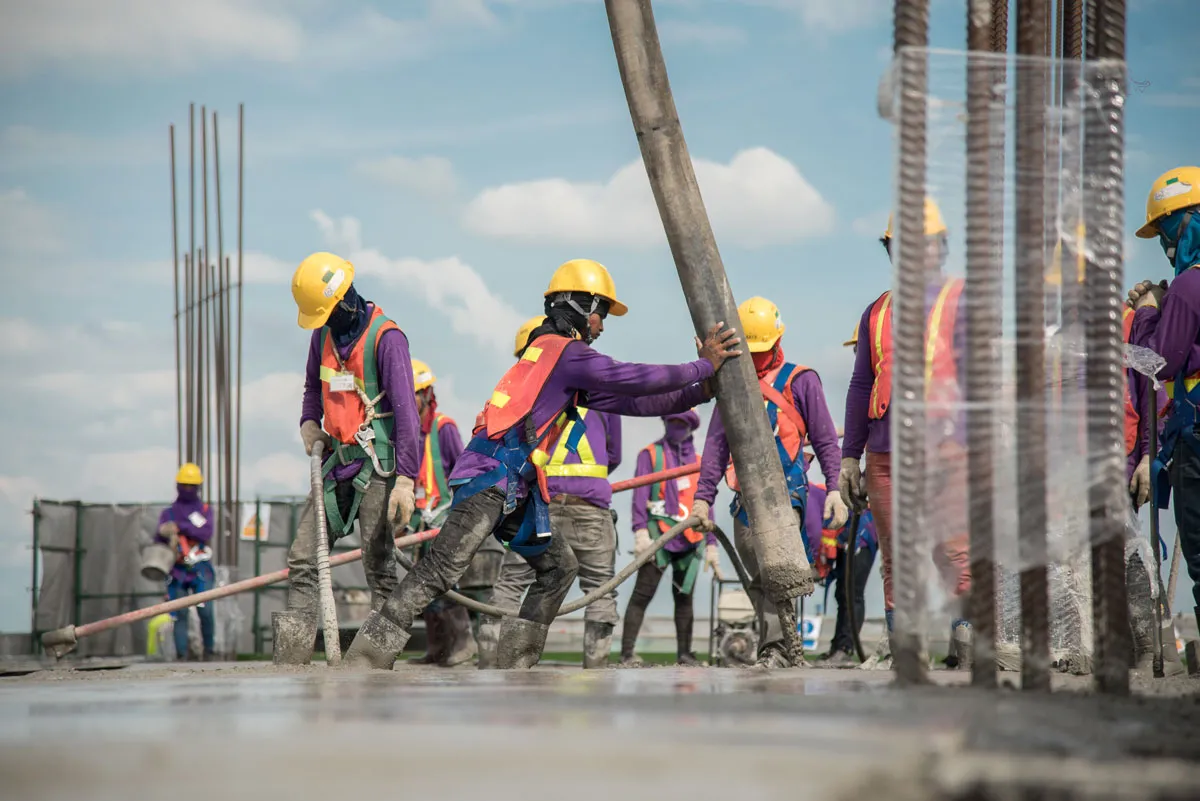
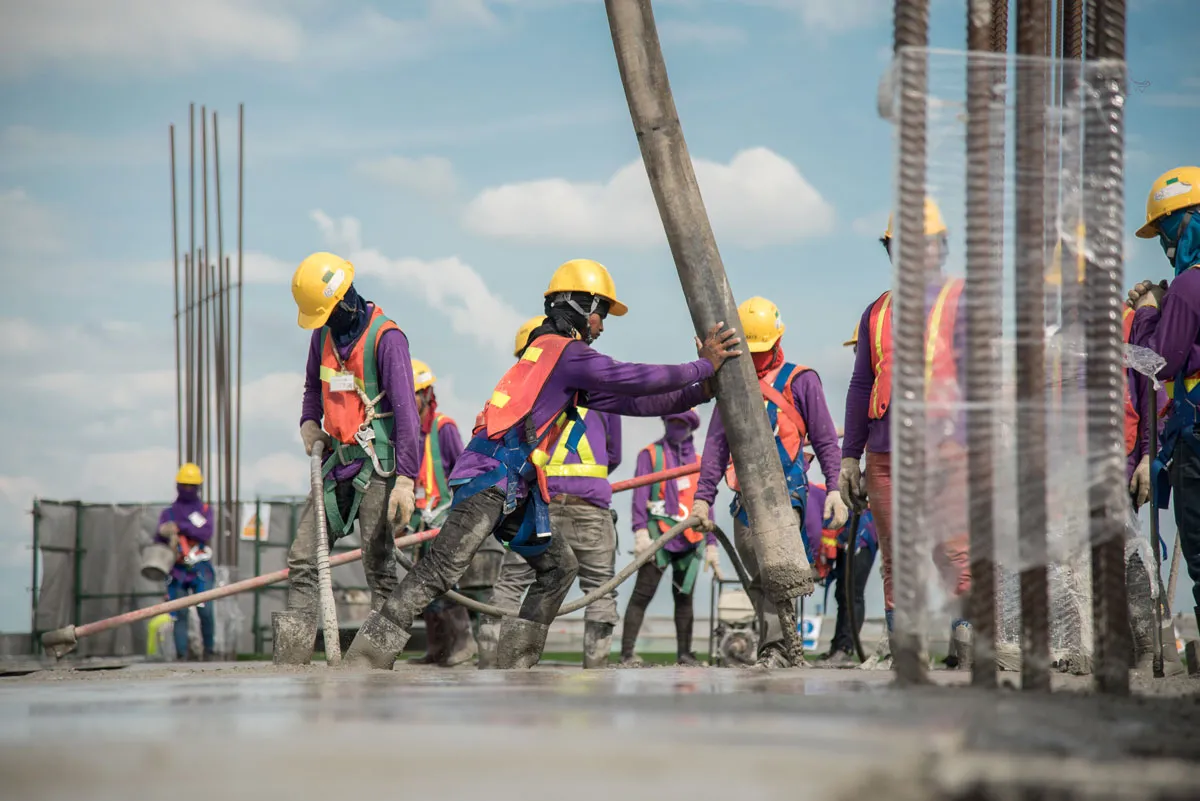
Construction, India’s second largest employer by industry, employs about 50 million workers but could additionally absorb another 40 million workers, according to estimates shared by the Construction Skill Development Council of India (CSDCI) in 2023. Within this, citing trade estimates, Rahul Bahl, Managing Director, Krishna Buildestates, says the shortage of trained, skilled workers is currently about 2 million, and is expected to rise to 5 million by 2030.Not only is the construction industry struggling to find workers but construction labour productivity in India significantly trails global benchmarks. Estimates suggest that worker productivity in India is barely 20-30 per cent of levels in high income OECD countries. And according to Dr Raj Reddy Myakala, Director, National Academy of Construction (NAC), “Insufficient formal skilling is largely to blame for this gap.”“Skilled worker shortages arising from inadequate training quality, limited industry ready talent and difficult working conditions directly affect workforce stability and efficiency,” according to Hariharan Subramanyan, AVP & Head of Project Management Centre of Excellence, Tata Projects.Inadequate training accounts for the low adoption of mechanisation and modern construction technologies, The ensuing manual methods, in turn, account for low productivity. Some other factors affecting construction productivity are the job’s physically demanding, temporary nature, the lack of work-life flexibility and poor onsite conditions, which deter new talent and hinder retention, leading to inconsistent workforce availability and reduced site productivity. “Being a civil engineer used to be a matter of pride – but no longer,” says Bahl. “Construction now competes with a wide set of sectors for the same semi-skilled and educated youth because of better-perceived working conditions elsewhere, higher-status jobs (white collar, tech, services), and the sector’s slow adaptation in skilling, safety and career pathways.” By significantly reducing distress-driven rural-to-urban migration among poorer households that once relied on short-term construction and informal work in urban centres, schemes like MNREGA have particularly exacerbated the shortage of workers, he adds. Inadequate design capability, frequent design changes, insufficient clarity on projects and poor project supervision and management also play a role in keeping construction productivity low.Turning around this state of affairs to ensure India’s competitiveness in the global construction ecosystem necessitates a deep dive to identify where the productivity losses are happening, how they can be eliminated, and how training can be expanded. Productivity lossesProductivity losses in India’s construction sector are most visible at the execution interface between labour, equipment and site planning, according to Dr Raj Reddy. Pointing out that productivity losses in infrastructure construction are most commonly visible at the interface between planning and execution, V Manivannan, Director & Chief Technical Officer, Afcons Infrastructure, explains, “Even when manpower and equipment are available, progress may slow down due to unprepared work fronts, delayed approvals or unresolved utility conflicts.”In most large projects, he says, productivity loss is less about labour availability and more about coordination between planning, design and execution teams, skill levels and work front readiness.Eliminating reworkRework can be directly attributed to skill shortages and is a big cause for productivity losses.“Poor workmanship in areas such as formwork alignment, reinforcement placement and finishing lead to repeated corrections, particularly in structural works and MEP installations,” says Dr Raj Reddy, estimating that rework can account for 5-15 per cent of project costs in poorly managed sites, besides potentially triggering liquidated damages and contractual penalties.Citing industry experience, Manivannan suggests that rework alone can account for 5-10 per cent of project cost, depending on the complexity of the project and the level of quality control during execution. In an industry where contractor margins are barely 5-8 per cent in many EPC projects, Dr Raj Reddy points out that rework and idle equipment inefficiencies can severely erode margins. So, it is vital to minimise rework instances.“The most cost-effective strategy for minimising rework is preventing it from occurring in the first place,” says Aditya Desai, Executive Director - PDS, India, JLL. At JLL, an unwavering commitment to clarity and robust planning before execution commences minimises the chances of rework. The fundamental principle driving operations is that uncertainty on paper translates to errors on site, which translate to schedule delays and cost overruns.JLL’s proven project management processes mandate that all construction drawings are not merely complete but demonstrably constructible before work authorisation. “This requires rigorous coordination across architectural, structural, MEP and specialist disciplines to eliminate conflicts and ambiguities, and a thorough review and approval of shop drawings,” he explains. “Method statements establishing clear expectations regarding methodology, sequencing, quality standards and safety requirements document the how alongside the what, and serve as contracts of understanding between project management teams and execution specialists.”Further, physical mock-ups of critical building elements – façade systems, bathroom pods, MEP coordination zones or specialty finishes – help discover constructability issues or aesthetic concerns before execution, adds Desai. “Collaborative onsite review sessions bring together supervisors, foremen and key trade specialists.”Knight Frank India utilises detailed design coordination, constructability reviews and digital modelling (BIM) at the preconstruction stage to identify clashes early and significantly reduce downstream rework.Equipment utilisationAnother area contributing to productivity losses is improper equipment utilisation, both the underutilisation of equipment and its misuse. In particular, “the underutilisation of high-value equipment such as tunnel boring machines, piling rigs, barges, jack-up platforms, cranes, batching plants or launching gantries can significantly impact productivity when activities aren’t properly synchronised,” says Manivannan.Dr Raj Reddy cites excavators, batching plants and cranes as equipment that frequently operate below optimal productivity, with their idleness increasing ownership and operating costs without productive output.Traditional approaches that link equipment deployment to master schedules are behind suboptimal equipment deployments, “because master schedules, by necessity, operate at a level of abstraction that doesn’t account for day-to-day site realities,” observes Desai. JLL’s approach centres on short-interval planning, specifically two-to-three-week lookahead schedules developed collaboratively with subcontractors and trade specialists, to bridge the gap between strategic master schedules and daily work execution. These schedules, Desai explains, “identify specific work fronts that will be ready for equipment deployment, confirming that preceding activities are complete, verifying that supporting requirements (power supply, access routes, material availability, workspace clearance) are in place, and establishing realistic daily and weekly production targets.”Alongside strong front-end planning, adopting a ‘first-time-right’ quality approach, the real-time monitoring of equipment utilisation and improved coordination between planning, design and site teams also play a crucial role in controlling costs associated with equipment idleness, says Manivannan.To mitigate labour and equipment losses, Knight Frank India uses integrated scheduling that aligns procurement with construction milestones. Real-time monitoring of material flow and equipment utilisation – supported by predictive maintenance – ensures assets remain active and timelines stay on track.Process managementConstruction is deeply process-driven but many processes have remained manual or semi-digital for far too long. Technology can play a major role in improving site productivity, provided it is used as intended. In reality, many sites end up deploying complex systems that are very functional but hardly usable and, hence, deliver less value. In contrast, Desai recommends using simple tools that are universally and consistently embraced.Across JLL projects, digital checklists have replaced paper-based inspection protocols. “Supervisors use tablet or mobile-based applications to conduct daily quality and safety inspections, automatically generating timestamped, geotagged records with photographic evidence,” says Desai. “Mobile-based reporting has transformed site communication. Supervisors, engineers and specialists can submit progress reports, highlight issues, request information and document site conditions from anywhere onsite, eliminating delays associated with returning to site offices for documentation tasks or making decisions.”Digitisation improves accountability, creates auditable records, enables trend analysis and eliminates the documentation gaps that plague paper-based systems. JLL’s project management software, too, provides schedule management, document control and reporting capabilities without overwhelming users with unnecessary complexity.“We deliberately select tools that balance functionality with usability, tools that solve real problems, and ensure their universal adoption through training and support,” adds Desai.Safety firstSafety incidents and near misses directly halt work and indirectly reduce workforce morale and productivity. They cause human tragedy, legal liability, schedule disruption and reputational damage, consequences far exceeding any short-term gains from compromising safety standards.Ensuring safety necessitates training. At JLL, comprehensive safety protocols include mandatory training before site deployment, daily toolbox talks addressing specific work activities and hazards, digital safety monitoring systems including wearable gears where appropriate, proactive reporting, monthly safety audits conducted by independent assessors and zero-tolerance enforcement of safety violations regardless of schedule pressure. “Safety is not negotiable – this principle is reinforced through leadership behaviour, resource allocation and consequence management,” says Desai.At L&T Construction, Suraksha Nayak is a new initiative offering Vocation in Safety in Construction, a one-year diploma to bring more workforce under the fold of safety. It aims at smoothly transitioning suitable security officers to a safety function, where they assist in implementing safety procedures, conducting toolbox talks and ensuring compliance with safety norms.Structured talks, targeted upskilling, toolbox meetings, and a dedicated Health, Safety, Environment Team help strengthen safety, shares Jatin Shah, Chief Operating Officer, Colliers India. “Rigorous inductions, real time audits and a zero tolerance culture further help.”Technologies like mechanised concreting, digital surveying and prefabrication often fail to achieve their intended productivity gains because workers lack the skills to operate them effectively, according to Dr Raj Reddy. Skilling avenuesInvesting in training upfront is far cheaper than absorbing the downstream cost of rework and inefficiency.India’s National Skill Development Corporation (NSDC) works with industry-led Sector Skill Councils (SSCs) to create standard training frameworks. In construction and infrastructure, the relevant sector skill councils, supported by the NSDC, have developed National Occupational Standards and Qualification Packs for specific job roles such as bar benders and steel fixers, formwork carpenters, masons and concrete workers, equipment operators, site supervisors and survey technicians. Standardising these roles has helped create nationally recognised skill certifications that can be used across projects and employers. NSDC supports training partners and institutions that deliver vocational courses aligned with sector skill council standards.The CSDCI works closely with contractors, infrastructure developers and training providers to standardise skill training, focusing on trades such as masonry and concreting, scaffolding and formwork, plumbing and electrical installation, road construction and site supervision and quality control. The council develops occupational standards, accredits training programmes and conducts skill assessments and certifications. Providing workers with recognised skill credentials improves their employment opportunities and mobility across projects.The Infrastructure Equipment Skill Council (IESC) focuses specifically on training workers in the operation and maintenance of construction equipment such as excavators, loaders, motor graders, tower cranes, batching plants, asphalt pavers and compactors.Water infrastructure is supported by the Indian Plumbing Skills Council, which focuses on plumbing, sanitation and water management trades.While the institutional framework for skill development is expanding, the industry continues to face challenges in translating training programmes into improved site productivity.In the industry, L&T Construction’s Construction Skills Training Institutes (CSTIs) have been providing structured and industry-relevant 45 to 90-day skill training across various construction, manufacturing and smart world trades since 2008. They offer three levels of skills and every successful candidate gets an L&T Certificate and Workmen Referral Card holding their personal data and the skill level of jobs they’ve done to easily track them when they are transferred. Additionally, candidates get Modular Employable Skills National Council for Vocational Training certification and CSDCI certification, which further enhance their employability and professional skills in the wider construction sector.Tata Projects’ Kaushal Nayak programme addresses augmentation. 12th pass candidates inducted as apprentice trainees are put through one-year on-the-job learning and exposed in basic trades (such as bar bending, masonry, carpentry, etc) during the first year. Skill Shakti focuses on upskilling helper/unskilled workers to the semi-skilled category through on-the-job trade training. Tata Projects covers approximately 6,000+ candidates under this initiative annually. Through the Tata Indian Institute of Skills, skilling initiatives will be scaled up in the coming years. Hariharan Subramanyan, AVP & Head of Project Management Centre of Excellence, Tata Projects, says says leveraging local ITIs and a suitable hub-and-spoke model could address the skill shortage and capability building in the long run.As many workers in the construction sector remain unaware of formal training and certification opportunities, there is a need for outreach programmes and industry awareness campaigns to encourage greater participation in skill development initiatives.Apprenticeship best practicesThe NSDC encourages employers to integrate apprenticeships and on-the-job training into their operations. Apprenticeships can become one of the most effective ways to bridge the gap between theoretical training and real-world construction experience, if they are structured and linked directly to project execution; that is, the trainees are attached to experienced supervisors or equipment operators during live project execution.Some best practices to integrate apprenticeships into live projects, according to Subramanyan, include providing safe and supportive onsite amenities to improve retention and learning outcomes; building structured, role specific training aligned with actual project needs; ensuring strong mentorship and continuous supervision to manage risks in dynamic site environments; addressing negative perceptions through orientation, safety assurance and showcasing modern construction practices; rotating apprentices across project lifecycle stages to build holistic capability; integrating daily safety protocols, toolbox talks and scenario based drills to reduce human error related incidents; partnering with skill bodies like Construction Industry Development Council, CSDCI, NSDC, etc, for standardised certification and industry ready competency; ensuring a robust feedback mechanism that clearly measures the learning and its impact on the work; and focusing on local skill availability and promoting opportunities within home states.To encourage contractors to formally integrate apprentices into projects, Dr Raj Reddy supports policy amendments or incentives.Supervisory improvementsWhile training gaps majorly cover the lowest cadres of a construction workforce, they also extend to supervisory cadres. “Supervisors are a critical link between engineering design and field execution,” says Manivannan, “so much so that when supervision lacks adequate technical understanding, the risk of quality deviations increases significantly.” Common gaps in supervisory skills, he says, include incorrect interpretation of drawings, poor control of alignment and tolerances, and inadequate monitoring of workmanship. Such gaps often result in defects such as honeycombing, reinforcement misplacement or dimensional inaccuracies, which eventually lead to rework and delays.While skill councils offer broad skilling programs, frontline and supervisory workforce require more precise, application-oriented upskilling, says Subramanyan, “to meet project demands and avoid delivery delays, rework, cost overruns and lower contractor margins.”A structured approach to supervisory skill development and the competency-based deployment of supervisors would help eliminate supervisory gaps, according to Manivannan. “Training programmes focusing on drawing interpretation, quality standards and construction methodology are essential, as are method statement-based execution, activity checklists, regular toolbox talks and onsite skill demonstrations.”Project management companies have devised their own ways to eliminate supervisory gaps.Knight Frank India eliminates under-skilled supervision through multilayered site governance, clear accountability frameworks for contractors and continuous competency assessments, says Deben Moza, International Partner, Senior Executive Director ‑ Head of Project Management Services, Knight Frank India. “Competency mapping during onboarding, mentoring programmes and onsite training help eliminate supervision skill challenges,” adds Shah. Skilled supervisors are an invaluable asset on site, which every company seeks to retain. At Tata Projects, Nirman Nayak addresses the retention of skilled supervisors by enrolling them in a long-term, flexible vocational degree programme conducted in collaboration with the CIDCI and Kalinga University.Supervisors must also be equipped to train juniors onsite. A Training of Trainer (ToT) certification programme by L&T designed to enhance the training capabilities of site engineers and supervisors is not limited to internal users but is also extended to external partners, including NAC, NSDC, CSDCI, etc.“Our ToT model enables experienced personnel to take on training roles, creating a sustainable internal training framework,” says Niranjana C, EVP and Head - Finance, Accounts and Administration, L&T Construction. “The certification programme is structured around two key competency areas: domain skills and platform skills.”OEM-led trainingModern infrastructure projects increasingly rely on sophisticated construction machinery, which must be effectively utilised to keep execution on track. Such utilisation, in turn, depends heavily on the competence of operators and maintenance personnel. But as Dimitrov Krishnan, Managing Director, Volvo CE India, points out, “The sophistication of construction machines makes formal training essential for operators.”OEM participation in skill development can help improve equipment productivity and safety because they are best positioned to provide operator training to unlock the full performance potential of machines. No one understands the equipment, technology and maintenance requirements better than the OEM.“OEM-supported training and certification programmes can provide specialised instruction on equipment operation, safety practices and preventive maintenance, and make use of simulator-based training for operators and technical workshops for site engineers,” proposes Manivannan. The need of the hour is for OEMs to work in partnership with contractors, industry bodies and training institutions to strengthen the sector’s skills ecosystem. OEMs such as JCB, ACE and Schneider Electric run certification programmes for machine operators. In collaboration with the IESC, Volvo Construction Equipment conducts operator training programmes with dealer support, through which close to 6,500 operators have been trained so far, shares Krishnan. “We have also partnered with GMR Group in Hyderabad and Delhi to support structured training programmes that combine classroom learning, simulator training and practical machine operation.”Another important Volvo CE initiative is the Iron Women programme, which aims to address the industry’s skills gap by encouraging and training more women to pursue careers as construction equipment operators. In addition, Volvo CE supports institutes such as The Indian Institute of Infrastructure and Construction Kerala and Svenska Academy by enabling access to machines for hands-on operator training.Given the scale of India’s construction sector, however, much broader industry collaboration is still needed.AI in trainingArtificial intelligence (AI) can play a transformative role in closing skill gaps in construction through training and predictive learning. AI can analyse telematics and machine data to identify operator inefficiencies and recommend targeted personalised training based on operator’s actual skill level, helping workers learn equipment operation, safety procedures and construction techniques through adaptive digital platforms. “AI-driven simulators can train equipment operators in a risk-free environment, improving their proficiency before they operate machines on site,” says Dr Raj Reddy.For example, Subramanyan cites the use of AI powered Augmented Reality (AR)/Virtual Reality (VR) welding simulators that allow trainees to practice welding in a risk free, immersive environment, eliminating hazards such as fire, toxic fumes and burn injuries before they ever touch real equipment.At L&T Construction’s CSTIs, potential trainees are exposed to a VR-based application to experience trades that they aspire to learn, and choose the most suitable one. The institutes are equipped with simulators in trades like bar bending and plumbing and welding to impart hands-on training to deliver an immersive learning experience. Trainees get real-time practical experience with controlled material wastage.Another VR application for plant and machinery assembly is designed to help trainers understand the correct sequence for engine assembly installation. “While trainers will not physically experience the weight of components during the virtual interaction,” Niranjana explains, “the system will provide contextual on-screen guidance or prompts within the VR environment indicating the recommended handling method for each component – such as whether it should be lifted with one hand, both hands, with assistance or using a crane.” This approach ensures users are aware of real-world handling considerations despite the absence of haptic feedback.Additionally, AI-enabled mobile applications can assist workers with step-by-step instructions, quality checks and safety protocols in real time. AI can help contractors track competencies across their workforce and deploy workers more effectively based on skill profiles.“Blending classroom learning, simulator training and real onsite exposure also helps deliver the best outcomes,” says Dr Raj Reddy.AI boostAlready, at a macro level, AI acts as a force multiplier for workforce mobility and productivity, boosting national competitiveness, according to Subramanyan.AI is no longer a futuristic concept; it is becoming the central nervous system of complex project delivery, adds Moza. “Its role is twofold: predictive power and operational dignity.”Through computer vision and AI-enabled analytics, Knight Frank India tracks progress and flags safety risks in real time. This doesn’t replace human expertise but enhances decision-making by providing high-fidelity ‘early warning signals’.Going forward, Shah expects an AI enabled resource to help with optimisation, improve labour utilisation, material flow and equipment planning. Generative AI will help automate reports and documentation, freeing managers for high value work. When integrated with digital twins, AI and Internet of Things (IoT) will provide real time comparisons of planned versus actual progress, enabling faster interventions. “AI is set to transform project management by enabling data driven decision making,” says Shah. “Future models will forecast delays, identify risks and recommend mitigation strategies early.” Some new generation roles where AI adoption is gaining significance include drone operator, BIM technician, IoT/smart site monitoring operator, heavy equipment operator, safety steward (HSE), quality inspector, etc. Digital toolingDigital technologies such as BIM, AI-powered construction simulation and optimisation platforms, mobile QA/QC apps and equipment telematics help teams visualise complex structures, identify design conflicts early, optimise project schedules and resources, track quality in real time and improve equipment utilisation.At Colliers India, “innovative approaches in construction sites like digital tools, project management web collaboration platforms, drone and lidar scans and 360° imaging ensure transparency and reduce errors,” says Shah. “We maintain productivity through continuous planning, risk analysis, constraint removal and close contractor engagement, enabling predictable timelines and consistent delivery. Our adoption of computer vision is enhancing quality and safety by detecting defects or unsafe behaviours from site footage.”Subramanyan lists simulation tools (AR/VR), digital measurement and layout tools, BIM and 3D visualisation tools, AI assisted inspection tools, mobile work management apps, digital twins and sensor based monitoring tools, smart, sensor enabled power tools, GNSS/Automated Total Station (ATS) systems and inclinometers/in place inclinometers as technologies widely used in the construction of infrastructure facilities for which upskilling is a critical requirement.As the effectiveness of these tools ultimately depends on the skills and judgment of the workforce using them, Manivannan says, “The goal of digital adoption should be to enhance the capabilities of engineers, supervisors and tradespeople rather than replace them.”Indeed, people cannot be replaced, not in the least in the construction industry, India’s second biggest employer. But their productivity can be improved – and that’s the need of the hour.