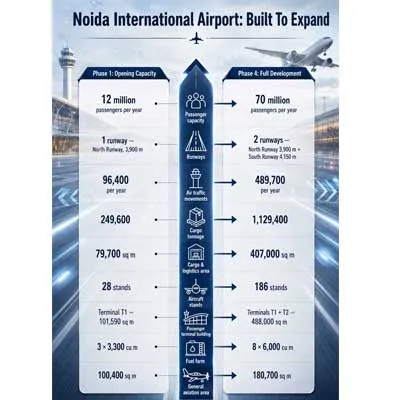
Noida International Airport (NIA) is not just another capacity addition to India’s aviation map. It is a test case in whether India can build airport infrastructure that is scalable from Day 1, operationally efficient at launch, and resilient enough to grow without the familiar pain points of brownfield expansion.Its significance lies not merely in the first phase but in the way the airport has been planned for its fourth. Scheduled to begin commercial operations on 15 June 2026, NIA’s first phase comprises one runway and one passenger terminal designed to handle 12 million passengers annually. At full development, the masterplan provides for four phases and a capacity of over 70 million passengers annually. Built beyond opening dayFor India’s airport pipeline, NIA raises a critical question: Can a greenfield megaproject serve immediate demand without limiting future growth?The answer begins with planning. According to Christoph Schnellmann, Vice Chairman, NIA, the project team made early decisions to create “a stronger foundation for long-term operations”. One of those decisions was to engage with airlines even before submitting the bid. “That gave us a clearer understanding of operational requirements and helped shape an airport designed for efficient, scalable operations in the Delhi-NCR region.” The greenfield advantageThe greenfield advantage is central to the project’s construction logic. “Working with a clean slate meant every element, from the terminal design and airside layout to the technology backbone, could be aligned around efficiency, passenger comfort and future scalability from the very beginning,” explains Schnellmann.This is where NIA begins to separate itself from a conventional airport build. The master plan is not simply adding capacity in phases; it is protecting the airport from the future constraints that often weaken older assets. The approved plan provides for two runways over the concession period: a 3,900-m north runway and a 4,150-m south runway. The passenger terminal area is planned to expand from 101,590 sq m in Phase 1 to 488,000 sq m by Phase 4. Aircraft stands are planned to increase from 28 in Phase 1 to 186 by Phase 4. Schnellmann says the passenger terminal has been designed from the outset for 30 million passengers annually, even though only the first 12 million-passenger module is being built in Phase 1. Expansion, he adds, will move first to 30 million passengers annually, then to 50 million, and ultimately 70 million as demand grows. Execution without driftFor the construction sector, the marvel lies in this choreography: a first phase that must operate efficiently on Day 1, while leaving the next three phases structurally, operationally and digitally possible.That is never easy on the ground. Pawann Kumar Singhal, General Manager - Projects, Tata Projects, shares, “The most critical on-ground decisions were about balancing speed with complexity: securing land and clearances early, sequencing construction to avoid bottlenecks, managing multi-agency coordination, and embedding risk management into daily execution.”At the airport scale, gaps between design intent and site realities can become expensive. Singhal says he recognised early that such gaps could derail execution speed. His response was to make coordination a daily discipline. “I established a Design Coordination Cell onsite, staffed with representatives from contractors, consultants and our project team. This cell met daily to resolve design queries in real time, rather than letting issues escalate through long correspondence chains.”Digital discipline supported that process. “We used BIM and common data environments to ensure that drawings, revisions and site instructions were synchronised,” he elaborates. “This eliminated the risk of teams working off outdated drawings.” For complex zones such as terminal interiors and airside pavements, mock-ups and pilot sections were built before full-scale execution. Site deviations or clashes had to be logged within 24 hours and jointly reviewed by consultants and contractors. The result is a quiet but important construction lesson: Speed comes not from bypassing coordination but from making coordination unavoidable. Low carbon, but buildableSustainability adds another layer to the project’s construction significance. NIA’s renewable energy plan includes 13 mw of onsite solar capacity, 10.8 mw of wind power supply and a ₹ 5.50 billion investment in solar and wind power supply, dry utilities and smart energy infrastructure. The agreement also includes a 25-year O&M commitment for critical dry utilities.Schnellmann says the project used Nanogence Catalyst in LC3 low-carbon cement, which supported material performance while helping reduce embodied carbon. He also points to locally sourced materials as a resilience measure, reducing dependence on distant suppliers and lowering supply-chain exposure.Swati Garg, Head of Department - Aviation, Ramboll India, frames the sustainability strategy as a matter of practical engineering. Ramboll’s role covered scheme design for both airside and landside infrastructure. “The airport’s decarbonisation approach had to embed sustainability while maintaining programme certainty, operational reliability, and long-term value,” she says. “Material choices required balancing opportunities to reduce embodied carbon with local availability and supply chain realities.”That is what gives the sustainability story credibility. It is not being presented as a decorative layer over the project. It has been treated as a construction, procurement and lifecycle-performance issue.Garg also highlights the climate-resilience thinking behind the airport’s water and drainage strategy. Nature-based systems, she says, were designed to handle intense rainfall events, storm conditions and operational surges. Ramboll combined hydrological modelling, system redundancy, staged storage and engineered infrastructure so that natural systems could support reliable airport operations rather than stand apart as isolated green features. Cargo as the second engineCargo is the other dimension that makes the airport larger than its passenger terminal. The master plan estimates cargo tonnage of 249,600 in Phase 1 and 1,129,400 by Phase 4. The cargo and logistics area is planned to grow from 79,700 sq m to 407,000 sq m. NIA has selected AISATS to develop an 80-acre multimodal cargo hub. The hub is planned with an integrated cargo terminal, warehousing and logistics zone, transhipment centre and facilities for road-to-road, road-to-air and air-to-road movement. For Western Uttar Pradesh and the NCR, this positions the airport not merely as a passenger gateway but as a logistics platform linked to manufacturing clusters and time-sensitive supply chains.Operational readiness is the final test of the construction story. NIA received its aerodrome licence from the Directorate General of Civil Aviation in March 2026. A validation flight using an IndiGo Airbus A320 in December 2024 confirmed approach procedures, navigational aids and air traffic control systems. Commercial flight operations are scheduled to commence from 15 June 2026. From readiness to performanceThe airport’s achievement is not only its scale – it is the attempt to align construction, operations, cargo, sustainability and future expansion into one infrastructure system. NIA matters because it shows what a greenfield airport can become when runways, terminals, cargo, drainage, energy systems, technology and phasing are not treated as separate packages, but as interdependent parts of the same long-term asset. Its construction legacy will depend on how effectively today’s planning absorbs tomorrow’s demand.With commercial operations scheduled from 15 June 2026, Noida International Airport now moves from construction readiness to operational performance. The focus shifts to how seamlessly it handles airlines, passengers, cargo, security and access from Day 1 – and how confidently its future phases begin to take shape. This is where Noida International Airport can move from a major airport project to a benchmark for India’s next generation of aviation infrastructure.FACT FILE Developer / Concessionaire: Yamuna International Airport Private (YIAPL), a 100% subsidiary of Zurich Airport International AGEPC Contractor: Tata Projects Cargo Partner / Multimodal Cargo Hub Developer: Air India SATS (AISATS)Renewable Energy and Dry Utilities Partner: Tata PowerFuel Farm and Hydrant System Concessionaire: Indian Oil Skytanking (IOSL)Baggage Handling System: Siemens LogisticsMaster System Integrator Consultant: ICAD Holding Air Navigation Services: Airports Authority of IndiaLighting Deployment: Signify (facilitated by Tata Projects)- PRANJAL PATIL