Air is a resource we seldom stop to think about. However, it has now become a subject of concern and interest owing to the deteriorating quality of our environment and the impact of the nation’s various developmental activities on its quality. With pollution being a grave issue, the other silent killer looming in our spaces is dust.
The first step to tackling air quality is reducing pollution at the source. But if that’s not possible, technology can step into the game.
Unearthing the problem
Cardiologist, Dr Srikanth Sola, took note that among his patients, while most were affected by commonly known risk factors of diabetes, high blood pressure and smoking there were also a few whose sole risk factor was proximity to dust and air pollution. “Nearly 7 million people die each year of air pollution – it is a fact that we have read in our textbooks,” Dr Sola, Co-Founder and CEO, Devic Earth, points out. There are only so many angioplasty operations one can do to stop this and Dr Sola wondered if there were a way to reduce the burden of air pollution instead.
He also has work experience in biomedical engineering and has worked to craft “technologies that save lives” with GE Healthcare, Siemens Healthcare and Phillips. “Long story short, we put together a team of scientist-engineers, and developed a reliable, affordable and safe technology that would reduce air pollution at scale.”
That’s how, in 2018, Dr Sola made the shift from the operating theatre to a startup venture, Devic Earth. Headquartered in Bengaluru, the team developed the technology in India and continues to manufacture its product in the country.
Any new technology takes time to develop consumer trust, acceptance and awareness. “We have worked with large reputed academic institutions such as IIT Kanpur, at the National Aerosol Laboratories, where they conducted studies to validate our technology,” shares Dr Sola. “We additionally got the product certified by independent labs, both within India and from TÜV Rheinland in Japan. We also meet all relevant international safety certifications for products of this type. And finally, we did plenty of use cases across different target industries such as cement, steel, thermal power, mines and other key sectors that are crucial to the development of cities, to showcase our product.”
Devic Earth usually promises 30 per cent improved air quality, but delivers 50 per cent or more within 3 months – the National Clean Air Programme aims at 20-30 per cent reduction in 5 years.
Clean tech
The technology is completely different from traditional air cleaners or air purifiers that use filters or fans to cleanse the air; the startup uses pulsed radio wave technology. “This technology was first developed in the 1970s to reduce pollution from water,” Dr Sola says. “The radio waves charge the pollutant particles and convert them into tiny magnets that attract each other. Thus, they individually become larger and heavier, and they settle down. The same happens in the air. For instance, if you don’t wash your car for a couple of days, you see a layer of dust on top of it.”
This process is termed by scientists as deposition. “When you expose both air or water to pulsed energy, you increase the charge on these pollutant particles, and this rate of deposition or settling happens about six to seven times faster.” The startup makes this process even more ingenious by first, making it effective over a large area and, second, by operating this on a 2.4 GHz Wi-Fi spectrum with power levels maintained under standard regulations.
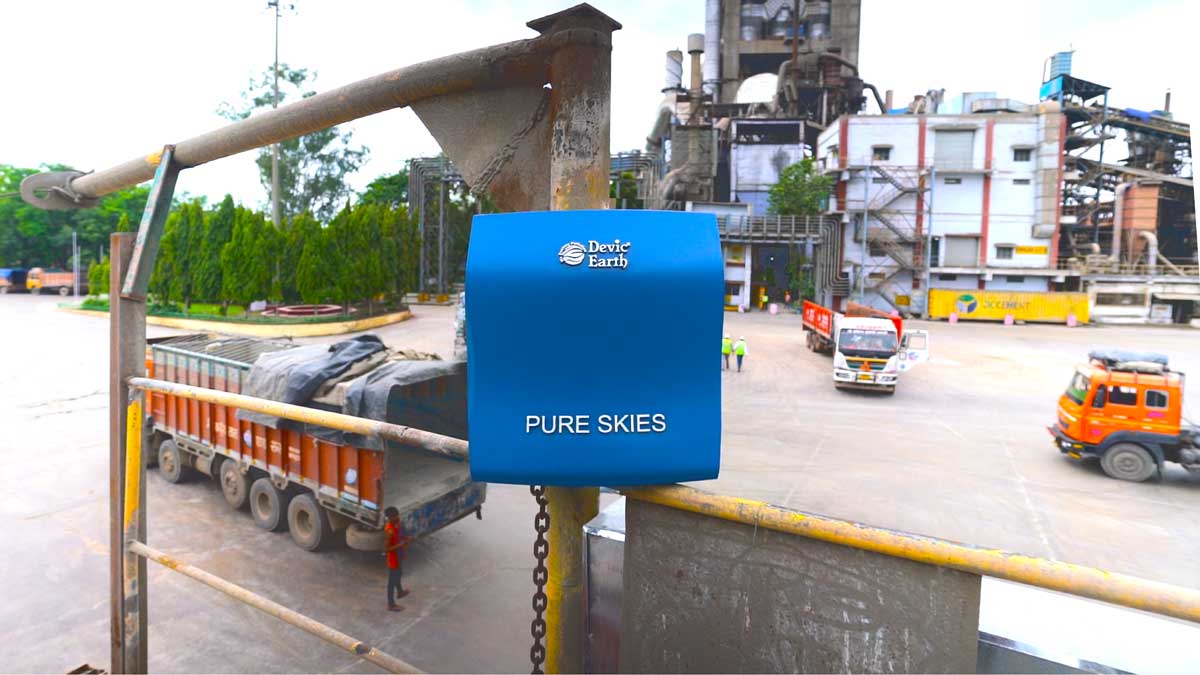
When these sleek machines called “Pure Skies” are placed outside, they can cover a distance of about 500 m radius, about 2 acre. These machines are small, about the size of a microwave oven, and are solar-powered. They contain antennas that send out radio waves to other hardware and IoT (Internet of Things) devices so that it is possible to communicate with each device and understand what’s happening locally, in the industry or smart cities around the world, where these devices are installed. “With this technology, we can understand the crucial bevels on the customer side such as temperature, wind speed or maybe a neighbour who is creating pollution, or if there is an industrial zone nearby and people are getting affected by that.” These insights can be used to tackle individual problems systematically.
To install these, a grid is envisioned, similar to how Wi-Fi routers are installed in large areas such as airports or railway stations. These machines are interlinked so they all talk to each other; if they are outdoors, they are additionally solar-powered and don’t need to be connected to the main power supply, which is also an option as per clients requirement to cater to outdoor areas. When not solar-powered, the consumption is about 8-10 w, which is about the usage of an LED bulb. For a site that is a large space such as an office tower or a cement plant, these can be installed around the tower so that the air that goes into the building is clean and so is the air on the campus.
Plug and purify
Just like the product, the delivery model Devic Earth offers is an innovative one too. “We make everything available by subscription or CAAS (Clean-Air-as-a-Service). You can take the product and try it out for three months,” Dr Sola elaborates. “Once you are happy, you can take a subscription for one year.” The longer the subscription, the higher the discount, he adds. Additionally, one pays for the number of acres coverable if the product is being installed outdoors, and per square foot if indoors.
The subscription covers the installation of the devices and their maintenance and also comes with a performance guarantee in case the startup fails to achieve its promised target. Clients are exempt from paying for those days. “It has never happened,” Dr Sola adds. “The units are robust.”
A centralised monitor goes with the machines – these are, however, made by third parties because “we want our customers to be able to trust the numbers,” he explains. All in all, the whole system is plug and play. Further, these devices can be installed in both new developments and existing structures with equal ease, but these can also be moved to ongoing projects or construction sites to manage pollution owing to dust.
After the pandemic
The pandemic made it all clear to everyone that air quality matters. “Directly or indirectly, the pandemic has accelerated the adoption of sustainability goals,” Dr Sola observes. Businesses realised they cannot keep going the way they have.
“Part of what we do is of course installing these machines,” he says. “But in our discussions, we work with sustainability leaders, environment health and safety offices, and we develop a lot of expertise and help them with their processes.”
On the move
Devic Earth’s current turnover is around Rs 38.7 million while Dr Sola says the company is aiming for Rs 115 million In the next three to five years, the startup plans to be a $50 million company. Among the projects coming up, the startup is working on a CO2 mitigation technology. There are also plans for handheld sets that can be clipped onto bags or purses and have portable purifying devices, which would be launched next year.
“Our goal is quite simple, we want to do for clean air what Tesla has done for electric vehicles.” he says in conclusion. “We want to be the Tesla of green technology.”
Where are the manufacturing units located?
We have two manufacturing facilities. One is our central office in Bengaluru and the other is in Andhra Pradesh Medtech Zone (AMTZ) in Visakhapatnam. Everything such as the QA and QC is done in house. We special-order the cabinets for our devices, and a few electric components such as the semiconductor chips are bought from outside.
We plan on going across the entire world. We have already started in South America and Europe. Next calendar year, we will start in the US, Australia, South Africa and South Asia.
Which are the key industries?
Cities, especially smart cities, which are looking to expand and provide a sustainable environment to their citizens. The second would be large real-estate developments looking to build sustainable environments for their occupants – these could be airports or shipping ports, suppliers that are providing materials to make these places possible such as steel, cement, mines, smelters, speciality chemicals and other types of heavy industries. These are all industries that generate pollution as part of their work and we work to minimise the extent of that pollution.
To name a few, these include JK Cement, ACC Cement, Electrosteel and Anupam Rasayan and a few years back we saw Devic Earth in the news for serving 25,000 runners at TCS Delhi & Kolkata marathons with clean air.