
Electrification and smart hydraulics anchor our strategy
Equipment

Electrification and smart hydraulics anchor our strategy

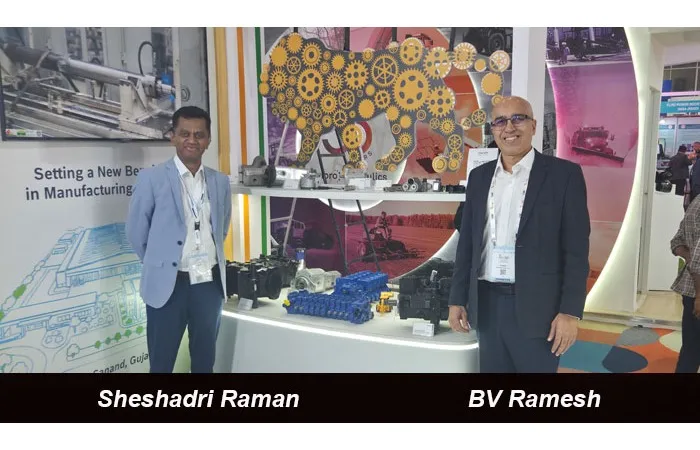
- BV Ramesh, Managing Director, and Sheshadri Raman, Chief Business officer, Mobile Applications, Bosch Rexroth (India), speak on digitalisation that is influencing Bosch Rexroth’s product direction.

What are the key themes being highlighted at your pavilion this year?
BV Ramesh (BVR): Our displays are centred on electrification, simplified engineering, smart hydraulics and automation. These themes directly support the transformation of mobile machines, helping customers improve efficiency, sustainability and competitiveness in their respective markets.

How is digitalisation influencing Rexroth’s product direction?
Sheshadri Raman (SR): Digitalisation is fundamentally about optimisation. Across our portfolio, the common thread is enabling machines to sense, learn and adapt. By selectively capturing the right signals and data, machines can improve efficiency and deliver better outcomes for end users. We focus on filtering what truly adds value rather than collecting data for its own sake.

What are the key challenges from an Indian component manufacturing perspective?
BVR: India is an extremely cost-competitive market. Our customers must compete with the most efficient machines globally, including those from neighbouring regions. This makes it essential for us to offer India-relevant product portfolios that balance performance, cost and reliability. To achieve this, we are expanding both engineering capabilities and manufacturing capacity within India.

Can you elaborate on Bosch Rexroth’s manufacturing footprint in India?
BVR: Bosch Rexroth has been present in India for nearly 50 years. We operate two state-of-the-art manufacturing facilities — one in Bengaluru and one in Ahmedabad. We are currently expanding capacity and increasing the localisation of India-relevant products. The goal is to manufacture more solutions in India, for India, while maintaining global quality benchmarks.

How do you view the outlook for the construction equipment market? What is your market strategy in India?
BVR: We see the last several years — and the next decade or more — as an infrastructure-led growth phase. Large investments in infrastructure, urbanisation, digitisation and agricultural linkages are reshaping demand. From our perspective, this translates into sustained double-digit growth potential over the next five to seven years, and possibly beyond.

Bosch Rexroth has long been synonymous with hydraulics and automation. Our strategy is to reinforce this positioning through innovation-led engagement at platforms like Excon. In many cases, we are the first choice for customers when it comes to hydraulic and automation solutions. As a tier I supplier, our role is to stand behind customers and support whatever machine or solution they want to build.

How does sustainability factor into your solutions for mobile machinery?
BVR: Our purpose is clear — we move industries to make our planet a better place. Over the last decade, we have evolved from supplying standalone hydraulic components to delivering integrated solutions that improve energy efficiency and reduce environmental impact. Sustainability is embedded not only in our products but in how those products enable cleaner, more efficient machines.

- BV Ramesh, Managing Director, and Sheshadri Raman, Chief Business officer, Mobile Applications, Bosch Rexroth (India), speak on digitalisation that is influencing Bosch Rexroth’s product direction.What are the key themes being highlighted at your pavilion this year?BV Ramesh (BVR): Our displays are centred on electrification, simplified engineering, smart hydraulics and automation. These themes directly support the transformation of mobile machines, helping customers improve efficiency, sustainability and competitiveness in their respective markets.How is digitalisation influencing Rexroth’s product direction?Sheshadri Raman (SR): Digitalisation is fundamentally about optimisation. Across our portfolio, the common thread is enabling machines to sense, learn and adapt. By selectively capturing the right signals and data, machines can improve efficiency and deliver better outcomes for end users. We focus on filtering what truly adds value rather than collecting data for its own sake.What are the key challenges from an Indian component manufacturing perspective?BVR: India is an extremely cost-competitive market. Our customers must compete with the most efficient machines globally, including those from neighbouring regions. This makes it essential for us to offer India-relevant product portfolios that balance performance, cost and reliability. To achieve this, we are expanding both engineering capabilities and manufacturing capacity within India.Can you elaborate on Bosch Rexroth’s manufacturing footprint in India?BVR: Bosch Rexroth has been present in India for nearly 50 years. We operate two state-of-the-art manufacturing facilities — one in Bengaluru and one in Ahmedabad. We are currently expanding capacity and increasing the localisation of India-relevant products. The goal is to manufacture more solutions in India, for India, while maintaining global quality benchmarks.How do you view the outlook for the construction equipment market? What is your market strategy in India?BVR: We see the last several years — and the next decade or more — as an infrastructure-led growth phase. Large investments in infrastructure, urbanisation, digitisation and agricultural linkages are reshaping demand. From our perspective, this translates into sustained double-digit growth potential over the next five to seven years, and possibly beyond.Bosch Rexroth has long been synonymous with hydraulics and automation. Our strategy is to reinforce this positioning through innovation-led engagement at platforms like Excon. In many cases, we are the first choice for customers when it comes to hydraulic and automation solutions. As a tier I supplier, our role is to stand behind customers and support whatever machine or solution they want to build.How does sustainability factor into your solutions for mobile machinery?BVR: Our purpose is clear — we move industries to make our planet a better place. Over the last decade, we have evolved from supplying standalone hydraulic components to delivering integrated solutions that improve energy efficiency and reduce environmental impact. Sustainability is embedded not only in our products but in how those products enable cleaner, more efficient machines.

Next Story
Infrastructure Transport

Indian Railways Steps Up Track Modernisation, Safety Drive

Indian Railways has made significant strides in modernising its track infrastructure and strengthening safety standards through sustained investment and focused execution over the past eleven years. These initiatives have played a crucial role in enabling safer, faster and more reliable train operations across the national network.During the financial year 2024–25, track renewal works were completed across 6,851 track kilometres. In the current financial year 2025–26, more than 7,500 track kilometres are undergoing renewal, while plans are in place to cover 7,900 track kilometres in 2026..

Next Story
Infrastructure Transport

PM Modi Dedicates Rs 8.30 Bn Waterways, Rail Projects in Bengal

Prime Minister Narendra Modi inaugurated, laid the foundation stone of and flagged off multiple development projects worth more than Rs 8.30 billion at Singur in Hooghly district, West Bengal, giving a major boost to rail and inland waterways infrastructure in the state. The projects are aimed at strengthening multimodal connectivity, improving cargo movement and accelerating regional economic growth.Addressing the gathering, the Prime Minister said that after visiting Malda a day earlier, he was pleased to interact with people in Hooghly. He emphasised that the development of eastern India is..

Next Story
Infrastructure Urban

Dr Jitendra Singh Launches India’s First Open-Sea Fish Farming Project

Union Minister of State (Independent Charge) for Science & Technology and Earth Sciences, Dr Jitendra Singh, launched India’s first-ever open-sea Marine Fish Farming project in the Andaman Sea, marking a major milestone in harnessing the country’s vast ocean resources for economic growth. The project was inaugurated at North Bay, Vijaya Puram, during the Minister’s field visit to the open waters of the Andaman Sea.Describing the initiative as a significant step towards realising the Blue Economy vision articulated by Prime Minister Narendra Modi, Dr Jitendra Singh said the project re..

Advertisement

Subscribe to Our Newsletter

Get daily newsletters around different themes from Construction world.

STAY CONNECTED

Advertisement

Advertisement

Advertisement

Advertisement

Open In App