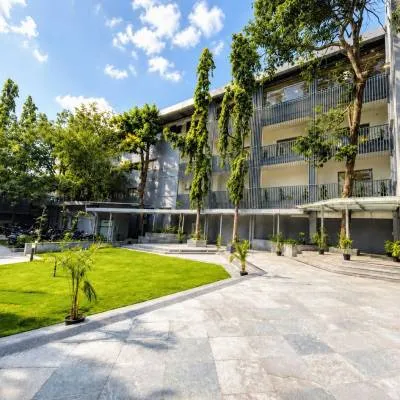
Bengaluru Residential Project Advances After K-RERA Approval
Real Estate

Bengaluru Residential Project Advances After K-RERA Approval

The residential development in northern Bengaluru has secured registration from the Karnataka Real Estate Regulatory Authority (K-RERA), enabling the project to move forward under the state regulatory framework. The clearance permits the developer to launch and market the housing scheme while complying with requirements on construction timelines, financial disclosures and consumer protection. The approval is regarded as a credibility signal that can bolster buyer confidence and reduce delivery risk. The clearance followed procedural review of project documents and statutory obligations.

Located in the northern growth belt, the project adds housing supply to a zone that has expanded rapidly and attracts developers for its connectivity to employment clusters. Infrastructure investments and improved road links have made peripheral neighbourhoods more accessible and suitable for planned communities. Developers are increasingly planning mixed use layouts that combine homes with community infrastructure. The new supply is expected to meet a segment of demand from young professionals and families seeking planned layouts.

The real estate regulatory regime has required developers to adopt clearer financial planning and defined construction schedules while increasing transparency in marketing and documentation. Registered projects must disclose layout plans, construction milestones and developer commitments on regulator platforms, helping prospective buyers assess project status. The framework imposes safeguards for consumer protection that were largely absent in earlier periods and is reshaping business practices across India's real estate sector.

Developers are incorporating shared amenities, green spaces and measures for water conservation and energy efficiency into new residential communities. Urban development specialists emphasise the need to align projects with broader planning objectives to enhance climate resilience and manage resources responsibly. With K-RERA registration now complete, construction and marketing activities are expected to progress in the coming months and the pace of sales will provide a gauge of housing demand. Market participants will monitor sales velocity closely.

The residential development in northern Bengaluru has secured registration from the Karnataka Real Estate Regulatory Authority (K-RERA), enabling the project to move forward under the state regulatory framework. The clearance permits the developer to launch and market the housing scheme while complying with requirements on construction timelines, financial disclosures and consumer protection. The approval is regarded as a credibility signal that can bolster buyer confidence and reduce delivery risk. The clearance followed procedural review of project documents and statutory obligations. Located in the northern growth belt, the project adds housing supply to a zone that has expanded rapidly and attracts developers for its connectivity to employment clusters. Infrastructure investments and improved road links have made peripheral neighbourhoods more accessible and suitable for planned communities. Developers are increasingly planning mixed use layouts that combine homes with community infrastructure. The new supply is expected to meet a segment of demand from young professionals and families seeking planned layouts. The real estate regulatory regime has required developers to adopt clearer financial planning and defined construction schedules while increasing transparency in marketing and documentation. Registered projects must disclose layout plans, construction milestones and developer commitments on regulator platforms, helping prospective buyers assess project status. The framework imposes safeguards for consumer protection that were largely absent in earlier periods and is reshaping business practices across India's real estate sector. Developers are incorporating shared amenities, green spaces and measures for water conservation and energy efficiency into new residential communities. Urban development specialists emphasise the need to align projects with broader planning objectives to enhance climate resilience and manage resources responsibly. With K-RERA registration now complete, construction and marketing activities are expected to progress in the coming months and the pace of sales will provide a gauge of housing demand. Market participants will monitor sales velocity closely.

Related Stories

Gold Stories

Next Story
Infrastructure Urban

KONE Opens India's First Digital Experience Centre in Pune

KONE, a global elevator and escalator manufacturer, has inaugurated its first Digital Experience Centre (DEC) in India, located in Pune. The facility aims to showcase how artificial intelligence (AI), connectivity and data-driven technologies can enhance customer experiences and improve building operations.The centre was inaugurated by Jussi Herlin, Executive Vice Chair, KONE Corporation; Philippe Delorme, President and CEO, KONE; and Nandan Nilekani, Co-founder and Chairman of the Board, Infosys.Designed as an interactive customer environment, the facility demonstrates digital solutions cover..

Next Story
Infrastructure Urban

CII GreenCo Launches Circularity Guidelines for Indian Industry

The Confederation of Indian Industry (CII) GreenCo Council has launched the CII GreenCo Circularity Guidelines – Pilot Version at the 17th CII GreenCo Waste & Resource Management Summit 2026 in Chennai. The initiative aims to strengthen resource efficiency, waste reduction and circular economy practices across Indian manufacturing and process industries.The guidelines introduce a structured framework with circularity indices covering raw materials, consumables, packaging and other resource inputs. These indicators will help industries assess existing practices, identify opportunities to ..

Next Story
Infrastructure Energy

Global Electronics Association Launches IPC-1783-CO2E Standard

The Global Electronics Association has introduced IPC-1783-CO2E, a new international standard aimed at improving consistency, transparency and comparability in product carbon footprint reporting across the electronics manufacturing industry.The standard, titled International Standard for Data Collection and Reporting of CO2 Equivalent (CO2e) Emissions for the Electronics Manufacturing Supply Chain, provides industry-specific guidance for collecting, estimating and reporting carbon emissions data.With increasing regulatory requirements and customer expectations, electronics manufacturers face c..

Advertisement

Subscribe to Our Newsletter

Get daily newsletters around different themes from Construction world.

STAY CONNECTED

Advertisement

SPECIAL OFFER
QR Code