
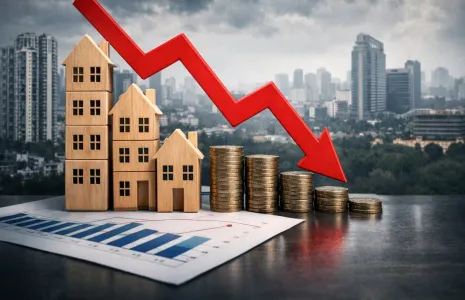

Housing sales across India’s top seven cities declined by 14 per cent in 2025 to around 395,000 units, down from about 459,000 units in 2024, according to a report by real estate consultancy ANAROCK. The slowdown has been attributed to rising property prices, layoffs in the IT sector, geopolitical tensions and broader economic uncertainty that weighed on residential demand during the year.
Despite the fall in volumes, the total value of homes sold increased by 6 per cent year-on-year, rising from about Rs 5.68 trillion in 2024 to over Rs 6 trillion in 2025, reflecting higher ticket sizes and a growing share of premium housing.
The seven cities covered in the report are the Mumbai Metropolitan Region (MMR), Delhi NCR, Bengaluru, Pune, Hyderabad, Chennai and Kolkata. MMR recorded the highest sales at around 127,875 units, though this represented an 18 per cent annual decline. Pune followed with about 65,135 units sold, marking a 20 per cent fall. Together, the two western markets accounted for nearly 49 per cent of total housing sales in 2025. Hyderabad, Pune and MMR were the worst hit in terms of sales decline.
Bengaluru saw a relatively modest fall of 5 per cent, with sales of approximately 62,205 units, while Delhi NCR recorded around 57,220 units sold, an 8 per cent decline year-on-year. Hyderabad reported sales of about 44,885 units, a sharp 23 per cent drop. Kolkata saw sales of nearly 16,125 units, down 12 per cent, while Chennai was the only city to buck the trend, registering a 15 per cent increase with around 22,180 units sold.
According to ANAROCK, MMR, Pune, Bengaluru, Hyderabad and NCR together accounted for 90 per cent of total housing sales across the top seven cities in 2025. New housing launches rose marginally by 2 per cent year-on-year, from roughly 412,000 units in 2024 to about 419,000 units in 2025. MMR and Bengaluru together contributed nearly 48 per cent of the new supply, while MMR, Pune, Bengaluru and NCR accounted for 79 per cent of total new additions.
“2025 has been a year of broad-spectrum upheaval, including geopolitical turmoil, IT sector layoffs, tariff tensions and other uncertainties,” said Anuj Puri, Chairman of ANAROCK Group. He noted that sales volumes stabilised at around 400,000 units across the top cities, even as overall sales value continued to rise. More than 21 per cent of new supply launched during the year was priced above Rs 25 million.
Puri added that average residential price growth moderated to single digits in 2025, with prices across the top seven cities rising by 8 per cent annually. Delhi NCR was the exception, recording a 23 per cent increase, largely driven by a higher share of premium launches. Of NCR’s total new supply of about 61,775 units, over 55 per cent was priced above Rs 25 million.
Looking ahead, ANAROCK said the sector’s performance in 2026 will depend on factors such as potential RBI rate cuts and developers’ pricing discipline. Lower home loan interest rates could help revive demand amid a relatively favourable economic outlook.
The report also highlighted a continued rise in luxury housing demand and supply, driven by a post-pandemic preference for larger, better-quality homes from branded developers. The share of new homes priced above Rs 25 million increased from 18 per cent in 2024 to 21 per cent in 2025, a trend expected to continue in 2026.
On average, housing prices across the top seven cities rose by 8 per cent, from about Rs 8,590 per sq ft at the end of Q4 2024 to around Rs 9,260 per sq ft by the end of Q4 2025. Delhi NCR recorded the sharpest increase, with average prices rising from roughly Rs 7,550 per sq ft to about Rs 9,300 per sq ft. Other cities saw single-digit appreciation of between 4 per cent and 9 per cent, compared with 13–27 per cent growth in 2024.
Unsold inventory across the top seven cities is expected to rise by 4 per cent by the end of 2025, mainly due to softer demand and increased supply, with around 577,000 units currently available in the primary market. Hyderabad was an exception, recording a 2 per cent decline in unsold stock to about 96,140 units due to limited new supply, while MMR also saw a marginal 1 per cent decline. All other cities reported an increase in unsold inventory, with Bengaluru witnessing a sharp 23 per cent rise.