

+
Retail Leasing Hits Three-Year High in 2025
Real Estate

Retail Leasing Hits Three-Year High in 2025

Retail space leasing across malls and high streets in India’s top seven cities rose by more than 50 per cent in 2025, reaching a three-year high as gross leasing volumes increased to 12.5 million square feet from 8.1 million square feet a year earlier, according to a report by JLL.

Delhi NCR led leasing activity with 3.02 million square feet, followed by Bengaluru at 2.97 million square feet, Hyderabad at 2.91 million square feet and Mumbai at 2.1 million square feet. Kolkata recorded leasing of 0.65 million square feet, Chennai 0.59 million square feet and Pune 0.24 million square feet.

JLL said the retail sector recorded a three-year high as gross leasing volumes surged 54 per cent year-on-year, signalling renewed confidence among retailers despite global economic uncertainty. Gross leasing includes retail space in shopping malls, high streets and prime retail developments.

In 2025, shopping malls accounted for 45 per cent of total leasing activity, while high streets commanded a dominant 48 per cent share. After moderating in 2024, retail leasing rebounded sharply in 2025, driven by rising discretionary spending, premium brand expansion and new supply.

The fourth quarter of 2025 emerged as the strongest period, with 3.6 million square feet of leasing recorded during the quarter. Around 6.3 million square feet of new retail supply was added during the year, enabling aggressive store rollouts across major urban markets.

Delhi NCR, Bengaluru and Hyderabad emerged as the top three retail markets, together accounting for 71 per cent of total leasing. Delhi NCR and Bengaluru each contributed 24 per cent of leasing activity, followed by Hyderabad at 23 per cent. Mumbai accounted for 17 per cent of leasing, while Chennai, Kolkata and Pune witnessed relatively limited activity due to supply constraints.

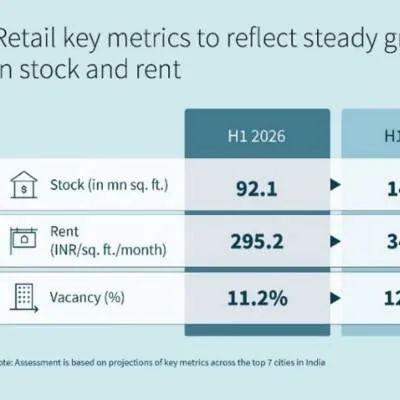
The top seven cities accounted for nearly 92 million square feet of mall stock in 2025. During the year, Delhi NCR, Hyderabad and Mumbai witnessed the launch of 15 shopping malls, contributing significantly to the nation’s overall mall inventory. The availability of premium institutional-grade mall space encouraged retailers to accelerate store launches in prime locations.

Domestic retailers remained the backbone of the market, accounting for 82 per cent of total leasing during the year. Retail space take-up by Indian brands exceeded 10 million square feet in 2025, up from 6.5 million square feet in 2024. Domestic brands expanded across both malls and high streets, with a growing preference for larger store formats.

Fashion and apparel continued to lead leasing with a 34 per cent share, while the food and beverage segment gained momentum, rising to 20 per cent in 2025. Direct-to-consumer brands accelerated physical expansion, leasing 0.9 million square feet during the year, supported by strong growth in fashion, beauty, jewellery and wellness categories.

Foreign brands also strengthened their presence, recording 36 per cent year-on-year growth in leased space, with 29 new international brands entering India, the highest in five years. JLL noted that nearly 47 million square feet of mall space is under construction across the top seven cities and expected to become operational by 2030.

The report highlighted that evolving consumer preferences and rising consumption spending will require developers to integrate technology, hospitality and experience-driven elements into future retail developments. Over the past five years, India’s retail sector has attracted about USD 2.3 billion in institutional investment, with future-ready retail assets expected to continue drawing capital.

Retail space leasing across malls and high streets in India’s top seven cities rose by more than 50 per cent in 2025, reaching a three-year high as gross leasing volumes increased to 12.5 million square feet from 8.1 million square feet a year earlier, according to a report by JLL. Delhi NCR led leasing activity with 3.02 million square feet, followed by Bengaluru at 2.97 million square feet, Hyderabad at 2.91 million square feet and Mumbai at 2.1 million square feet. Kolkata recorded leasing of 0.65 million square feet, Chennai 0.59 million square feet and Pune 0.24 million square feet. JLL said the retail sector recorded a three-year high as gross leasing volumes surged 54 per cent year-on-year, signalling renewed confidence among retailers despite global economic uncertainty. Gross leasing includes retail space in shopping malls, high streets and prime retail developments. In 2025, shopping malls accounted for 45 per cent of total leasing activity, while high streets commanded a dominant 48 per cent share. After moderating in 2024, retail leasing rebounded sharply in 2025, driven by rising discretionary spending, premium brand expansion and new supply. The fourth quarter of 2025 emerged as the strongest period, with 3.6 million square feet of leasing recorded during the quarter. Around 6.3 million square feet of new retail supply was added during the year, enabling aggressive store rollouts across major urban markets. Delhi NCR, Bengaluru and Hyderabad emerged as the top three retail markets, together accounting for 71 per cent of total leasing. Delhi NCR and Bengaluru each contributed 24 per cent of leasing activity, followed by Hyderabad at 23 per cent. Mumbai accounted for 17 per cent of leasing, while Chennai, Kolkata and Pune witnessed relatively limited activity due to supply constraints. The top seven cities accounted for nearly 92 million square feet of mall stock in 2025. During the year, Delhi NCR, Hyderabad and Mumbai witnessed the launch of 15 shopping malls, contributing significantly to the nation’s overall mall inventory. The availability of premium institutional-grade mall space encouraged retailers to accelerate store launches in prime locations. Domestic retailers remained the backbone of the market, accounting for 82 per cent of total leasing during the year. Retail space take-up by Indian brands exceeded 10 million square feet in 2025, up from 6.5 million square feet in 2024. Domestic brands expanded across both malls and high streets, with a growing preference for larger store formats. Fashion and apparel continued to lead leasing with a 34 per cent share, while the food and beverage segment gained momentum, rising to 20 per cent in 2025. Direct-to-consumer brands accelerated physical expansion, leasing 0.9 million square feet during the year, supported by strong growth in fashion, beauty, jewellery and wellness categories. Foreign brands also strengthened their presence, recording 36 per cent year-on-year growth in leased space, with 29 new international brands entering India, the highest in five years. JLL noted that nearly 47 million square feet of mall space is under construction across the top seven cities and expected to become operational by 2030. The report highlighted that evolving consumer preferences and rising consumption spending will require developers to integrate technology, hospitality and experience-driven elements into future retail developments. Over the past five years, India’s retail sector has attracted about USD 2.3 billion in institutional investment, with future-ready retail assets expected to continue drawing capital.

Related Stories

Gold Stories

Next Story
Products

Interio by Godrej launches modular workplace solutions

Interio by Godrej has launched Workscapes, a modular workplace solutions category designed to help organisations configure and adapt workspaces to changing requirements. The portfolio combines mobile and compatible furniture and support elements that can be rearranged across different work modes without changes to fixed layouts.Workscapes includes Collaboration Tables, Privacy Solutions, Mobile Markerboards and Space Dividers, Power Solutions, Storage and Support Elements, Meeting and Presentation Tools, and Seating Elements. The range is designed for focused work, collaboration, informal disc..

Next Story
Infrastructure Urban

CAFE-III Gives Auto Industry Investment Clarity

The government’s new Corporate Average Fuel Economy (CAFE-III) norms have provided the automobile industry with a clearer framework for technology investments, according to industry representatives. The framework seeks to balance environmental objectives with flexibility for manufacturers while encouraging the adoption of flex-fuel vehicles and biofuels. Society of Indian Automobile Manufacturers (SIAM) President Shenu Agarwal said the five-year framework would give automakers greater predictability to plan investments and accelerate innovation. He said the regulation established annual targ..

Next Story
Infrastructure Energy

Mines Ministry to Auction Two Offshore Mineral Blocks in Andaman Sea

The Ministry of Mines will launch an auction of two offshore mineral blocks in the Andaman Sea on Thursday, seeking to unlock India’s offshore mineral potential and strengthen long-term mineral resource security. The blocks will be offered under a composite licence, which permits exploration and development activities in accordance with the applicable regulatory framework. The ministry said the auction was intended to encourage systematic exploration, attract investment and promote the use of advanced technologies for offshore mineral exploration and development. The initiative is also aimed..

Advertisement

Subscribe to Our Newsletter

Get daily newsletters around different themes from Construction world.

STAY CONNECTED

Advertisement

SPECIAL OFFER
QR Code