AIM And Hitachi Partner To Build National Innovation Platform
Technology

AIM And Hitachi Partner To Build National Innovation Platform

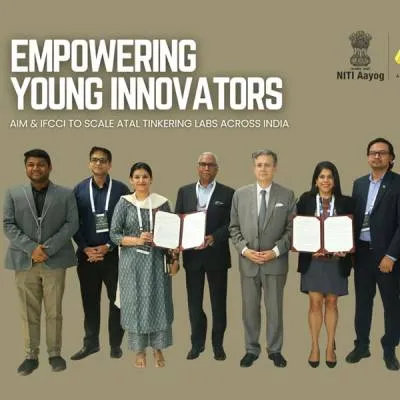
The Atal Innovation Mission (AIM), NITI Aayog, and Hitachi MGRM Net Ltd. have entered into a strategic partnership through a Statement of Intent signed on 1 December 2025. The collaboration aims to develop and deploy a unified national Innovation Platform, MStar™ Global AI Connect, which will use artificial intelligence and other emerging technologies to build a culture of innovation and entrepreneurship across India.

The SoI was signed by Dr Deepak Bagla, AIM Mission Director, and Dr Bharat Kaushal, Executive Chairman, Hitachi India and Managing Director, Hitachi MGRM Net Ltd.

The partnership will support the Government’s vision of a Viksit Bharat by enabling a federated, nationwide digital backbone. This platform will connect schools from rural, suburban and urban regions to mentors, research institutions, incubators, accelerators and industry partners. The initiative aims to create a strong school-to-startup pipeline, speed up the lab-to-market journey for Indian innovations and support the development of export-ready products and technologies.

Speaking at the signing, Dr Deepak Bagla said AIM has always believed that every child is a potential innovator. The partnership will help identify and nurture this talent at scale, shifting from isolated success stories to a structured, inclusive and scalable national pipeline of innovators, start-ups and job creators.

Dr Bharat Kaushal emphasised that MStar™ Global AI Connect aims to instil a problem-solving and innovation mindset in every willing child. The platform will connect learners to mentors, incubators, industry and markets, while remaining inclusive, multilingual and aligned with India’s long-term development goals.

NITI Aayog and Hitachi MGRM Net intend to collaborate across AIM programmes to strengthen innovation and entrepreneurship pathways throughout the country. Guided by the objective of a Viksit Bharat, the partnership will work to build a federated digital innovation backbone that enhances school-to-startup transitions, accelerates commercialisation, improves export readiness and expands quality employment opportunities.

Key objectives include:

Universal reach: Enabling nationwide onboarding of schools, students, mentors, institutions and incubators with multilingual access, including rural and underserved regions.

Virtual–physical fusion: Establishing virtual ATLs and virtual AICs linked to physical hubs to increase participation, resource access and remote mentorship.

End-to-end innovation lifecycle: Managing workflows from ideation to pilot, tracking technology readiness levels, conducting milestone reviews and enabling challenge grants and procurement.

Talent pathways: Identifying and nurturing gifted and skilled learners through design-thinking projects, challenges and hackathons.

IP and market linkages: Supporting IP creation and filing, ethical research, investor connects, CSR and grant access, public procurement integration and export facilitation.

Public-value analytics: Providing policy-relevant insights on inclusion, skills, start-ups, jobs and trade to inform national and state-level decision-making.

The joint initiative will integrate innovation resources nationwide, enhance teacher capabilities, support frontier-technology skilling, drive IP creation and cultivate future-ready talent through a single interoperable innovation backbone.

The Statement of Intent reaffirms AIM’s commitment to democratising access to innovation and entrepreneurship, and Hitachi MGRM Net’s dedication to building digital public-value platforms for national development.

The Atal Innovation Mission (AIM), NITI Aayog, and Hitachi MGRM Net Ltd. have entered into a strategic partnership through a Statement of Intent signed on 1 December 2025. The collaboration aims to develop and deploy a unified national Innovation Platform, MStar™ Global AI Connect, which will use artificial intelligence and other emerging technologies to build a culture of innovation and entrepreneurship across India. The SoI was signed by Dr Deepak Bagla, AIM Mission Director, and Dr Bharat Kaushal, Executive Chairman, Hitachi India and Managing Director, Hitachi MGRM Net Ltd. The partnership will support the Government’s vision of a Viksit Bharat by enabling a federated, nationwide digital backbone. This platform will connect schools from rural, suburban and urban regions to mentors, research institutions, incubators, accelerators and industry partners. The initiative aims to create a strong school-to-startup pipeline, speed up the lab-to-market journey for Indian innovations and support the development of export-ready products and technologies. Speaking at the signing, Dr Deepak Bagla said AIM has always believed that every child is a potential innovator. The partnership will help identify and nurture this talent at scale, shifting from isolated success stories to a structured, inclusive and scalable national pipeline of innovators, start-ups and job creators. Dr Bharat Kaushal emphasised that MStar™ Global AI Connect aims to instil a problem-solving and innovation mindset in every willing child. The platform will connect learners to mentors, incubators, industry and markets, while remaining inclusive, multilingual and aligned with India’s long-term development goals. NITI Aayog and Hitachi MGRM Net intend to collaborate across AIM programmes to strengthen innovation and entrepreneurship pathways throughout the country. Guided by the objective of a Viksit Bharat, the partnership will work to build a federated digital innovation backbone that enhances school-to-startup transitions, accelerates commercialisation, improves export readiness and expands quality employment opportunities. Key objectives include: Universal reach: Enabling nationwide onboarding of schools, students, mentors, institutions and incubators with multilingual access, including rural and underserved regions. Virtual–physical fusion: Establishing virtual ATLs and virtual AICs linked to physical hubs to increase participation, resource access and remote mentorship. End-to-end innovation lifecycle: Managing workflows from ideation to pilot, tracking technology readiness levels, conducting milestone reviews and enabling challenge grants and procurement. Talent pathways: Identifying and nurturing gifted and skilled learners through design-thinking projects, challenges and hackathons. IP and market linkages: Supporting IP creation and filing, ethical research, investor connects, CSR and grant access, public procurement integration and export facilitation. Public-value analytics: Providing policy-relevant insights on inclusion, skills, start-ups, jobs and trade to inform national and state-level decision-making. The joint initiative will integrate innovation resources nationwide, enhance teacher capabilities, support frontier-technology skilling, drive IP creation and cultivate future-ready talent through a single interoperable innovation backbone. The Statement of Intent reaffirms AIM’s commitment to democratising access to innovation and entrepreneurship, and Hitachi MGRM Net’s dedication to building digital public-value platforms for national development.

Next Story
Infrastructure Urban

Centre Boosts FPO Growth With New Credit And Market Support

The Government is implementing the Central Sector Scheme on the formation and promotion of 10,000 Farmer Producer Organisations (FPOs), under which all 10,000 FPOs have now been registered. The scheme provides Rs 1.8 million per FPO for three years as management support, a matching equity grant of up to Rs 1.5 million, and a credit guarantee of up to Rs 0.02 billion through eligible lending institutions. It also offers assistance for training, market linkages and alignment with other schemes. FPOs receive support to obtain input licences for seed, fertiliser and pesticide supplies, as well as..

Next Story
Infrastructure Urban

PM-KISAN Drives Farm Income Gains And Rural Stability

The PM-KISAN scheme, a central sector initiative launched in February 2019, aims to support the financial needs of farmers holding cultivable land. Under the scheme, Rs 6,000 per year is transferred in three equal instalments to Aadhaar-seeded bank accounts through Direct Benefit Transfer. Eligibility is based primarily on cultivable landholding, with certain exclusions for individuals of higher economic status. A farmer-centric digital infrastructure ensures scheme benefits reach farmers across India without intermediaries. With full transparency in registration and verification, the Governm..

Next Story
Infrastructure Urban

Govt Extends Pro Tem Security Certificate To Two Years

In a further push to improve ease of doing business and ensure continuity for the telecom industry, the National Centre for Communication Security (NCCS) under the Department of Telecommunications has extended the validity of the Pro Tem Security Certification from six months to two years. The Pro Tem Certification, initially launched in October 2024 with a six-month validity, was designed to prevent business disruption for IP Router and Wi-Fi CPE products, which became subject to mandatory security certification from 1 October 2024. Under this certification, OEMs submit a declaration confirm..

Advertisement

Subscribe to Our Newsletter

Get daily newsletters around different themes from Construction world.

STAY CONNECTED

Advertisement

Advertisement

Advertisement

Advertisement

Open In App