+
DSIR Eases Norms for Deep-tech Startups on 42nd Foundation Day
Technology

DSIR Eases Norms for Deep-tech Startups on 42nd Foundation Day

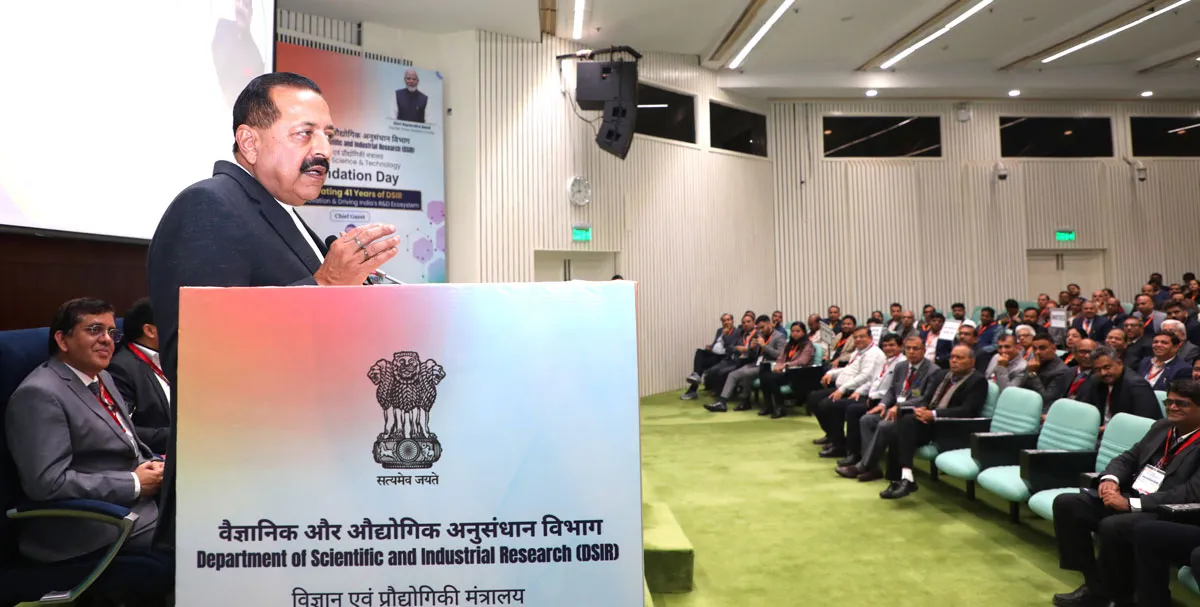
The government announced a major relaxation for deep-tech startups seeking recognition under the Department of Scientific and Industrial Research (DSIR), waiving the mandatory three-year existence requirement. The announcement was made by Union Minister of State (Independent Charge) for Science and Technology Dr Jitendra Singh during the 42nd Foundation Day celebrations of DSIR, under the Ministry of Science and Technology.

The reform is aimed at accelerating India’s startup and innovation ecosystem by providing early support to first-time entrepreneurs and promising innovators. Dr. Singh said the move would help deep-tech startups scale faster, even before they become fully established. Referring to the ₹1 lakh crore Research, Development and Innovation (RDI) Fund, he noted that while the fund supports startups that have attained technological maturity, early-stage innovators are backed through multiple schemes of departments such as the Department of Science and Technology (DST), CSIR and the Technology Development Board (TDB).

“For early-stage innovators or Startups, a wide basket of schemes already exists… The removal of the three-year existence requirement is a significant incentive,” Dr. Jitendra Singh said, adding that the decision reflects the government’s confidence in India’s innovators and their long-term sustainability.

He explained that although CSIR had been extending financial assistance, including loans of up to ₹1 crore, these were earlier linked to a minimum three-year existence to demonstrate viability. “That requirement has now been done away with,” the Minister said, while clarifying that evaluation standards linked to technological maturity would continue.

Congratulating the DSIR fraternity, Dr. Singh described the relationship between DSIR and CSIR as an “intergenerational symbiosis”, highlighting their complementary roles in technology transfer, industry partnerships and innovation facilitation. He said India has moved beyond the phase of Atmanirbhar Bharat and is now emerging as a country on which others increasingly rely for vaccines, medical devices and indigenous technologies.

Highlighting DSIR’s four pillars—science, industry, R&D and technology transfer—the Minister said industry participation is essential for sustainable research. He also noted the growing role of women in innovation, with over 10,000 women beneficiaries, including more than 55 women-led self-help groups, under DSIR-supported schemes.

News source: PIB

The government announced a major relaxation for deep-tech startups seeking recognition under the Department of Scientific and Industrial Research (DSIR), waiving the mandatory three-year existence requirement. The announcement was made by Union Minister of State (Independent Charge) for Science and Technology Dr Jitendra Singh during the 42nd Foundation Day celebrations of DSIR, under the Ministry of Science and Technology.The reform is aimed at accelerating India’s startup and innovation ecosystem by providing early support to first-time entrepreneurs and promising innovators. Dr. Singh said the move would help deep-tech startups scale faster, even before they become fully established. Referring to the ₹1 lakh crore Research, Development and Innovation (RDI) Fund, he noted that while the fund supports startups that have attained technological maturity, early-stage innovators are backed through multiple schemes of departments such as the Department of Science and Technology (DST), CSIR and the Technology Development Board (TDB).“For early-stage innovators or Startups, a wide basket of schemes already exists… The removal of the three-year existence requirement is a significant incentive,” Dr. Jitendra Singh said, adding that the decision reflects the government’s confidence in India’s innovators and their long-term sustainability.He explained that although CSIR had been extending financial assistance, including loans of up to ₹1 crore, these were earlier linked to a minimum three-year existence to demonstrate viability. “That requirement has now been done away with,” the Minister said, while clarifying that evaluation standards linked to technological maturity would continue.Congratulating the DSIR fraternity, Dr. Singh described the relationship between DSIR and CSIR as an “intergenerational symbiosis”, highlighting their complementary roles in technology transfer, industry partnerships and innovation facilitation. He said India has moved beyond the phase of Atmanirbhar Bharat and is now emerging as a country on which others increasingly rely for vaccines, medical devices and indigenous technologies.Highlighting DSIR’s four pillars—science, industry, R&D and technology transfer—the Minister said industry participation is essential for sustainable research. He also noted the growing role of women in innovation, with over 10,000 women beneficiaries, including more than 55 women-led self-help groups, under DSIR-supported schemes.News source: PIB

Next Story
Infrastructure Transport

Second Mountain Tunnel Breakthrough in Palghar Advances High Speed Rail

The Mumbai-Ahmedabad high speed rail (MAHSR) project reached a milestone with the breakthrough of a mountain tunnel in Palghar, Maharashtra. Mountain tunnel MT-six measures 454 metres long and 14.4 metres wide and will accommodate up and down tracks. The breakthrough follows MT-five near Saphale on second January 2026 and the MT-six excavation was completed from both ends using the New Austrian Tunnelling Method. The ministry reported that the tunnelling was completed within 12 months. The New Austrian Tunnelling Method is favoured for its flexibility in complex geology and irregular tunnel s..

Next Story
Infrastructure Transport

Modi Government Pushes Atmanirbhar Container Drive With BCSL MoU

The Union Government advanced a plan to create an integrated, domestically anchored container ecosystem with the signing of a Memorandum of Understanding to establish the Bharat Container Shipping Line (BCSL). The MoU was signed by key agencies including the Shipping Corporation of India and Container Corporation of India alongside major port authorities and Sagarmala Finance Corporation Limited under the Ministry of Ports, Shipping and Waterways, in the presence of senior ministers. The initiative aligns with the Container Manufacturing Assistance Scheme announced in the Union Budget 2026–2..

Next Story
Infrastructure Urban

Ministry Reports Gains In Mobility For Marginalised Communities

The Ministry of Social Justice and Empowerment is implementing skill development, education and rehabilitation schemes to promote socio-economic mobility and sustainable livelihoods for marginalised and disadvantaged communities across the country. Programmes target Scheduled Castes, Other Backward Classes, Economically Weaker Sections, De-notified Tribes and Safai Karamcharis through specialised implementing corporations and empanelled training institutes. Pradhan Mantri Dakshata Aur Kushalta Sampann Hitgrahi Yojana, or PM-DAKSH, provided skill training and placement support through the Nati..

Advertisement

Subscribe to Our Newsletter

Get daily newsletters around different themes from Construction world.

STAY CONNECTED

Advertisement

Advertisement

Advertisement

Open In App