


+
TDB Backs Autoscope AI Whole Slide Imaging System
Technology

TDB Backs Autoscope AI Whole Slide Imaging System

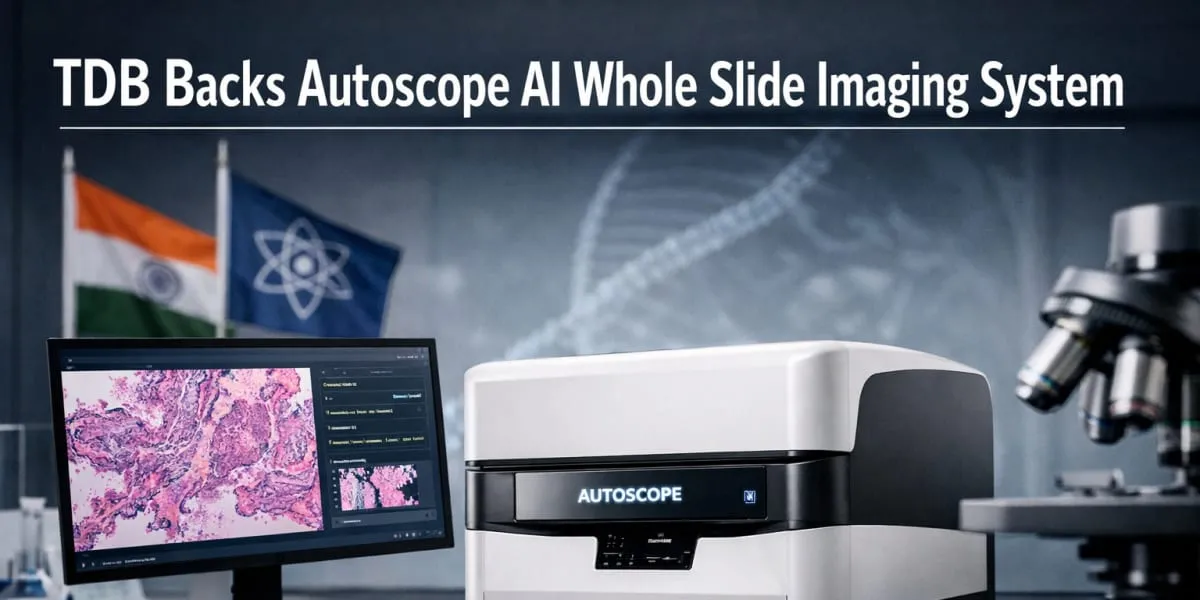
The Technology Development Board (TDB) of the Department of Science and Technology (DST) has entered into an agreement with Ayukriyam Innovations Pvt. Ltd. to develop Autoscope, a fully automated whole slide imaging and artificial intelligence (AI) driven diagnostic system. The project is intended to promote deep?tech innovation and technological self?reliance in healthcare by translating laboratory research into marketable solutions. The assistance aims to reduce import dependence for high?end imaging systems and to support Aatmanirbhar Bharat objectives.

Ayukriyam Innovations Pvt. Ltd. is a deep?tech spin?off from the Molecular Imaging and Diagnostics Lab in the Department of Biochemical Engineering and Biotechnology at the Indian Institute of Technology Delhi (IIT Delhi). The company is focused on microscopy systems integrated with AI to enable rapid and deployable diagnosis of infectious diseases, particularly in resource?constrained settings. The developers are pursuing standardised, scalable workflows suitable for wider clinical adoption.

The Autoscope platform is being developed as a whole slide imaging system combined with AI driven image analytics to offer high throughput and standardised diagnostic workflows. The system seeks to enhance diagnostic accuracy while reducing dependence on imported equipment through indigenous research and development. Field performance evaluations are planned to assess clinical utility and operational scalability across diverse healthcare settings.

The sanctioned assistance from TDB will support establishment of a dedicated manufacturing facility, production of multiple product batches, and comprehensive field evaluations to prepare the platform for commercialisation. TDB reiterated its mandate to provide financial assistance for commercialisation of indigenous technologies developed through institutional research linkages and the Government underlined continued commitment to innovation?led growth in healthcare. The Secretary of TDB indicated that indigenous development of integrated imaging and AI platforms is vital for strengthening healthcare infrastructure, and the promoters of Ayukriyam conveyed that the support would accelerate manufacturing readiness and field deployment.

The Technology Development Board (TDB) of the Department of Science and Technology (DST) has entered into an agreement with Ayukriyam Innovations Pvt. Ltd. to develop Autoscope, a fully automated whole slide imaging and artificial intelligence (AI) driven diagnostic system. The project is intended to promote deep?tech innovation and technological self?reliance in healthcare by translating laboratory research into marketable solutions. The assistance aims to reduce import dependence for high?end imaging systems and to support Aatmanirbhar Bharat objectives. Ayukriyam Innovations Pvt. Ltd. is a deep?tech spin?off from the Molecular Imaging and Diagnostics Lab in the Department of Biochemical Engineering and Biotechnology at the Indian Institute of Technology Delhi (IIT Delhi). The company is focused on microscopy systems integrated with AI to enable rapid and deployable diagnosis of infectious diseases, particularly in resource?constrained settings. The developers are pursuing standardised, scalable workflows suitable for wider clinical adoption. The Autoscope platform is being developed as a whole slide imaging system combined with AI driven image analytics to offer high throughput and standardised diagnostic workflows. The system seeks to enhance diagnostic accuracy while reducing dependence on imported equipment through indigenous research and development. Field performance evaluations are planned to assess clinical utility and operational scalability across diverse healthcare settings. The sanctioned assistance from TDB will support establishment of a dedicated manufacturing facility, production of multiple product batches, and comprehensive field evaluations to prepare the platform for commercialisation. TDB reiterated its mandate to provide financial assistance for commercialisation of indigenous technologies developed through institutional research linkages and the Government underlined continued commitment to innovation?led growth in healthcare. The Secretary of TDB indicated that indigenous development of integrated imaging and AI platforms is vital for strengthening healthcare infrastructure, and the promoters of Ayukriyam conveyed that the support would accelerate manufacturing readiness and field deployment.

Next Story
Infrastructure Urban

Implementation Status of Jal Jeevan Mission

Since August 2019 the Government has implemented Jal Jeevan Mission to provide assured potable water through household tap connections in rural India. At the start of the mission only 32.3 million (mn) rural households, representing 16.7 per cent, were reported to have tap water connections. States and union territories have reported that 125.8 mn additional rural households have since been provided with tap connections. As a result, of about 193.6 mn rural households roughly 158.2 mn, or 81.71 per cent, are reported to have tap water supply at home.\n\nThe State, district and village level st..

Next Story
Infrastructure Urban

Jal Jeevan Mission Reaches Eighty One Per Cent Rural Coverage

The Government reported substantial progress under the Jal Jeevan Mission, launched in August 2019 to provide tap water to every rural household. At launch only 32.3 million (mn) rural households had tap connections and states and Union territories reported provision of 125.8 mn additional households by March 2026. Consequently, out of about 193.6 mn rural households around 158.2 mn, or 81.71 per cent, are reported to have tap water at home. The Finance Minister announced extension of the mission until 2028 in the 2025-26 budget speech. The Swachh Bharat Mission Grameen, launched in October 20..

Next Story
Infrastructure Urban

Empowering Local Governance for Sustainable Rural Water Supply

The Ministry of Jal Shakti has aligned the Jal Jeevan Mission (JJM) with the 73rd Amendment to strengthen village level planning and community ownership of water supply. Gram Panchayats, village water and sanitation committees and Pani Samitis are to plan, implement, manage and maintain piped water systems, with gram sabha processes formalising handover and oversight. Implementation support agencies including non government organisations, community based organisations and self help groups have been empanelled to train local committees and promote women participation. Under JJM, the department ..

Advertisement

Subscribe to Our Newsletter

Get daily newsletters around different themes from Construction world.

STAY CONNECTED

Advertisement

Advertisement

Advertisement