ALEMAI Launches ‘Aluminium Bharat’, Urges Policy Support
ECONOMY & POLICY

ALEMAI Launches ‘Aluminium Bharat’, Urges Policy Support

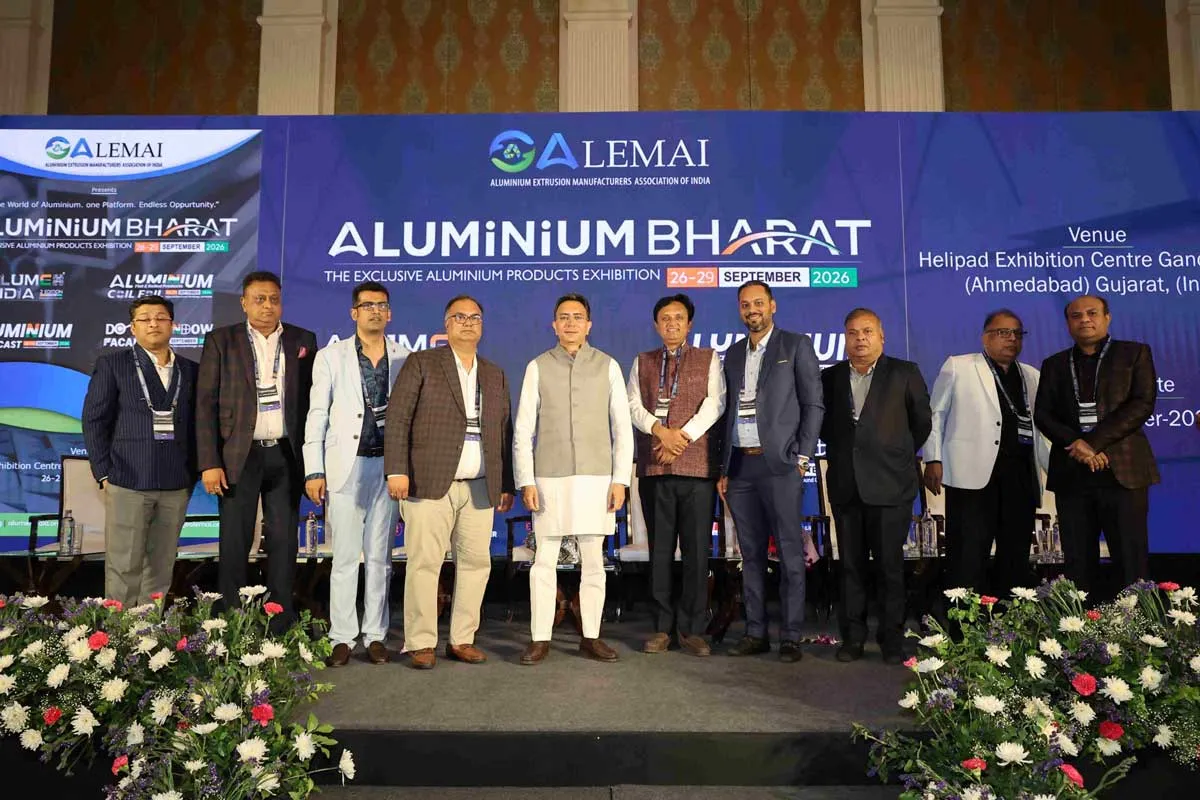
The Aluminium Extrusion Manufacturers Association of India (ALEMAI) launched the ‘Aluminium Bharat’ initiative on April 7, 2026, in New Delhi. The initiative, formally unveiled by Shri Jitin Prasada, Minister of State for Commerce and Industry, aims to strengthen India’s aluminum ecosystem by addressing both domestic and global challenges impacting the sector.

‘Aluminium Bharat’ will bring together policymakers, industry leaders, and global stakeholders to co-create a roadmap for sustainable growth. The initiative also includes ‘Aluminium Bharat 2026,’ India’s first comprehensive exhibition for the aluminum value chain, scheduled for September 26–29, 2026, in Gandhinagar, Gujarat. This exhibition will position India alongside global platforms like Aluminum China and Aluminum Düsseldorf, showcasing primary and downstream aluminum products.

Shri Prasada emphasized the need to build resilient domestic manufacturing capabilities, saying, “The initiative, ‘Aluminium Bharat,’ is a statement of intent that India will move up the global value chain in aluminium manufacturing. We are committed to making Bharat a global hub for high-value aluminium products.”

Mr. Jitendra Chopra, President of ALEMAI, highlighted the severe contraction in India’s midstream and downstream aluminium sectors, with production dropping by 40–50%. The sector is operating under stress, with utilization significantly below potential despite a strong installed capacity of 4.2 million tonnes.

The industry faces challenges, including rising raw material and energy costs, exacerbated by geopolitical tensions in West Asia, impacting energy-intensive industries like aluminum. The limited availability of aluminium scrap, high input costs, and the influx of low-cost imports are eroding India’s competitiveness.

The aluminium value chain supports over 10 lakh jobs in India, and strengthening the downstream sector is essential for advancing India’s $5 trillion economy and ‘Viksit Bharat 2047’ vision. Additionally, aluminium’s role in India’s circular economy and sustainability goals underscores its importance in the country's decarbonization and Net-Zero targets.

The Aluminium Extrusion Manufacturers Association of India (ALEMAI) launched the ‘Aluminium Bharat’ initiative on April 7, 2026, in New Delhi. The initiative, formally unveiled by Shri Jitin Prasada, Minister of State for Commerce and Industry, aims to strengthen India’s aluminum ecosystem by addressing both domestic and global challenges impacting the sector.‘Aluminium Bharat’ will bring together policymakers, industry leaders, and global stakeholders to co-create a roadmap for sustainable growth. The initiative also includes ‘Aluminium Bharat 2026,’ India’s first comprehensive exhibition for the aluminum value chain, scheduled for September 26–29, 2026, in Gandhinagar, Gujarat. This exhibition will position India alongside global platforms like Aluminum China and Aluminum Düsseldorf, showcasing primary and downstream aluminum products.Shri Prasada emphasized the need to build resilient domestic manufacturing capabilities, saying, “The initiative, ‘Aluminium Bharat,’ is a statement of intent that India will move up the global value chain in aluminium manufacturing. We are committed to making Bharat a global hub for high-value aluminium products.”Mr. Jitendra Chopra, President of ALEMAI, highlighted the severe contraction in India’s midstream and downstream aluminium sectors, with production dropping by 40–50%. The sector is operating under stress, with utilization significantly below potential despite a strong installed capacity of 4.2 million tonnes.The industry faces challenges, including rising raw material and energy costs, exacerbated by geopolitical tensions in West Asia, impacting energy-intensive industries like aluminum. The limited availability of aluminium scrap, high input costs, and the influx of low-cost imports are eroding India’s competitiveness.The aluminium value chain supports over 10 lakh jobs in India, and strengthening the downstream sector is essential for advancing India’s $5 trillion economy and ‘Viksit Bharat 2047’ vision. Additionally, aluminium’s role in India’s circular economy and sustainability goals underscores its importance in the country's decarbonization and Net-Zero targets.

Next Story
Infrastructure Energy

India Adds Record 44.61 GW Solar Capacity in FY2026

India’s solar sector reached a milestone in FY2026, with cumulative installed capacity crossing 150 GW and annual additions hitting a record 44.61 GW, exceeding the government target of 34 GW and nearly doubling FY2025’s 23.83 GW. Distributed Renewable Energy contributed 16.3 GW, while PPA and C&I segments accounted for 34 per cent and 30 per cent, respectively.India has risen from 9th globally in 2015 to 3rd in cumulative solar capacity by 2025 and is set to become the world’s second-largest solar market in annual installations in 2026. Seven states, led by Rajasthan and Gujarat, ac..

Next Story
Real Estate

Abhee Ventures unveils Scottish-themed 45-acre township in Bengaluru

Abhee Ventures, a leading South Indian real estate developer, has announced “Codename New Dimension,” a 45-acre Scottish-themed residential township at Gunjur on Whitefield–Sarjapur Road, Bengaluru. Strategically located between Whitefield and Sarjapur Road, Gunjur benefits from strong connectivity to the Outer Ring Road IT corridor, ITPL, EPIP, the upcoming Dommasandra Metro Station, and the proposed SWIFT City and Peripheral Ring Road.The township, designed in collaboration with London-based UHA London and India’s RSP Architects, offers low-density living with 85 per cent open spaces..

Next Story
Infrastructure Urban

BPE launches world’s thinnest Active Tile for legacy data centres

Best Power Equipments (India) Pvt Ltd (BPE), a leading provider of power solutions, data centre systems, and Battery Energy Storage Systems (BESS), has launched the BPE Active Tile, the world’s thinnest active tile designed for legacy data centres and telecom infrastructure. At just 65 mm thick, the tile requires significantly less space than conventional active tiles, which need nearly 450 mm floor depth.“Most legacy data centres were built decades ago for lower IT loads and traditional airflow patterns,” said A Prabhu, Executive Director – Technical (Global Operations), BPE. “As ra..

Advertisement

Subscribe to Our Newsletter

Get daily newsletters around different themes from Construction world.

STAY CONNECTED

Advertisement

Advertisement

Advertisement