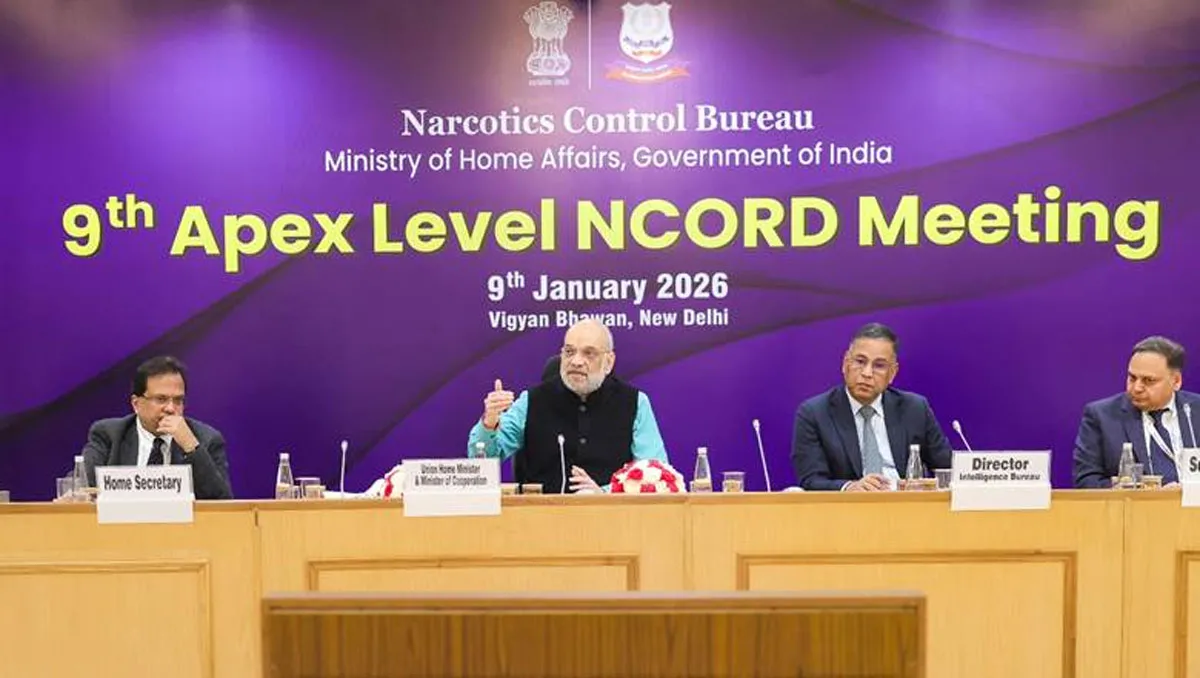
Amit Shah Chairs 9th NCORD Meet, Launches NCB Office
ECONOMY & POLICY

Amit Shah Chairs 9th NCORD Meet, Launches NCB Office

Union Home Minister and Minister of Cooperation Shri Amit Shah recently chaired the 9th Apex-Level Meeting of the Narco-Coordination Centre (NCORD) in New Delhi and inaugurated the Narcotics Control Bureau’s office in Amritsar. The hybrid meeting, organised by the NCB, was attended by central ministries, state governments and drug law enforcement agencies.

Addressing the meeting, Shri Shah said all departments of the Government of India must prepare a roadmap up to 2029 with a robust monitoring mechanism, stressing that the drug menace is more closely linked to narco-terrorism than to routine law and order issues. He announced that from March 31, 2026, a three-year nationwide campaign will be undertaken to fight drugs on all fronts with defined targets and time-bound reviews.

The Home Minister said that under the leadership of Prime Minister Shri Narendra Modi, significant progress has been made in the past 11 years, particularly after the reorganisation of NCORD in 2019. He underlined a three-pronged approach comprising a ruthless strategy to break the drug supply chain, a strategic approach to reduce demand and a humane approach towards harm reduction.

Highlighting enforcement outcomes, Shri Shah said that during 2004–2013, drugs worth Rs 400 billion, amounting to 2.6 million kilograms, were seized, while between 2014 and 2025, seizures rose to Rs 1.7 trillion, totalling 111 trillion kilograms. He added that action against synthetic drugs has improved and the quantity of drugs disposed of has increased eleven-fold.

Shri Shah directed all departments and state police forces to strengthen command, compliance and accountability, focus on kingpins and logistics routes, improve conviction rates through timely charge sheets and forensic support, and ensure faster destruction of seized drugs to achieve the goal of a drug-free India.

Union Home Minister and Minister of Cooperation Shri Amit Shah recently chaired the 9th Apex-Level Meeting of the Narco-Coordination Centre (NCORD) in New Delhi and inaugurated the Narcotics Control Bureau’s office in Amritsar. The hybrid meeting, organised by the NCB, was attended by central ministries, state governments and drug law enforcement agencies. Addressing the meeting, Shri Shah said all departments of the Government of India must prepare a roadmap up to 2029 with a robust monitoring mechanism, stressing that the drug menace is more closely linked to narco-terrorism than to routine law and order issues. He announced that from March 31, 2026, a three-year nationwide campaign will be undertaken to fight drugs on all fronts with defined targets and time-bound reviews. The Home Minister said that under the leadership of Prime Minister Shri Narendra Modi, significant progress has been made in the past 11 years, particularly after the reorganisation of NCORD in 2019. He underlined a three-pronged approach comprising a ruthless strategy to break the drug supply chain, a strategic approach to reduce demand and a humane approach towards harm reduction. Highlighting enforcement outcomes, Shri Shah said that during 2004–2013, drugs worth Rs 400 billion, amounting to 2.6 million kilograms, were seized, while between 2014 and 2025, seizures rose to Rs 1.7 trillion, totalling 111 trillion kilograms. He added that action against synthetic drugs has improved and the quantity of drugs disposed of has increased eleven-fold. Shri Shah directed all departments and state police forces to strengthen command, compliance and accountability, focus on kingpins and logistics routes, improve conviction rates through timely charge sheets and forensic support, and ensure faster destruction of seized drugs to achieve the goal of a drug-free India.

Next Story
Real Estate

Union Budge: Infra-Led Urban Shift

The Union Budget FY27 reinforces infrastructure-led urbanisation as the backbone of India’s real estate and housing growth. Higher public capital expenditure, City Economic Regions, risk-mitigation mechanisms and REIT-led asset monetisation are being widely viewed as long-term enablers, even as the industry continues to seek sharper supply-side reforms and affordability-focused measures. Here are a few industry insights:Dr Niranjan Hiranandani, Chairman, NAREDCO & Hiranandani Group“The Union Budget 2026-27 is growth-oriented and stability-focused, supporting consumption and aiming to s..

Next Story
Infrastructure Urban

Budget 2026 Charts Path for Infrastructure-Led, Tech-Driven Growth

The Union Budget 2026–27 signals strong continuity in India’s macroeconomic strategy, anchored in elevated public capital expenditure, fiscal discipline, and a sharper focus on manufacturing, infrastructure, and regional development. With capital outlay pegged at ₹12.2 lakh crore and a fiscal deficit target of around 4.3 per cent, the Budget balances growth ambition with stability, offering long-term visibility to investors and project developers.A dominant theme is the centrality of infrastructure as a multiplier for economic expansion. Public capex now accounts for over 3.3 per cent of..

Next Story
Infrastructure Energy

Tata Power Arm Crosses 10 GW EPC Milestone

Tata Power Renewable Energy Ltd (TPREL) has achieved a major milestone by executing 10 gigawatts of engineering, procurement and construction (EPC) renewable energy projects to date, reinforcing its position in India’s clean energy infrastructure sector. According to the company, the executed portfolio comprises 4.2 gigawatts of in-house projects and 5.8 gigawatts of third-party projects. Of the total 10 gigawatts commissioned so far, 9.7 gigawatts are solar projects and 290 megawatts are wind projects. In the first nine months of FY26, TPREL commissioned 1.88 gigawatts of EPC renewable en..

Advertisement

Subscribe to Our Newsletter

Get daily newsletters around different themes from Construction world.

STAY CONNECTED

Advertisement

Advertisement

Advertisement

Advertisement

Open In App