+
Arunachal Signs MoU With Norwegian Firm For River Kinetic Demo
ECONOMY & POLICY

Arunachal Signs MoU With Norwegian Firm For River Kinetic Demo

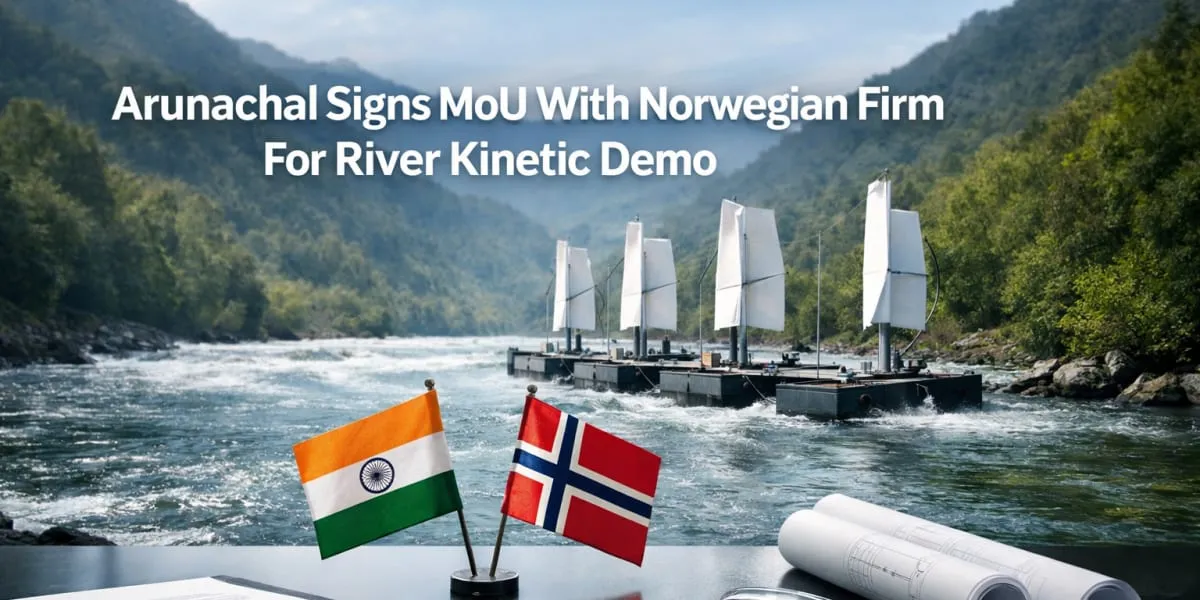
Arunachal Pradesh on 14 July signed a memorandum of understanding with Norway's Tidal Sail AS to implement a 500 kilowatt (kW) river kinetic energy demonstration project intended as India's first such plant. The agreement was signed between the Centre for Earth Sciences and Himalayan Studies (CES&HS), Government of Arunachal Pradesh (GoAP), and Tidal Sail AS under the India?Norway Green Partnership. The initiative is supported by the Ministry of New and Renewable Energy (MNRE), Government of India (GoI), and Innovation Norway.

The project will demonstrate technology that generates electricity directly from river currents without major civil infrastructure and aims to provide an environmentally sustainable, cost effective renewable option. Science and Technology Minister Dasanglu Pul described the agreement as a milestone in the state's clean energy transition and said the partnership reflects a shared commitment to innovation and international cooperation. She noted the state's extensive river systems offer substantial renewable potential and expressed confidence the project will strengthen energy security while ensuring responsible utilisation of natural resources.

Norwegian Ambassador to India May?Elin Stener said Arunachal's rivers make it a suitable location for the demonstration and that the project is expected to complement existing renewable sources and enhance long term energy security. Centre for Earth Sciences and Himalayan Studies director Tana Tage said the demonstration will diversify the state's renewable portfolio and explore decentralised power generation for remote regions. He added that successful implementation may reduce reliance on fossil fuels, lower carbon emissions and help preserve river ecosystems while positioning Arunachal as a leader in next generation renewable innovation.

Officials said the MoU marks a new phase in India?Norway cooperation and is expected to facilitate deployment of river kinetic energy technologies across Himalayan systems, contributing to sustainable development and long term energy security in the state. The minister thanked MNRE, the Ministry of External Affairs, the Royal Norwegian Embassy, Innovation Norway, Tidal Sail AS and partner institutions for support. CES&HS noted expanding collaboration with Norwegian bodies including the Norwegian Geotechnical Institute in areas such as geothermal energy and sustainable infrastructure.

Arunachal Pradesh on 14 July signed a memorandum of understanding with Norway's Tidal Sail AS to implement a 500 kilowatt (kW) river kinetic energy demonstration project intended as India's first such plant. The agreement was signed between the Centre for Earth Sciences and Himalayan Studies (CES&HS), Government of Arunachal Pradesh (GoAP), and Tidal Sail AS under the India?Norway Green Partnership. The initiative is supported by the Ministry of New and Renewable Energy (MNRE), Government of India (GoI), and Innovation Norway. The project will demonstrate technology that generates electricity directly from river currents without major civil infrastructure and aims to provide an environmentally sustainable, cost effective renewable option. Science and Technology Minister Dasanglu Pul described the agreement as a milestone in the state's clean energy transition and said the partnership reflects a shared commitment to innovation and international cooperation. She noted the state's extensive river systems offer substantial renewable potential and expressed confidence the project will strengthen energy security while ensuring responsible utilisation of natural resources. Norwegian Ambassador to India May?Elin Stener said Arunachal's rivers make it a suitable location for the demonstration and that the project is expected to complement existing renewable sources and enhance long term energy security. Centre for Earth Sciences and Himalayan Studies director Tana Tage said the demonstration will diversify the state's renewable portfolio and explore decentralised power generation for remote regions. He added that successful implementation may reduce reliance on fossil fuels, lower carbon emissions and help preserve river ecosystems while positioning Arunachal as a leader in next generation renewable innovation. Officials said the MoU marks a new phase in India?Norway cooperation and is expected to facilitate deployment of river kinetic energy technologies across Himalayan systems, contributing to sustainable development and long term energy security in the state. The minister thanked MNRE, the Ministry of External Affairs, the Royal Norwegian Embassy, Innovation Norway, Tidal Sail AS and partner institutions for support. CES&HS noted expanding collaboration with Norwegian bodies including the Norwegian Geotechnical Institute in areas such as geothermal energy and sustainable infrastructure.

Related Stories

Gold Stories

Next Story
Infrastructure Urban

Infrastructure Opportunity Outlook by IMPACCT.Info

India’s infrastructure pipeline is witnessing dynamic activity across stages — from immediate bidding to future planning. IMPACCT segments these into three categories: Immediate, 3–6 Month, and Future Opportunities, enabling businesses to identify, prepare, and participate in high-value tenders and projects across sectors.To read full article Click Here ..

Next Story
Real Estate

Glass, Reframed!

Glass façades, quintessential aesthetic building envelopes globally, have been widely adopted in India as well. But when the focus is high-performance building systems that deliver energy efficiency, comfort and architectural identity, glass isn’t the only preference. Combination solutions, involving glass and some other material, improve façade outcomes. Some combinations come at comparable prices, some at a higher price. Here is a selection of performance-oriented solutions...To read the full story Click Here ..

Next Story
Infrastructure Urban

Beyond Building Faster

India’s cities are expanding at an unprecedented pace, bringing new infrastructure and development opportunities while also intensifying challenges around mobility, public spaces, liveability and supporting infrastructure. The question, therefore, is not simply whether India can build faster, but whether it can build cities that work better.At a CW webinar, Are We Designing Better Cities – or Just Building Faster?, moderator Ar. Samir Shaikh, Founding Principal, AR&UD Studio, brought together perspectives from design, development, master planning and technology...To read the full artic..

Advertisement

Subscribe to Our Newsletter

Get daily newsletters around different themes from Construction world.

STAY CONNECTED

Advertisement

SPECIAL OFFER
QR Code