Arunachal Approves Rs. 22.05 bn Road Plan for 126 Villages
ROADS & HIGHWAYS

Arunachal Approves Rs. 22.05 bn Road Plan for 126 Villages

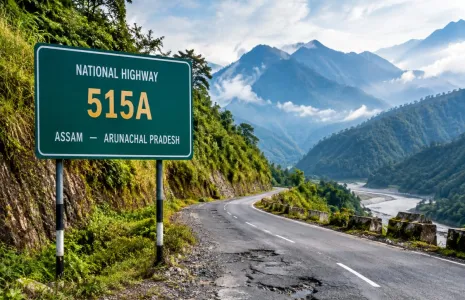
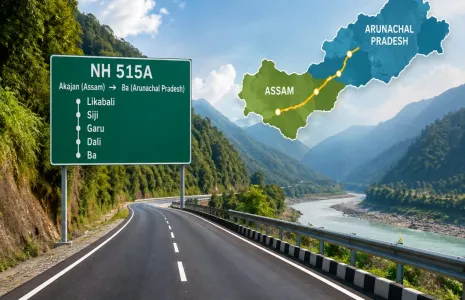
Arunachal Pradesh has approved a road connectivity plan worth Rs. 22.05 bn to connect 126 border villages under the Centre’s Vibrant Villages Programme. The State Cabinet said the projects would cover 1,022 km of roads across strategically important frontier areas.

The Cabinet release said 455 villages across 11 districts had been selected under Phase I of the programme. A further 122 villages along the Myanmar and Bhutan borders have been included in Phase II, extending the initiative beyond settlements covered under the initial phase.

The road projects are intended to improve access to healthcare, education, markets, government services and economic opportunities in remote communities. Better connectivity is also expected to assist the movement of agricultural produce and essential supplies while supporting tourism, local enterprises and other livelihood activities.

The Vibrant Villages Programme-I was approved by the Union Government in February 2023 and covers selected settlements along India’s northern border in Arunachal Pradesh, Himachal Pradesh, Sikkim, Uttarakhand and Ladakh. Its areas of intervention include village infrastructure, livelihood generation, tourism, cultural heritage, skill development, agriculture and allied activities, energy, education, healthcare and telecommunications.

The Union Government describes VVP-II as a separate Central Sector Scheme for selected villages along international land borders other than the northern border covered by VVP-I. Arunachal Pradesh shares international borders with China, Bhutan and Myanmar, making reliable road access important for connecting frontier communities with the wider state.

The Cabinet release did not provide a village-wise list of the 126 villages, individual completion dates or a detailed implementation schedule for the 122 villages included in Phase II. The eventual impact of the programme will depend on project execution, road maintenance and whether improved connectivity leads to lasting gains in public services, livelihoods and living conditions.

Arunachal Pradesh has approved a road connectivity plan worth Rs. 22.05 bn to connect 126 border villages under the Centre’s Vibrant Villages Programme. The State Cabinet said the projects would cover 1,022 km of roads across strategically important frontier areas. The Cabinet release said 455 villages across 11 districts had been selected under Phase I of the programme. A further 122 villages along the Myanmar and Bhutan borders have been included in Phase II, extending the initiative beyond settlements covered under the initial phase. The road projects are intended to improve access to healthcare, education, markets, government services and economic opportunities in remote communities. Better connectivity is also expected to assist the movement of agricultural produce and essential supplies while supporting tourism, local enterprises and other livelihood activities. The Vibrant Villages Programme-I was approved by the Union Government in February 2023 and covers selected settlements along India’s northern border in Arunachal Pradesh, Himachal Pradesh, Sikkim, Uttarakhand and Ladakh. Its areas of intervention include village infrastructure, livelihood generation, tourism, cultural heritage, skill development, agriculture and allied activities, energy, education, healthcare and telecommunications. The Union Government describes VVP-II as a separate Central Sector Scheme for selected villages along international land borders other than the northern border covered by VVP-I. Arunachal Pradesh shares international borders with China, Bhutan and Myanmar, making reliable road access important for connecting frontier communities with the wider state. The Cabinet release did not provide a village-wise list of the 126 villages, individual completion dates or a detailed implementation schedule for the 122 villages included in Phase II. The eventual impact of the programme will depend on project execution, road maintenance and whether improved connectivity leads to lasting gains in public services, livelihoods and living conditions.

Related Stories

Gold Stories

Next Story
Infrastructure Energy

DMRC Invites Bids for Solar-Linked BESS Power Procurement

Delhi Metro Rail Corporation (DMRC) has invited bids for renewable energy from an Inter-State Transmission System (ISTS)-connected generating plant combining a solar photovoltaic (PV) system with a co-located Battery Energy Storage System (BESS). The procurement will be conducted through competitive bidding followed by an e-reverse auction. The last date for submitting online bids is December 10, 2026, at 3 PM. DMRC will open the technical bids on December 11, 2026, at 3 PM. The opening of financial bids and the e-reverse auction will be scheduled after completion of the technical evaluation. ..

Next Story
Infrastructure Energy

Solar Growth May Slow Beyond FY28 on Awards, Grid Constraints

India’s solar capacity growth could face headwinds beyond FY28 as slower renewable energy project awards, delays in signing power agreements and transmission constraints threaten expansion, according to a report by Yes Securities. Near-term additions remain supported by a construction pipeline exceeding 150 GW and rising rooftop installations, but weaker award activity could affect capacity additions and industry volumes in FY29 and FY30. Solar capacity additions nearly doubled to 44.61 GW in FY26 from 23.83 GW in FY25. Installations remained strong in the first half of FY27, when 21 GW of s..

Next Story
Infrastructure Transport

India’s First High-Speed Rail Service to Begin in 2027

India’s first high-speed rail service will commence in 2027, with the Surat-Vapi section of the Mumbai-Ahmedabad High-Speed Rail corridor scheduled to open first, Railway Minister Ashwini Vaishnaw said. The remaining sections to Mumbai will be opened in phases. Vaishnaw said 456 km of pier work and 371 km of viaduct construction had been completed by September. About 600,000 noise barriers had been installed along a 299 km stretch, while 9,300 overhead equipment masts had been erected across a 206 km viaduct. Four mountain tunnels have been excavated, and 5 km of the 21 km Maharashtra tunnel..

Advertisement

Subscribe to Our Newsletter

Get daily newsletters around different themes from Construction world.

STAY CONNECTED

Advertisement

SPECIAL OFFER
QR Code