+
Auto PLI Drives Domestic e2W Growth, Raises Export Concerns
ECONOMY & POLICY

Auto PLI Drives Domestic e2W Growth, Raises Export Concerns

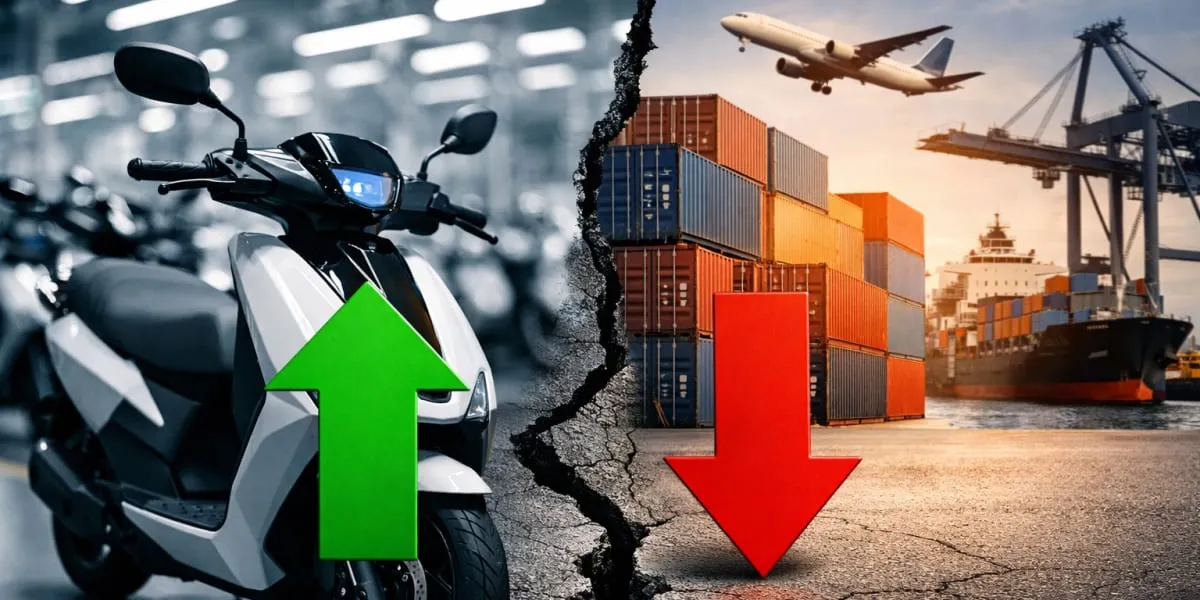
The Centre for Digital Economy Policy Research reported that the auto production-linked incentive scheme has accelerated production scale among approved electric two-wheeler manufacturers but has materially altered competitive dynamics, with the cost advantage largely used to capture domestic market share rather than to build export-ready platforms. The think tank warned that the current design favours scale at the expense of innovation and may marginalise companies that invested heavily in early technological development.

The report found that non-PLI electric two-wheeler manufacturers experienced a sharp market contraction, with growth falling from 407 per cent in FY22 to minus 33 per cent in FY24 and further to minus 11 per cent in FY25 following the rollout of the scheme. It noted that PLI-approved original equipment manufacturers benefit from an estimated 13-16 per cent cost advantage, enabling more aggressive pricing strategies and faster capacity expansion that have distorted market structure.

The analysis highlighted a stark contrast in export performance, with 77 per cent of India's electric two-wheeler exports driven by non-PLI models and PLI-approved models accounting for less than one-fourth of total exports despite the cost edge. The centre cautioned that a policy focus solely on scaling production risks undermining long-term competitiveness and could lead to the loss of key traditional export markets such as Nepal and parts of Latin America and Africa to Chinese manufacturers like Yadea and Sunra.

The report recorded that by December 2025 only Rs 23,219.4 mn had been disbursed against a cumulative target of Rs 37,540 mn, with only nine per cent of the total outlay disbursed against an expected 14.47 per cent. It recommended opening a targeted window for innovation-led original equipment manufacturers that demonstrate strong localisation depth by complying with the PM E-DRIVE Phased Manufacturing Programme, adopting a first-come-first-serve mechanism to prevent inactive players from hoarding approvals and fiscal space, and conducting periodic performance reviews to exit non-performing beneficiaries and reallocate fiscal space.

The Centre for Digital Economy Policy Research reported that the auto production-linked incentive scheme has accelerated production scale among approved electric two-wheeler manufacturers but has materially altered competitive dynamics, with the cost advantage largely used to capture domestic market share rather than to build export-ready platforms. The think tank warned that the current design favours scale at the expense of innovation and may marginalise companies that invested heavily in early technological development. The report found that non-PLI electric two-wheeler manufacturers experienced a sharp market contraction, with growth falling from 407 per cent in FY22 to minus 33 per cent in FY24 and further to minus 11 per cent in FY25 following the rollout of the scheme. It noted that PLI-approved original equipment manufacturers benefit from an estimated 13-16 per cent cost advantage, enabling more aggressive pricing strategies and faster capacity expansion that have distorted market structure. The analysis highlighted a stark contrast in export performance, with 77 per cent of India's electric two-wheeler exports driven by non-PLI models and PLI-approved models accounting for less than one-fourth of total exports despite the cost edge. The centre cautioned that a policy focus solely on scaling production risks undermining long-term competitiveness and could lead to the loss of key traditional export markets such as Nepal and parts of Latin America and Africa to Chinese manufacturers like Yadea and Sunra. The report recorded that by December 2025 only Rs 23,219.4 mn had been disbursed against a cumulative target of Rs 37,540 mn, with only nine per cent of the total outlay disbursed against an expected 14.47 per cent. It recommended opening a targeted window for innovation-led original equipment manufacturers that demonstrate strong localisation depth by complying with the PM E-DRIVE Phased Manufacturing Programme, adopting a first-come-first-serve mechanism to prevent inactive players from hoarding approvals and fiscal space, and conducting periodic performance reviews to exit non-performing beneficiaries and reallocate fiscal space.

Next Story
Building Material

Operational Excellence Redefined!

Operational excellence in cement has moved far beyond the old pursuit of ‘more tonne’. The new benchmark is smarter, cleaner, more reliable production—delivered with discipline across process, people and data. In an industry where energy can account for nearly 30 per cent of manufacturing cost, even marginal gains translate into meaningful value. As Dr SB Hegde, Professor, Jain College of Engineering & Technology, Hubli and Visiting Professor, Pennsylvania State University, USA, puts it, “Operational excellence… is no longer about producing more. It is about producing smarter, cleane..

Next Story
Infrastructure Urban

CMC Reviews State Progress on Polluted Rivers and Sewage Management

The 21st meeting of the Central Monitoring Committee (CMC) on river rejuvenation was held under the chairpersonship of Shri V. L. Kantha Rao, Secretary of the Department of Water Resources, River Development and Ganga Rejuvenation in the Ministry of Jal Shakti. The meeting was attended by senior officials including the Director General of the National Mission for Clean Ganga (NMCG) and representatives of state governments and state pollution control boards. The committee reviewed the latest status of polluted river stretches based on the Central Pollution Control Board (CPCB) 2025 report and e..

Next Story
Infrastructure Urban

India Proposes Biomanufacturing Working Group With Delaware

Union Minister for Science and Technology Dr Jitendra Singh proposed a small India–Delaware biomanufacturing working group to convert discussions into collaborations in research, manufacturing and startup ecosystems. The proposal was made during his meeting with a visiting US delegation led by Delaware Governor Matt Meyer at Seva Teerth. Both sides focused on bilateral collaboration in pharma, biotechnology, clean energy and innovation-led industrial growth. The minister said science, technology and biotechnology are a key pillar of the India–US strategic partnership and that India seeks d..

Advertisement

Subscribe to Our Newsletter

Get daily newsletters around different themes from Construction world.

STAY CONNECTED

Advertisement

Advertisement

Advertisement

Open In App