BHASHINI, NHA Sign MoU to Enable Multilingual Digital Health
ECONOMY & POLICY

BHASHINI, NHA Sign MoU to Enable Multilingual Digital Health

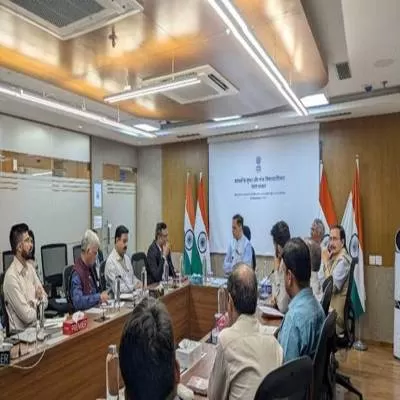
The Digital India BHASHINI Division (DIBD) under the Ministry of Electronics and Information Technology participated recently in the Chintan Shivir – National Review of Ayushman Bharat Pradhan Mantri Jan Arogya Yojana (AB PM-JAY) and Ayushman Bharat Digital Mission (ABDM), held on 19 January 2026 in Bhubaneswar, Odisha. 
The review was organised by the National Health Authority (NHA) and brought together senior officials from the Union and State Governments, technical institutions and implementing agencies to assess progress and strengthen the adoption of digital health initiatives nationwide.
A key highlight of the first day was the signing of a Memorandum of Understanding between the National Health Authority and the Digital India BHASHINI Division to enable multilingual translation services and AI-powered language support across NHA’s digital health platforms, including AB PM-JAY and ABDM. 
The MoU was exchanged during the inaugural session in the presence of senior leadership from the Government of Odisha, NHA and partner institutions.
Under the collaboration, BHASHINI’s language technologies—covering translation APIs, speech recognition and text-to-speech tools—will be integrated into beneficiary-facing and administrative applications. 
This is expected to improve last-mile service delivery, enhance citizen engagement and ensure digital health platforms are accessible across linguistic and geographic boundaries.
The national review meeting opened with a welcome address by the Secretary, Health, Government of Odisha, followed by remarks from the Chief Executive Officer, National Health Authority. Mukesh Mahaling, Minister for Health, Government of Odisha, attended as Chief Guest.
The session also marked the launch of the Health Benefit Package Manual and a compendium of best practices under AB PM-JAY, along with the exchange of MoUs with partner institutions.
Amitabh Nag, CEO, Digital India BHASHINI Division, highlighted that as digital health systems scale across the country, the use of artificial intelligence becomes essential. He emphasised that AI solutions must be multilingual and voice-enabled to deliver meaningful public value in a linguistically diverse country like India, while also strengthening citizen engagement, grievance redressal and clinical documentation.
During the deliberations, Kiran Gopal Vaska, Joint Secretary, ABDM, underlined the role of language AI in easing doctors’ time constraints through tools such as voice-to-text and natural language processing, enabling seamless patient–doctor interactions and automatic creation of electronic health records.
The MoU aligns with the Government of India’s broader vision of embedding Indian languages into Digital Public Infrastructure and advancing citizen-centric, AI-enabled governance in the healthcare sector.

The Digital India BHASHINI Division (DIBD) under the Ministry of Electronics and Information Technology participated recently in the Chintan Shivir – National Review of Ayushman Bharat Pradhan Mantri Jan Arogya Yojana (AB PM-JAY) and Ayushman Bharat Digital Mission (ABDM), held on 19 January 2026 in Bhubaneswar, Odisha. The review was organised by the National Health Authority (NHA) and brought together senior officials from the Union and State Governments, technical institutions and implementing agencies to assess progress and strengthen the adoption of digital health initiatives nationwide.A key highlight of the first day was the signing of a Memorandum of Understanding between the National Health Authority and the Digital India BHASHINI Division to enable multilingual translation services and AI-powered language support across NHA’s digital health platforms, including AB PM-JAY and ABDM. The MoU was exchanged during the inaugural session in the presence of senior leadership from the Government of Odisha, NHA and partner institutions.Under the collaboration, BHASHINI’s language technologies—covering translation APIs, speech recognition and text-to-speech tools—will be integrated into beneficiary-facing and administrative applications. This is expected to improve last-mile service delivery, enhance citizen engagement and ensure digital health platforms are accessible across linguistic and geographic boundaries.The national review meeting opened with a welcome address by the Secretary, Health, Government of Odisha, followed by remarks from the Chief Executive Officer, National Health Authority. Mukesh Mahaling, Minister for Health, Government of Odisha, attended as Chief Guest.The session also marked the launch of the Health Benefit Package Manual and a compendium of best practices under AB PM-JAY, along with the exchange of MoUs with partner institutions.Amitabh Nag, CEO, Digital India BHASHINI Division, highlighted that as digital health systems scale across the country, the use of artificial intelligence becomes essential. He emphasised that AI solutions must be multilingual and voice-enabled to deliver meaningful public value in a linguistically diverse country like India, while also strengthening citizen engagement, grievance redressal and clinical documentation.During the deliberations, Kiran Gopal Vaska, Joint Secretary, ABDM, underlined the role of language AI in easing doctors’ time constraints through tools such as voice-to-text and natural language processing, enabling seamless patient–doctor interactions and automatic creation of electronic health records.The MoU aligns with the Government of India’s broader vision of embedding Indian languages into Digital Public Infrastructure and advancing citizen-centric, AI-enabled governance in the healthcare sector.

Next Story
Infrastructure Transport

Namo Bharat Rapid Rail to Redefine Medium-Distance Intercity Travel

India’s urban and regional transport landscape has steadily evolved alongside rapid urbanisation, population growth and economic expansion. The foundation of this journey was laid with early suburban rail networks such as the Mumbai Suburban Railway, introduced in 1853, and tram systems in cities including Kolkata and Chennai. These were followed by modern rapid transit solutions to improve urban mobility, beginning with the Kolkata Metro in 1984 and later the Delhi Metro in 2002. Together, these systems transformed intra-city travel by offering safer, faster and more reliable connectivity w..

Next Story
Infrastructure Energy

ABB Dispatches First Locally Made Wind Power Converter in India

ABB has recently dispatched its first wind power converter manufactured in India, marking a key milestone following its acquisition of Gamesa Electric’s power electronics business in December 2025. The converter was produced at ABB’s state-of-the-art Nelamangala facility near Bengaluru and supplied to a wind turbine OEM, reinforcing the company’s strengthened focus on the wind energy segment. The dispatch reflects ABB’s strategy to integrate proven wind energy conversion technologies into its portfolio while supporting India’s ‘Make in India’ and ‘Atmanirbhar Bharat’ initiat..

Next Story
Real Estate

Trident Realty Launches Premium Integrated Township in Panipat

Trident Realty has recently announced the launch of Trident Parktown, a premium integrated township planned over approximately 125 acres in Sectors 19A and 40, Panipat. The project marks the developer’s strategic expansion into one of North India’s fast-evolving urban centres, supported by improving infrastructure and connectivity. The township involves a total investment of 12 billion and has been conceptualised as a balanced, future-ready development. Phase one will offer over 400 residential plots, with sizes starting from 200 sq yds. The overall master plan includes a mix of plotted d..

Advertisement

Subscribe to Our Newsletter

Get daily newsletters around different themes from Construction world.

STAY CONNECTED

Advertisement

Advertisement

Advertisement

Advertisement

Open In App