Bhupender Yadav Inaugurates Conference on Aravalli Eco-restoration
ECONOMY & POLICY

Bhupender Yadav Inaugurates Conference on Aravalli Eco-restoration

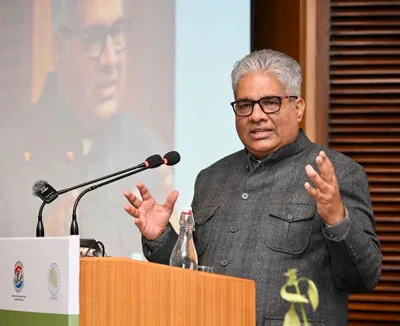
Bhupender Yadav, Union Minister for Environment, Forest and Climate Change, inaugurated the National Conference on Eco-restoration of the Aravalli Landscape: Strengthening the Aravalli Green Wall in New Delhi. On the occasion, the Minister also released a report titled Eco-restoration of the Aravalli Landscape, prepared by the Sankala Foundation.

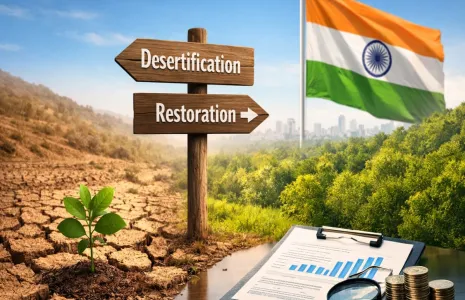
Addressing the conference, Bhupender Yadav, Union Minister for Environment, Forest and Climate Change, said the Aravalli Green Wall Project was launched in line with Prime Minister Narendra Modi’s vision and India’s commitment under the United Nations Convention to Combat Desertification (UNCCD) to restore 26 million hectares of degraded land. He said 6.45 million hectares of degraded land have been identified in the Aravalli region, with greening work initiated across 2.7 million hectares in Gujarat, Delhi, Haryana and Rajasthan.

The Minister noted that Divisional Forest Officers from 29 Aravalli districts are implementing the project, with a focus on plantation of native species suitable for arid and semi-arid conditions. Highlighting a major conservation decision, he said nearly 97 square kilometres of degraded Aravalli revenue land from Naurangpur to Nuh in Haryana has been identified for afforestation and declared a Protected Forest by the state government.

Emphasising the ecological and historical importance of the Aravallis, the Minister said the region, one of the world’s oldest mountain ranges, is safeguarded by four tiger reserves and 18 protected areas, alongside other green interventions. He added that India has emerged as a global leader in wildlife conservation and continues to balance ecological stability with economic aspirations.

The inaugural session was also addressed by Rao Narbir Singh, Environment Minister, Haryana; Tanmay Kumar, Secretary, Ministry of Environment, Forest and Climate Change; Sushil Kumar Awasthi, Director General of Forests; Rasmus Abildgaard Kristensen, Ambassador of Denmark to India; and representatives of the Sankala Foundation. The conference brought together policymakers, experts and civil society to deliberate on landscape-scale, community-driven restoration of the Aravalli range.

Bhupender Yadav, Union Minister for Environment, Forest and Climate Change, inaugurated the National Conference on Eco-restoration of the Aravalli Landscape: Strengthening the Aravalli Green Wall in New Delhi. On the occasion, the Minister also released a report titled Eco-restoration of the Aravalli Landscape, prepared by the Sankala Foundation.Addressing the conference, Bhupender Yadav, Union Minister for Environment, Forest and Climate Change, said the Aravalli Green Wall Project was launched in line with Prime Minister Narendra Modi’s vision and India’s commitment under the United Nations Convention to Combat Desertification (UNCCD) to restore 26 million hectares of degraded land. He said 6.45 million hectares of degraded land have been identified in the Aravalli region, with greening work initiated across 2.7 million hectares in Gujarat, Delhi, Haryana and Rajasthan.The Minister noted that Divisional Forest Officers from 29 Aravalli districts are implementing the project, with a focus on plantation of native species suitable for arid and semi-arid conditions. Highlighting a major conservation decision, he said nearly 97 square kilometres of degraded Aravalli revenue land from Naurangpur to Nuh in Haryana has been identified for afforestation and declared a Protected Forest by the state government.Emphasising the ecological and historical importance of the Aravallis, the Minister said the region, one of the world’s oldest mountain ranges, is safeguarded by four tiger reserves and 18 protected areas, alongside other green interventions. He added that India has emerged as a global leader in wildlife conservation and continues to balance ecological stability with economic aspirations.The inaugural session was also addressed by Rao Narbir Singh, Environment Minister, Haryana; Tanmay Kumar, Secretary, Ministry of Environment, Forest and Climate Change; Sushil Kumar Awasthi, Director General of Forests; Rasmus Abildgaard Kristensen, Ambassador of Denmark to India; and representatives of the Sankala Foundation. The conference brought together policymakers, experts and civil society to deliberate on landscape-scale, community-driven restoration of the Aravalli range.

Next Story
Infrastructure Urban

Implementation Status of Jal Jeevan Mission

Since August 2019 the Government has implemented Jal Jeevan Mission to provide assured potable water through household tap connections in rural India. At the start of the mission only 32.3 million (mn) rural households, representing 16.7 per cent, were reported to have tap water connections. States and union territories have reported that 125.8 mn additional rural households have since been provided with tap connections. As a result, of about 193.6 mn rural households roughly 158.2 mn, or 81.71 per cent, are reported to have tap water supply at home.\n\nThe State, district and village level st..

Next Story
Infrastructure Urban

Jal Jeevan Mission Reaches Eighty One Per Cent Rural Coverage

The Government reported substantial progress under the Jal Jeevan Mission, launched in August 2019 to provide tap water to every rural household. At launch only 32.3 million (mn) rural households had tap connections and states and Union territories reported provision of 125.8 mn additional households by March 2026. Consequently, out of about 193.6 mn rural households around 158.2 mn, or 81.71 per cent, are reported to have tap water at home. The Finance Minister announced extension of the mission until 2028 in the 2025-26 budget speech. The Swachh Bharat Mission Grameen, launched in October 20..

Next Story
Infrastructure Urban

Empowering Local Governance for Sustainable Rural Water Supply

The Ministry of Jal Shakti has aligned the Jal Jeevan Mission (JJM) with the 73rd Amendment to strengthen village level planning and community ownership of water supply. Gram Panchayats, village water and sanitation committees and Pani Samitis are to plan, implement, manage and maintain piped water systems, with gram sabha processes formalising handover and oversight. Implementation support agencies including non government organisations, community based organisations and self help groups have been empanelled to train local committees and promote women participation. Under JJM, the department ..

Advertisement

Subscribe to Our Newsletter

Get daily newsletters around different themes from Construction world.

STAY CONNECTED

Advertisement

Advertisement

Advertisement