Bihar Assembly Passes Rural Development Budget Demands
ECONOMY & POLICY

Bihar Assembly Passes Rural Development Budget Demands

The Bihar Assembly in Patna on Feb 17 approved the Rural Development Department's budgetary demands for the financial year 2026-27 totalling Rs 237.01 billion (bn). The allocation was presented as part of state budget discussions and secured passage after legislative consideration. The approval covers planned spending across housing and rural employment initiatives.\n\nRural Development and Transport Minister Shrawan Kumar replied to the debate and said the government is prioritising completion of houses for poor families while creating employment opportunities through various schemes. The department will focus on implementing existing programmes and coordinating with local authorities to ensure delivery of benefits. Administrative measures have been strengthened to monitor progress.\n\nOfficials noted that nearly two million (mn) people have applied online for houses under the Pradhan Mantri Awas Yojana. Based on surveys conducted as per directions of the Central government, officials prepared a list of about 10.4 million (mn) eligible beneficiaries for housing assistance. The compilation is intended to guide allocation of funds and prioritisation of construction work.\n\nOfficials said the department will use the approved budget to accelerate housing completion and support livelihoods through existing rural schemes while maintaining accountability in disbursement. Coordination with the Central government and local bodies will continue to verify beneficiary records and address discrepancies uncovered during surveys. The passage of the budgetary demands sets the fiscal framework for the department in the coming financial year.\n\nThe ministry highlighted that the volume of online applications required strengthening of digital verification systems and capacity building at the district level. Staff training and improved data management are being prioritised to reduce processing times and avoid duplication. These measures are expected to facilitate faster sanctioning of assistance and create short term work opportunities during construction phases.\n\nThe Assembly approval will allow the department to finalise allocations and issue implementation guidelines to field offices. Progress reports will be sought periodically to ensure funds translate into completed houses and livelihood outcomes. The government anticipates that the combined focus on housing and employment will address urgent needs in rural areas.

The Bihar Assembly in Patna on Feb 17 approved the Rural Development Department's budgetary demands for the financial year 2026-27 totalling Rs 237.01 billion (bn). The allocation was presented as part of state budget discussions and secured passage after legislative consideration. The approval covers planned spending across housing and rural employment initiatives.\n\nRural Development and Transport Minister Shrawan Kumar replied to the debate and said the government is prioritising completion of houses for poor families while creating employment opportunities through various schemes. The department will focus on implementing existing programmes and coordinating with local authorities to ensure delivery of benefits. Administrative measures have been strengthened to monitor progress.\n\nOfficials noted that nearly two million (mn) people have applied online for houses under the Pradhan Mantri Awas Yojana. Based on surveys conducted as per directions of the Central government, officials prepared a list of about 10.4 million (mn) eligible beneficiaries for housing assistance. The compilation is intended to guide allocation of funds and prioritisation of construction work.\n\nOfficials said the department will use the approved budget to accelerate housing completion and support livelihoods through existing rural schemes while maintaining accountability in disbursement. Coordination with the Central government and local bodies will continue to verify beneficiary records and address discrepancies uncovered during surveys. The passage of the budgetary demands sets the fiscal framework for the department in the coming financial year.\n\nThe ministry highlighted that the volume of online applications required strengthening of digital verification systems and capacity building at the district level. Staff training and improved data management are being prioritised to reduce processing times and avoid duplication. These measures are expected to facilitate faster sanctioning of assistance and create short term work opportunities during construction phases.\n\nThe Assembly approval will allow the department to finalise allocations and issue implementation guidelines to field offices. Progress reports will be sought periodically to ensure funds translate into completed houses and livelihood outcomes. The government anticipates that the combined focus on housing and employment will address urgent needs in rural areas.

Related Stories

Gold Stories

Next Story
Infrastructure Urban

KONE Opens India's First Digital Experience Centre in Pune

KONE, a global elevator and escalator manufacturer, has inaugurated its first Digital Experience Centre (DEC) in India, located in Pune. The facility aims to showcase how artificial intelligence (AI), connectivity and data-driven technologies can enhance customer experiences and improve building operations.The centre was inaugurated by Jussi Herlin, Executive Vice Chair, KONE Corporation; Philippe Delorme, President and CEO, KONE; and Nandan Nilekani, Co-founder and Chairman of the Board, Infosys.Designed as an interactive customer environment, the facility demonstrates digital solutions cover..

Next Story
Infrastructure Urban

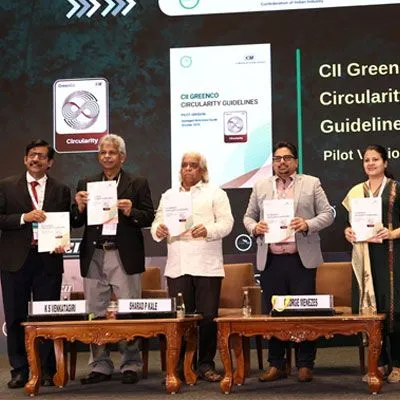
CII GreenCo Launches Circularity Guidelines for Indian Industry

The Confederation of Indian Industry (CII) GreenCo Council has launched the CII GreenCo Circularity Guidelines – Pilot Version at the 17th CII GreenCo Waste & Resource Management Summit 2026 in Chennai. The initiative aims to strengthen resource efficiency, waste reduction and circular economy practices across Indian manufacturing and process industries.The guidelines introduce a structured framework with circularity indices covering raw materials, consumables, packaging and other resource inputs. These indicators will help industries assess existing practices, identify opportunities to ..

Next Story
Infrastructure Energy

Global Electronics Association Launches IPC-1783-CO2E Standard

The Global Electronics Association has introduced IPC-1783-CO2E, a new international standard aimed at improving consistency, transparency and comparability in product carbon footprint reporting across the electronics manufacturing industry.The standard, titled International Standard for Data Collection and Reporting of CO2 Equivalent (CO2e) Emissions for the Electronics Manufacturing Supply Chain, provides industry-specific guidance for collecting, estimating and reporting carbon emissions data.With increasing regulatory requirements and customer expectations, electronics manufacturers face c..

Advertisement

Subscribe to Our Newsletter

Get daily newsletters around different themes from Construction world.

STAY CONNECTED

Advertisement

SPECIAL OFFER
QR Code