Cabinet Approves ATF Price Stabilisation Fund for Airlines
ECONOMY & POLICY

Cabinet Approves ATF Price Stabilisation Fund for Airlines

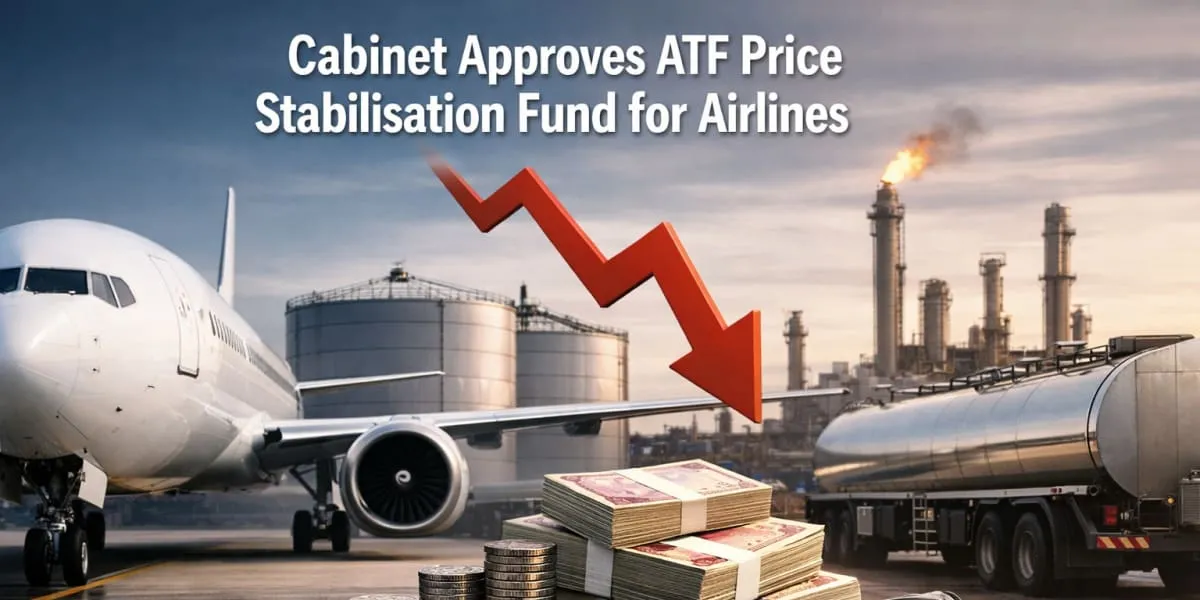
The Union Cabinet has approved one?time budgetary support not exceeding Rs 100 billion (bn) as an interest?free advance to Oil Marketing Companies to stabilise aviation turbine fuel pricing for scheduled Indian airlines. The advance will be provided through the Demands for Grants of the Ministry of Petroleum and Natural Gas to address exceptional price volatility arising from the West Asia crisis. The corpus will compensate OMCs for losses when import parity prices exceed the benchmark under the approved mechanism. The measure applies to domestic and international operations of willing scheduled carriers.

Recovery and true up will be carried out when international ATF prices moderate, with differential amounts returned to the Consolidated Fund of India until the advance is settled. A fixed?price arrangement is intended to reduce airlines' exposure to sudden spikes and improve predictability for operational and financial planning. Participating carriers will procure ATF only from OMCs under a memorandum of understanding for up to three years, subject to annual review.

Implementation will be overseen by a monitoring committee with representatives of the ministries and the Department of Expenditure, and all claims and recoveries will be auditable. The support is temporary and recoverable, with provision to extend beyond 36 months only with competent authority approval if the corpus is not fully trued up. The arrangement is aimed at protecting OMCs from losses caused by capped domestic prices alongside high international rates and at ensuring continuity of services.

The Cabinet noted that international ATF prices have surged nearly two point five times from Rs 60.50 per litre in March 2026 to Rs 142 per litre in May 2026 and that ATF accounts for nearly 40 per cent of airline operating costs, rising to as much as 60 per cent in extreme volatility. Closure of neighbouring airspace has increased flight distances and fuel burn, adding to long?haul costs and higher fares. Authorities expect the scheme to sustain connectivity to regional and remote centres, moderate fare volatility for passengers and preserve employment across aviation and related sectors.

The Union Cabinet has approved one?time budgetary support not exceeding Rs 100 billion (bn) as an interest?free advance to Oil Marketing Companies to stabilise aviation turbine fuel pricing for scheduled Indian airlines. The advance will be provided through the Demands for Grants of the Ministry of Petroleum and Natural Gas to address exceptional price volatility arising from the West Asia crisis. The corpus will compensate OMCs for losses when import parity prices exceed the benchmark under the approved mechanism. The measure applies to domestic and international operations of willing scheduled carriers. Recovery and true up will be carried out when international ATF prices moderate, with differential amounts returned to the Consolidated Fund of India until the advance is settled. A fixed?price arrangement is intended to reduce airlines' exposure to sudden spikes and improve predictability for operational and financial planning. Participating carriers will procure ATF only from OMCs under a memorandum of understanding for up to three years, subject to annual review. Implementation will be overseen by a monitoring committee with representatives of the ministries and the Department of Expenditure, and all claims and recoveries will be auditable. The support is temporary and recoverable, with provision to extend beyond 36 months only with competent authority approval if the corpus is not fully trued up. The arrangement is aimed at protecting OMCs from losses caused by capped domestic prices alongside high international rates and at ensuring continuity of services. The Cabinet noted that international ATF prices have surged nearly two point five times from Rs 60.50 per litre in March 2026 to Rs 142 per litre in May 2026 and that ATF accounts for nearly 40 per cent of airline operating costs, rising to as much as 60 per cent in extreme volatility. Closure of neighbouring airspace has increased flight distances and fuel burn, adding to long?haul costs and higher fares. Authorities expect the scheme to sustain connectivity to regional and remote centres, moderate fare volatility for passengers and preserve employment across aviation and related sectors.

Next Story
Infrastructure Urban

Cabinet Approves Two Year Scheme To Replace Old Trucks And Buses

The Union Cabinet, chaired by the Prime Minister, approved a two-year scheme to reduce air pollution in the Delhi–NCR region and promote cleaner mobility. The programme will be funded through the National Capital Region Planning Board under the Ministry of Housing and Urban Affairs and implemented by the Ministry of Road Transport and Highways and the Ministry of Petroleum and Natural Gas, with participating States and Union Territories of Delhi, Haryana, Rajasthan and Uttar Pradesh. The total financial outlay has been set at Rs 95.85 billion (bn), with the Central Government contributing Rs..

Next Story
Infrastructure Transport

Bengaluru Suburban Rail And Metro To Share 500-Metre Corridor

Bengaluru suburban rail and the Metro will share a 500-metre corridor at Benniganahalli, a decision that planners say will reduce capital expenditure and urban disruption. The consolidation of alignments across the short stretch is intended to avoid duplication of elevated structures and station facilities while cutting land acquisition needs. Authorities put the maximum savings at Rs 1.69 bn (1,690 mn). The arrangement also aims to streamline construction interfaces between the two systems. The shared corridor will require coordinated design of track beds, piers and passenger access so that s..

Next Story
Infrastructure Urban

DRDO And IAF Complete Successful RudraM-II Flight Tests

The Defence Research and Development Organisation (DRDO) and the Indian Air Force (IAF) have conducted successful flight tests of the RudraM-II air-to-surface missile from an airborne platform. The trials were carried out under extreme release conditions with a critical trajectory that established the capability of all subsystems. The series of releases tested the missile's guidance, seeker and propulsion elements in an operationally representative environment. The missiles, released from the aircraft, were guided to a predefined target with pinpoint accuracy and all test objectives were fully..

Advertisement

Subscribe to Our Newsletter

Get daily newsletters around different themes from Construction world.

STAY CONNECTED

Advertisement

Advertisement

Advertisement