Cabinet Approves Rs 12.64 bn Rail Project In Karnataka And Andhra Pradesh
RAILWAYS & METRO RAIL

Cabinet Approves Rs 12.64 bn Rail Project In Karnataka And Andhra Pradesh

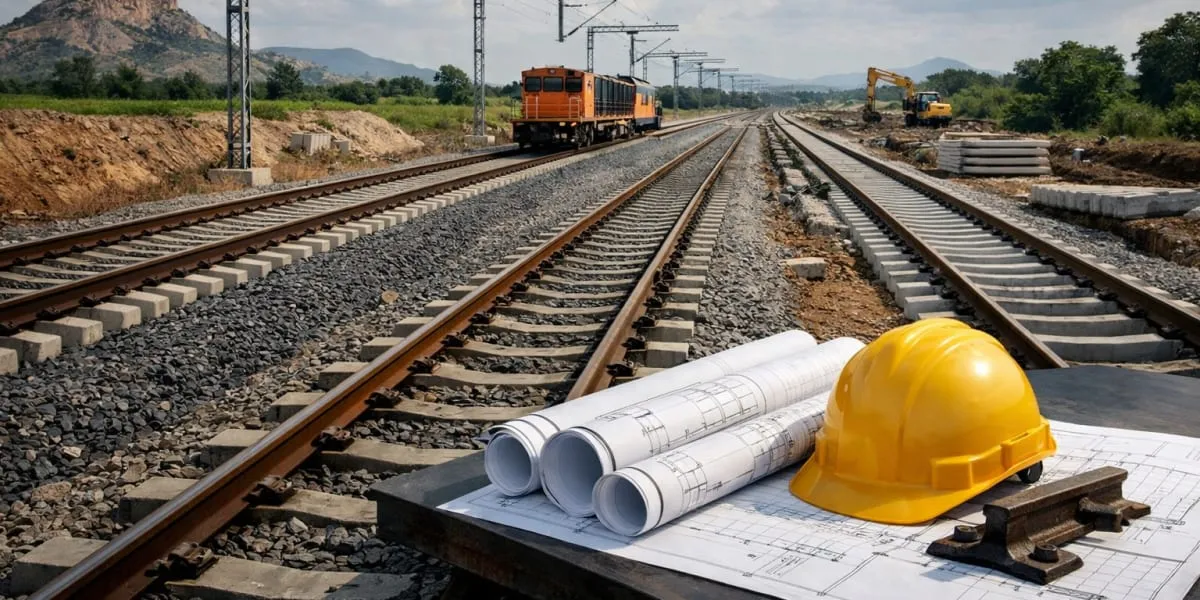
The Union Cabinet has approved a Rs 12.64 billion (bn) railway project to lay third and fourth lines on the Ballari–Guntakal route to boost capacity and ease congestion on a key corridor. The project was cleared by the Cabinet Committee on Economic Affairs chaired by the Prime Minister and is expected to be completed by 2028-29.

The work will add around 46 km of new track across three districts in Karnataka and Andhra Pradesh under the PM Gati Shakti National Master Plan, improving network resilience and operational flexibility. The additional lines will allow Indian Railways to run more services while reducing delays for both passengers and freight along the corridor.

The scheme is expected to improve connectivity for 99 villages with a combined population of nearly zero point seven million (mn) people, easing daily commutes and access to services. It is also intended to make travel simpler for tourists and pilgrims visiting Ballari Fort and the Sri Kumara Swamy Temple.

The Ballari–Guntakal section serves as a key freight corridor for minerals and industrial goods such as iron ore, dolomite, limestone, iron and steel, coal, fertilisers and food grains. The additional lines are expected to enable carriage of an estimated 16.22 million tonnes (mn t) per year of extra freight, which should reduce delays and strengthen supply chains.

A shift of freight from road to rail is projected to yield environmental gains, with forecasts suggesting savings of 13.2 million litres of fuel and reductions of 66.7 million kilograms (kg), about 66.7 mn kg, equivalent to planting nearly 2.7 million (mn) trees. The project therefore aims to boost capacity, ease congestion and support regional economic activity.

The Union Cabinet has approved a Rs 12.64 billion (bn) railway project to lay third and fourth lines on the Ballari–Guntakal route to boost capacity and ease congestion on a key corridor. The project was cleared by the Cabinet Committee on Economic Affairs chaired by the Prime Minister and is expected to be completed by 2028-29. The work will add around 46 km of new track across three districts in Karnataka and Andhra Pradesh under the PM Gati Shakti National Master Plan, improving network resilience and operational flexibility. The additional lines will allow Indian Railways to run more services while reducing delays for both passengers and freight along the corridor. The scheme is expected to improve connectivity for 99 villages with a combined population of nearly zero point seven million (mn) people, easing daily commutes and access to services. It is also intended to make travel simpler for tourists and pilgrims visiting Ballari Fort and the Sri Kumara Swamy Temple. The Ballari–Guntakal section serves as a key freight corridor for minerals and industrial goods such as iron ore, dolomite, limestone, iron and steel, coal, fertilisers and food grains. The additional lines are expected to enable carriage of an estimated 16.22 million tonnes (mn t) per year of extra freight, which should reduce delays and strengthen supply chains. A shift of freight from road to rail is projected to yield environmental gains, with forecasts suggesting savings of 13.2 million litres of fuel and reductions of 66.7 million kilograms (kg), about 66.7 mn kg, equivalent to planting nearly 2.7 million (mn) trees. The project therefore aims to boost capacity, ease congestion and support regional economic activity.

Next Story
Infrastructure Urban

Centre Clears Power Distribution Upgrade for Uttar Pradesh

The Central Government has approved power distribution projects worth Rs 407.39 billion for Uttar Pradesh under the Revamped Distribution Sector Scheme (RDSS). The investment will be used to modernise the state's electricity distribution infrastructure and strengthen network capacity across urban and rural areas. The package targets one of the country's largest distribution networks as the state experiences rapid urbanisation and rising electricity consumption. Planned interventions include the strengthening of distribution lines, modernisation of substations, replacement of ageing electrical ..

Next Story
Infrastructure Energy

India Data Centres To Consume 191 TWh By 2040 Driving Renewables

A Wood Mackenzie report says India's operational data centre capacity is projected to increase more than fivefold to 12 gigawatt (GW) by 2030 from 2.2 GW in 2025 as artificial intelligence (AI) and cloud computing drive demand. It projects electricity consumption to rise from 10 terawatt-hour (TWh) in 2025 to 191 TWh by 2040. The study forecasts a compound annual growth rate of around 40 per cent and notes AI-dedicated capacity will surge nearly 24-fold from 275 megawatt (MW) in 2025 to 6,546 MW by 2030. The report places India's digital economy at Rs 32 trillion (tn) in 2025 and says it contr..

Next Story
Infrastructure Transport

Hydrogen Train Completes 1,200 Kilometres Of Trials

India's first hydrogen train was flagged off between Jind and Sonipat on July 17 and has travelled over 1,200 kilometres in trials, saving diesel consumption of more than 3,200 litres, a Railway Ministry press release said. The deployment marks the introduction of a zero-emission fuel cell train into route testing and represents a milestone in domestic rail innovation. The train generates electricity onboard through a chemical reaction between hydrogen and oxygen, producing electricity to propel the vehicle while emitting only water vapour as a by-product. There is no smoke and no tailpipe car..

Advertisement

Subscribe to Our Newsletter

Get daily newsletters around different themes from Construction world.

STAY CONNECTED

Advertisement

Advertisement

Advertisement