CAG Flags Planning And Land Acquisition Issues In Bangalore Metro
ECONOMY & POLICY

CAG Flags Planning And Land Acquisition Issues In Bangalore Metro

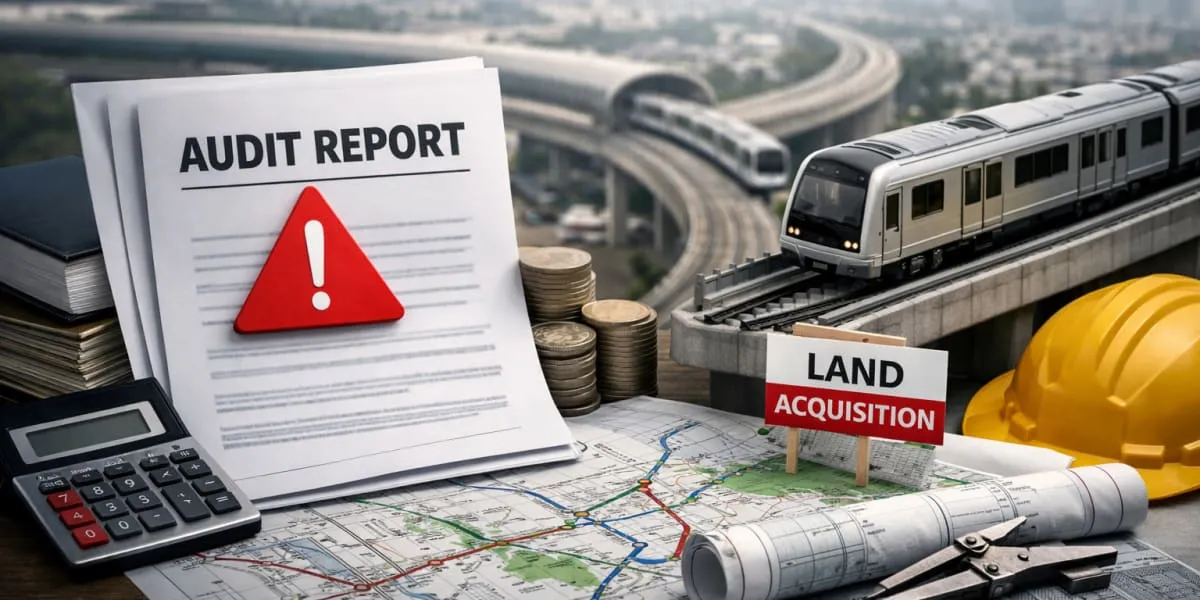
The Comptroller and Auditor General of India (CAG) presented a performance audit on implementation of Phase one and Phase two of the Bangalore Metro Rail Project by Bangalore Metro Rail Corporation Limited (BMRCL). The report defines monetary units as million (mn) and billion (bn) and outlines deficiencies in planning and execution.

Commercial operations of Phase one began from October 2011 and became fully operational in June 2017 over 42.30 kilometres. Phase two ran partly between January 2021 and March 2023 over 27.36 kilometres, with the balance planned for completion by December 2026. The audit reviewed progress up to March 2023 for selected contracts.

The audit found that Phase two detailed project reports were prepared without a comprehensive mobility plan, transit oriented development or land use policy. It observed that actual peak hour peak direction traffic for Phase one in 2021 ranged from 6,429 to 8,852 and that ridership used for financial and economic internal rates of return appeared to be overestimated. The report noted that no detailed study was undertaken to ascertain reasons for low ridership.

On land management the audit recorded that BMRCL acquired 62.67 hectares against 45.24 hectares projected for Phase one and 145.16 hectares against 165.09 hectares projected for Phase two. It estimated an increase of Rs 66.03 bn in land acquisition cost and excess land compensation of Rs 2.95 bn.

The audit noted additional compensation of Rs 1.87 bn paid as interest at 12 per cent due to delayed notifications and that taxes in estimates of nine civil contracts raised project cost by Rs 12.22 bn. It highlighted that BMRCL remained dependent on the Karnataka government to service debt because of insufficient revenue and persistent cash losses.

During 2016-17 to 2022-23 actual farebox revenue was Rs 17.58 bn against projected revenue of Rs 77.37 bn. The audit attributed low ridership to non-integration with BMTC, inadequate last-mile connectivity and insufficient parking and observed that 0.223 mn sq ft of 0.246 mn sq ft of built-up area at stations remained vacant, costing Rs 385.3 mn.

The Comptroller and Auditor General of India (CAG) presented a performance audit on implementation of Phase one and Phase two of the Bangalore Metro Rail Project by Bangalore Metro Rail Corporation Limited (BMRCL). The report defines monetary units as million (mn) and billion (bn) and outlines deficiencies in planning and execution. Commercial operations of Phase one began from October 2011 and became fully operational in June 2017 over 42.30 kilometres. Phase two ran partly between January 2021 and March 2023 over 27.36 kilometres, with the balance planned for completion by December 2026. The audit reviewed progress up to March 2023 for selected contracts. The audit found that Phase two detailed project reports were prepared without a comprehensive mobility plan, transit oriented development or land use policy. It observed that actual peak hour peak direction traffic for Phase one in 2021 ranged from 6,429 to 8,852 and that ridership used for financial and economic internal rates of return appeared to be overestimated. The report noted that no detailed study was undertaken to ascertain reasons for low ridership. On land management the audit recorded that BMRCL acquired 62.67 hectares against 45.24 hectares projected for Phase one and 145.16 hectares against 165.09 hectares projected for Phase two. It estimated an increase of Rs 66.03 bn in land acquisition cost and excess land compensation of Rs 2.95 bn. The audit noted additional compensation of Rs 1.87 bn paid as interest at 12 per cent due to delayed notifications and that taxes in estimates of nine civil contracts raised project cost by Rs 12.22 bn. It highlighted that BMRCL remained dependent on the Karnataka government to service debt because of insufficient revenue and persistent cash losses. During 2016-17 to 2022-23 actual farebox revenue was Rs 17.58 bn against projected revenue of Rs 77.37 bn. The audit attributed low ridership to non-integration with BMTC, inadequate last-mile connectivity and insufficient parking and observed that 0.223 mn sq ft of 0.246 mn sq ft of built-up area at stations remained vacant, costing Rs 385.3 mn.

Related Stories

Gold Stories

Next Story
Infrastructure Urban

Sabarmati Riverfront Two Plots Up for Auction at Rs2.24 bn Base Price

Two commercial plots on the western bank of the Sabarmati Riverfront will be auctioned with a base price of Rs 112 crore each, equivalent to Rs 1.12 bn apiece and Rs 2.24 billion in total. The parcels are located adjacent to the Metro Rail Bridge in Ahmedabad and form the first commercial offering after a prolonged pause. The Riverfront Development Corporation has framed the sale as part of a phased commercial release to revive development along the riverfront. The combined base valuation has been set by the corporation to reflect market rates along the riverfront. The corporation has fixed a ..

Next Story
Infrastructure Urban

Andhra Pradesh to Connect Over One Million Streetlights

Andhra Pradesh will undertake a statewide smart streetlighting programme across all 123 Urban Local Bodies (ULBs), bringing around 1.05 million (mn) streetlights under an AI enabled monitoring and management system. The programme will be implemented by Energy Efficiency Services Limited (EESL) with the Commissioner and Director of Municipal Administration under the state Municipal Administration and Urban Development Department. The project aims to convert conventional streetlighting into a digitally managed municipal service monitored and maintained remotely. The initial phase will cover abou..

Next Story
Infrastructure Urban

AMC To Procure Four Machines For Guard Rail Cleaning

Ahmedabad Municipal Corporation will introduce four specialised machines for cleaning guard railings along major roads and the central verges of BRTS and Metro corridors. The civic body plans to replace manual labour with mechanised cleaning to improve maintenance of road infrastructure and greenery. The purchase is estimated at Rs 82.8 million (mn), excluding GST. The proposal sets the base price of each machine at about Rs 20.7 million (mn) so four units total Rs 82.8 million (mn) before GST. 18 per cent GST will be applicable separately. During the warranty period each machine will operate ..

Advertisement

Subscribe to Our Newsletter

Get daily newsletters around different themes from Construction world.

STAY CONNECTED

Advertisement