CAQM Revokes Stage I Of GRAP Across NCR After AQI Improves
ECONOMY & POLICY

CAQM Revokes Stage I Of GRAP Across NCR After AQI Improves

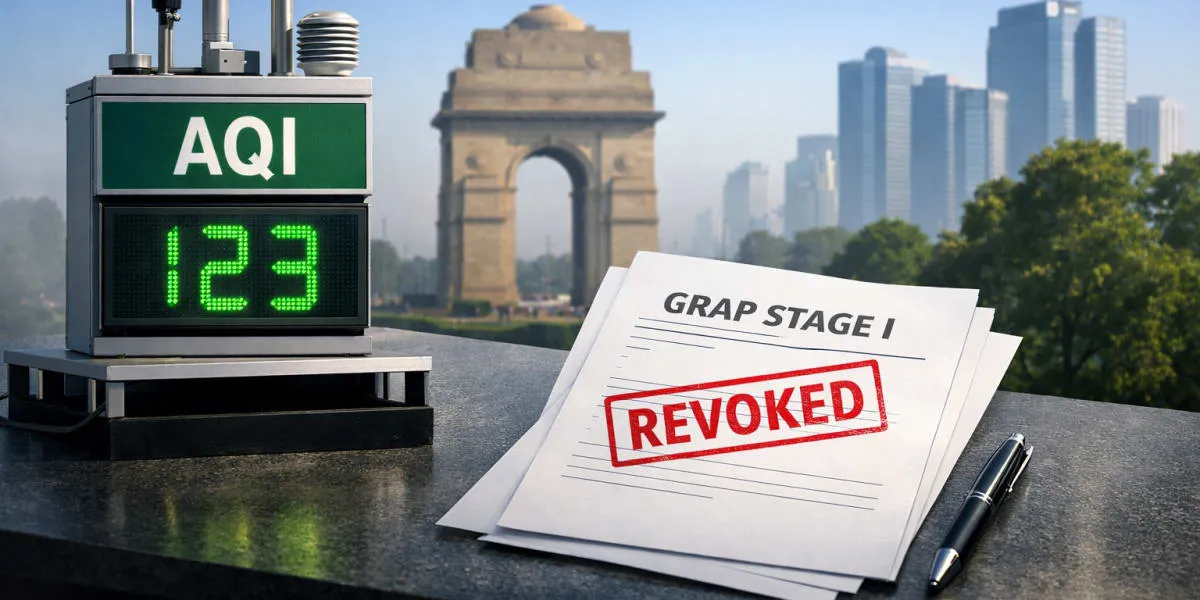
The Sub-Committee on the Graded Response Action Plan (GRAP) of the Commission for Air Quality Management in the National Capital Region (NCR) and Adjoining Areas (CAQM) revoked all actions under Stage-I of the extant GRAP schedule across the NCR with immediate effect after a notable improvement in Delhi's air quality. The decision followed a fall in the citywide daily average air quality index from 207 on 28 May 2026 to 123 on 29 May 2026. The Sub-Committee reviewed measurements and regional conditions before taking the step.

Forecasts supplied by the India Meteorological Department and the Indian Institute of Tropical Meteorology (IMD/IITM) indicated that the AQI was likely to remain in the Moderate category in the coming days. The Sub-Committee had originally invoked Stage-I on 19 May 2026 when the average AQI of Delhi began to trend upwards. The Committee reconvened to assess meteorological inputs and projections from IMD/IITM.

While reviewing overall air quality parameters across Delhi-NCR, the Sub-Committee noted that strong winds accompanied by light rain had contributed to the observed improvement, with the AQI recorded at 123 at four pm on 29 May 2026. The group observed these conditions alongside modelled forecasts before agreeing to lift Stage-I measures. The decision was unanimous.

All agencies of the concerned state governments and the Government of the National Capital Territory of Delhi (NCT) within the NCR have been advised to ensure strict implementation of statutory directions, advisories and orders issued by the Commission and by other authorities. These include rules, regulations and guidelines issued by the Ministry of Environment, Forest and Climate Change (MoEFCC), the Central Pollution Control Board (CPCB), and the respective state pollution control boards and the Delhi Pollution Control Committee (DPCC). The Sub-Committee emphasised that continued adherence across contributing sectors is necessary to sustain improved AQI levels and prevent a return to the Poor category.

The Sub-Committee will periodically review conditions and take further decisions as warranted. Agencies were instructed to remain prepared to reinstate measures should air quality deteriorate.

The Sub-Committee on the Graded Response Action Plan (GRAP) of the Commission for Air Quality Management in the National Capital Region (NCR) and Adjoining Areas (CAQM) revoked all actions under Stage-I of the extant GRAP schedule across the NCR with immediate effect after a notable improvement in Delhi's air quality. The decision followed a fall in the citywide daily average air quality index from 207 on 28 May 2026 to 123 on 29 May 2026. The Sub-Committee reviewed measurements and regional conditions before taking the step. Forecasts supplied by the India Meteorological Department and the Indian Institute of Tropical Meteorology (IMD/IITM) indicated that the AQI was likely to remain in the Moderate category in the coming days. The Sub-Committee had originally invoked Stage-I on 19 May 2026 when the average AQI of Delhi began to trend upwards. The Committee reconvened to assess meteorological inputs and projections from IMD/IITM. While reviewing overall air quality parameters across Delhi-NCR, the Sub-Committee noted that strong winds accompanied by light rain had contributed to the observed improvement, with the AQI recorded at 123 at four pm on 29 May 2026. The group observed these conditions alongside modelled forecasts before agreeing to lift Stage-I measures. The decision was unanimous. All agencies of the concerned state governments and the Government of the National Capital Territory of Delhi (NCT) within the NCR have been advised to ensure strict implementation of statutory directions, advisories and orders issued by the Commission and by other authorities. These include rules, regulations and guidelines issued by the Ministry of Environment, Forest and Climate Change (MoEFCC), the Central Pollution Control Board (CPCB), and the respective state pollution control boards and the Delhi Pollution Control Committee (DPCC). The Sub-Committee emphasised that continued adherence across contributing sectors is necessary to sustain improved AQI levels and prevent a return to the Poor category. The Sub-Committee will periodically review conditions and take further decisions as warranted. Agencies were instructed to remain prepared to reinstate measures should air quality deteriorate.

Next Story
Infrastructure Urban

Table Space Strengthens DESYN Leadership Team

Table Space has announced strategic leadership appointments within DESYN, its integrated Design and Build business, as it looks to strengthen operations across key enterprise and GCC markets in India. DESYN was launched as a strategic extension of Table Space’s workspace solutions portfolio to meet rising demand for agile, high-quality and rapidly deployable enterprise workspaces.Shruti Ookabhoy has joined DESYN as Executive Director and will lead the Design vertical, focusing on design capability, operational excellence and team development across markets. She brings over 22 years of experi..

Next Story
Infrastructure Transport

Concord Associate Bags Rs 2.79 Bn Kavach Order

Concord Control Systems said its associate company, Progota India, has received a Rs 2.79 bn domestic order from Indian Railways for the supply, installation, testing and commissioning of on-board Kavach 4.0 loco equipment.The order is scheduled for execution within 12 months and strengthens Concord’s role in India’s railway safety and signalling ecosystem. Kavach is India’s indigenous automatic train protection system, designed to improve operational safety by helping prevent signal passing at danger and reducing collision risks.Gaurav Lath, Joint Managing Director, Concord Control Syst..

Next Story
Technology

Dhoot Partners RideVision For ADAS Solutions

Dhoot Transmission has partnered with Israel-based RideVision to introduce Advanced Driver Assistance Systems (ADAS) solutions in India, marking its entry into intelligent mobility and automotive safety technologies.The collaboration will bring globally proven ADAS technologies to India, customised for local road conditions and mobility needs. It will strengthen Dhoot Transmission’s existing electronics portfolio and support its long-term focus on next-generation automotive electronics.Naveen Kumar, CEO – India, Wiring Harness and Electronics, Dhoot Transmission, said the partnership combi..

Advertisement

Subscribe to Our Newsletter

Get daily newsletters around different themes from Construction world.

STAY CONNECTED

Advertisement

Advertisement

Advertisement

-->