+
CBIC Showcases Digital Customs Reforms At WTO Sessions
ECONOMY & POLICY

CBIC Showcases Digital Customs Reforms At WTO Sessions

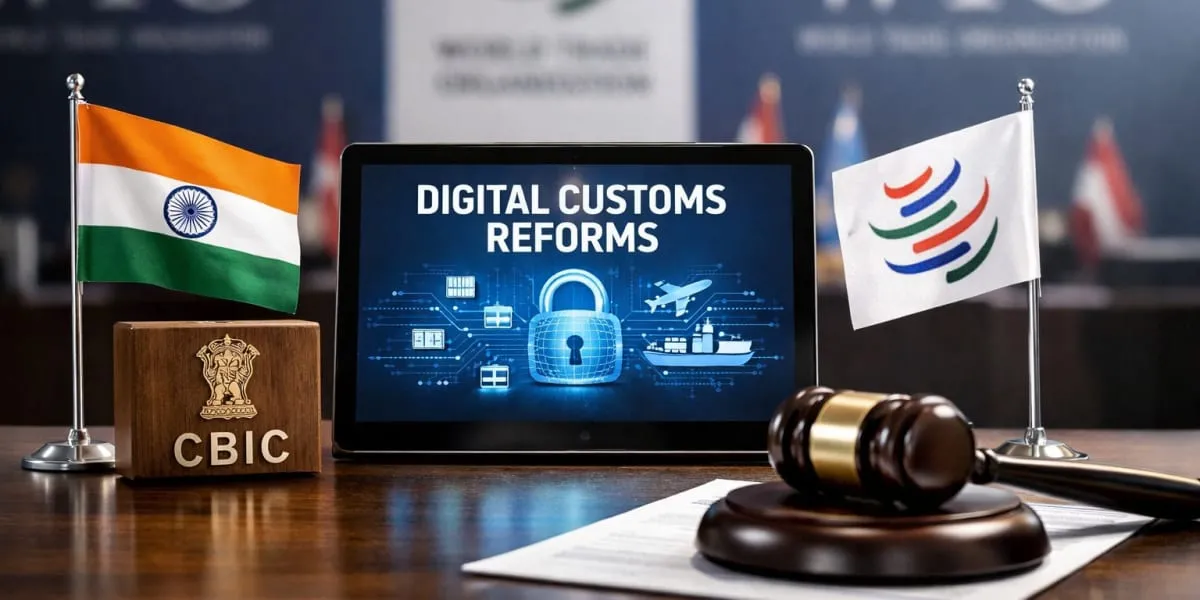
The Central Board of Indirect Taxes and Customs (CBIC), Government of India, with the Permanent Mission of India to the World Trade Organisation (WTO), organised special sessions on trade facilitation on 24th February 2026 in Geneva. The Indian delegation was led by the Special Secretary and Member (Customs), Surjit Bhujabal. Delegates from around 40 countries and the WTO Secretariat attended, showing strong international interest.

India presented its full implementation of the WTO Trade Facilitation Agreement, notifying 100 per cent of commitments, and outlined a shift towards TFA Plus under the National Trade Facilitation Action Plan 3.0. The CBIC described a whole of government approach to a faceless, contactless and paperless customs ecosystem achieved through digitalisation and process re?engineering. Officials cited systems including a single window interface, a robust risk management system and the Authorised Economic Operator programme, along with electronic exchange of origin data and cargo tracking.

Capacity building was emphasised, with the National Academy of Customs, Indirect Taxes and Narcotics (NACIN) and the Central Revenue Control Laboratory (CRCL) noted as regional training and laboratory centres recognised by the World Customs Organisation. Since 2022 NACIN has run 65 trainings benefiting more than 1,800 international participants from about 30 countries, while CRCL has trained over 300 officers, often in collaboration with the WCO and the Asian Development Bank. India offered partnerships to help developing countries implement trade facilitation commitments.

Officials said digital customs reforms have reduced compliance burdens for micro, small and medium enterprises and strengthened integration into global value chains. The CBIC's Ease of Doing Business reforms for 2026 focus on a single interconnected digital window, trust based systems for recognised trusted importers and simplified e?commerce export procedures. Measures highlighted include removal of the Rs 1 million (mn) value cap on courier exports, introduction of return to origin for unclaimed international courier consignments and a simplified, risk based framework for e?commerce returns, which delegates welcomed.

The Central Board of Indirect Taxes and Customs (CBIC), Government of India, with the Permanent Mission of India to the World Trade Organisation (WTO), organised special sessions on trade facilitation on 24th February 2026 in Geneva. The Indian delegation was led by the Special Secretary and Member (Customs), Surjit Bhujabal. Delegates from around 40 countries and the WTO Secretariat attended, showing strong international interest. India presented its full implementation of the WTO Trade Facilitation Agreement, notifying 100 per cent of commitments, and outlined a shift towards TFA Plus under the National Trade Facilitation Action Plan 3.0. The CBIC described a whole of government approach to a faceless, contactless and paperless customs ecosystem achieved through digitalisation and process re?engineering. Officials cited systems including a single window interface, a robust risk management system and the Authorised Economic Operator programme, along with electronic exchange of origin data and cargo tracking. Capacity building was emphasised, with the National Academy of Customs, Indirect Taxes and Narcotics (NACIN) and the Central Revenue Control Laboratory (CRCL) noted as regional training and laboratory centres recognised by the World Customs Organisation. Since 2022 NACIN has run 65 trainings benefiting more than 1,800 international participants from about 30 countries, while CRCL has trained over 300 officers, often in collaboration with the WCO and the Asian Development Bank. India offered partnerships to help developing countries implement trade facilitation commitments. Officials said digital customs reforms have reduced compliance burdens for micro, small and medium enterprises and strengthened integration into global value chains. The CBIC's Ease of Doing Business reforms for 2026 focus on a single interconnected digital window, trust based systems for recognised trusted importers and simplified e?commerce export procedures. Measures highlighted include removal of the Rs 1 million (mn) value cap on courier exports, introduction of return to origin for unclaimed international courier consignments and a simplified, risk based framework for e?commerce returns, which delegates welcomed.

Next Story
Building Material

Walplast’s GypEx Range Secures GreenPro Certification

Walplast Products has received GreenPro Ecolabel certification from the CII-Green Products and Services Council for six products under its HomeSure GypEx gypsum plaster portfolio. The certification, valid until December 2027, recognises the products as Green Products in line with established sustainability standards.The certified products include HomeSure GypEx Machine Spray Plaster, HomeSure GypEx Silver Plus Plaster, HomeSure GypEx Silver Plaster, HomeSure GypEx Platinum Plaster, Nova 125 Premium Gypsum Plaster and HomeSure GypEx Kwik Set (Jointing Compound). All are manufactured at the comp..

Next Story
Real Estate

Southco Launches N5 Lift-and-Turn Latch

Southco has introduced the N5 Lift-and-Turn Compression Latch, featuring a folding T-handle and integrated sealing performance within a compact hardware design.The N5 latch is engineered for ergonomic operation in demanding environments. Its folding T-handle allows for easy grip and actuation, including with gloved hands, and folds into the housing when not in use to maintain a low-profile appearance and reduce catch points. The overall design minimises panel footprint and enclosure intrusion, enabling efficient use of internal and surface space.Despite its compact configuration, the latch is ..

Next Story
Building Material

Adani Cement, NAREDCO Form Strategic Alliance

Adani Cement has entered into a strategic partnership with the National Real Estate Development Council (NAREDCO) to support India’s expanding housing and infrastructure requirements aligned with the vision of Viksit Bharat 2047.The collaboration brings together Adani Cement’s building materials portfolio, research capabilities and technical expertise with NAREDCO’s network of over 15,000 member organisations. The partnership will focus on skill development, knowledge exchange, technology adoption and sustainable construction practices across the real estate ecosystem.Joint initiatives w..

Advertisement

Subscribe to Our Newsletter

Get daily newsletters around different themes from Construction world.

STAY CONNECTED

Advertisement

Advertisement

Advertisement

Open In App