Gurugram Metro Corridor Revised To Include 27 Stations
RAILWAYS & METRO RAIL

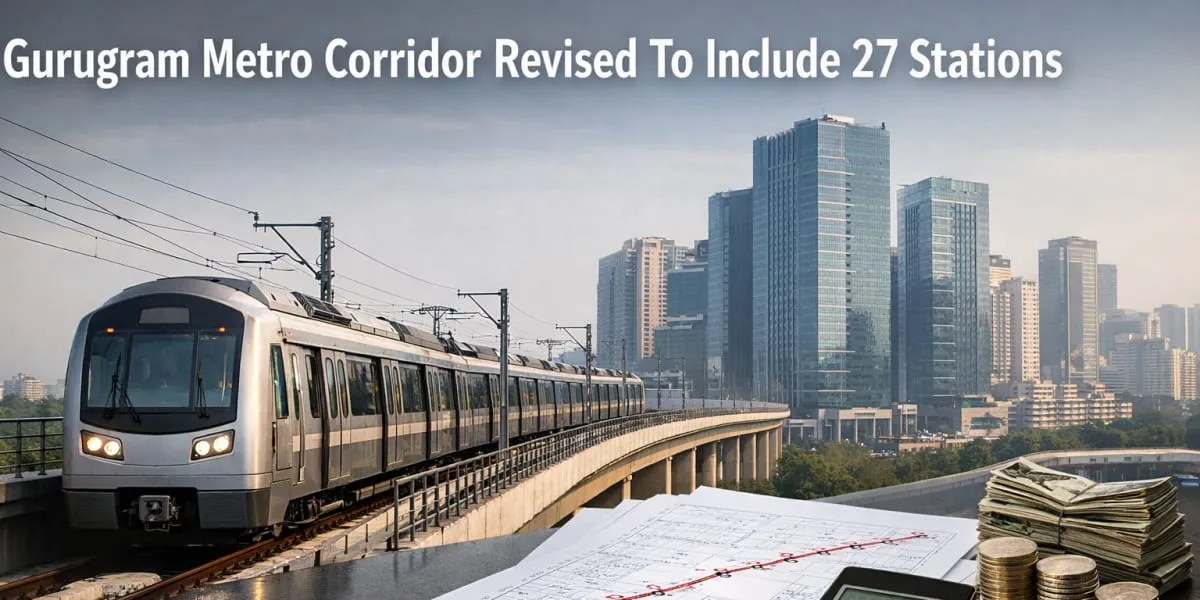
Gurugram Metro Corridor Revised To Include 27 Stations

The Haryana Cabinet approved a revised cost of Rupee (Rs) 10,266.54 crore (Rs 102.67 bn) for the Gurugram Metro corridor linking Millennium City Centre and Cyber City, the state release indicated. The revised estimate is almost double the original sanctioned cost of Rs 5,452.72 crore (Rs 54.53 bn) approved in 2020 and reflects a substantial escalation in project outlay. Officials described the change as significant for budgeting, procurement and delivery schedules.

The corridor will extend for 28.50 km and include 27 stations connecting commercial hubs and residential areas across Gurugram. The Detailed Project Report was first approved by the Haryana Cabinet on August 13, 2020 and later received central clearance, after which alignment refinements were undertaken. The revised design incorporates additional stations and infrastructure to address growing passenger demand and urban expansion.

The Cabinet also approved funding arrangements that allocate the full soft loan component to the World Bank. The total soft loan of Rs 2,688.57 crore (Rs 26.89 bn) will now be met entirely by the World Bank, simplifying the financing structure compared with earlier plans. Previously the soft loan exposure had been split with Rs 1,075.428 crore (Rs 10.75 bn) from the World Bank and Rs 1,613.14 crore (Rs 16.13 bn) from the European Investment Bank.

The project package includes integration with the existing Rapid Metro network and a major depot and related facilities on 22.86 hectares of government land in Sector-33. A one point eight km metro spur from Sector-5 to Gurugram Railway Station was approved to improve multimodal transfers and passenger convenience. Planners indicated that such links will enhance connectivity between train and metro services across the city.

A report attributed the increase in project cost primarily to rising input prices between 2019 and 2023, higher GST rates, alignment changes and additional infrastructure requirements. The state administration signalled that the revised financing and design steps should streamline implementation and reduce coordination challenges. The Cabinet decision is expected to shape subsequent procurement and execution phases.

The Haryana Cabinet approved a revised cost of Rupee (Rs) 10,266.54 crore (Rs 102.67 bn) for the Gurugram Metro corridor linking Millennium City Centre and Cyber City, the state release indicated. The revised estimate is almost double the original sanctioned cost of Rs 5,452.72 crore (Rs 54.53 bn) approved in 2020 and reflects a substantial escalation in project outlay. Officials described the change as significant for budgeting, procurement and delivery schedules. The corridor will extend for 28.50 km and include 27 stations connecting commercial hubs and residential areas across Gurugram. The Detailed Project Report was first approved by the Haryana Cabinet on August 13, 2020 and later received central clearance, after which alignment refinements were undertaken. The revised design incorporates additional stations and infrastructure to address growing passenger demand and urban expansion. The Cabinet also approved funding arrangements that allocate the full soft loan component to the World Bank. The total soft loan of Rs 2,688.57 crore (Rs 26.89 bn) will now be met entirely by the World Bank, simplifying the financing structure compared with earlier plans. Previously the soft loan exposure had been split with Rs 1,075.428 crore (Rs 10.75 bn) from the World Bank and Rs 1,613.14 crore (Rs 16.13 bn) from the European Investment Bank. The project package includes integration with the existing Rapid Metro network and a major depot and related facilities on 22.86 hectares of government land in Sector-33. A one point eight km metro spur from Sector-5 to Gurugram Railway Station was approved to improve multimodal transfers and passenger convenience. Planners indicated that such links will enhance connectivity between train and metro services across the city. A report attributed the increase in project cost primarily to rising input prices between 2019 and 2023, higher GST rates, alignment changes and additional infrastructure requirements. The state administration signalled that the revised financing and design steps should streamline implementation and reduce coordination challenges. The Cabinet decision is expected to shape subsequent procurement and execution phases.

Next Story
Resources

KBL Launches Smart Skid Mounted Fire Pump Set

Kirloskar Brothers (KBL) has launched its Smart Skid Mounted Fire Pump Set, an integrated fire protection solution designed to improve operational efficiency, remote monitoring and installation flexibility. The system was inaugurated by Ms Madhuritai Misal, Hon. Minister of State for Urban Development, Government of Maharashtra.The Smart Skid Mounted Fire Pump Set is a factory-tested, pre-packaged solution that combines FM/UL-certified motor and engine pump sets with IoT-enabled remote monitoring. Designed to deliver a flow rate of 170 m³/hr at a head of 100 metres, the system aims to provide..

Next Story
Real Estate

Senior Living Shifts Beyond Retirement Housing

Senior living in India is increasingly being positioned as a lifestyle-driven housing segment rather than conventional retirement accommodation. Across projects in Bengaluru, Pune and the NCR, developers are focusing on wellness ecosystems, assisted independence and active ageing, reflecting changing perceptions of later life among urban affluent buyers.The shift is being driven by financially secure seniors seeking socially engaged and professionally managed communities instead of ageing in large family homes. Developers are also moving away from standalone retirement campuses, particularly i..

Next Story
Products

Antica Ceramica Launches Heritage-Inspired Terracotta Tiles

Antica Ceramica has launched a new terracotta tile collection inspired by India’s architectural heritage and designed for contemporary interiors and exteriors. The range combines handcrafted aesthetics with modern functionality, bringing warmth, texture and cultural character to residential and hospitality spaces.Drawing inspiration from traditional courtyards, verandahs and heritage homes, the collection features terracotta tones, handcrafted motifs and customisable patterns aimed at transforming flooring and surfaces into design elements. The launch reflects growing demand for natural mate..

Advertisement

Subscribe to Our Newsletter

Get daily newsletters around different themes from Construction world.

STAY CONNECTED

Advertisement

Advertisement

Advertisement

-->