+
Centre Launches MSME Export Credit Support Schemes
ECONOMY & POLICY

Centre Launches MSME Export Credit Support Schemes

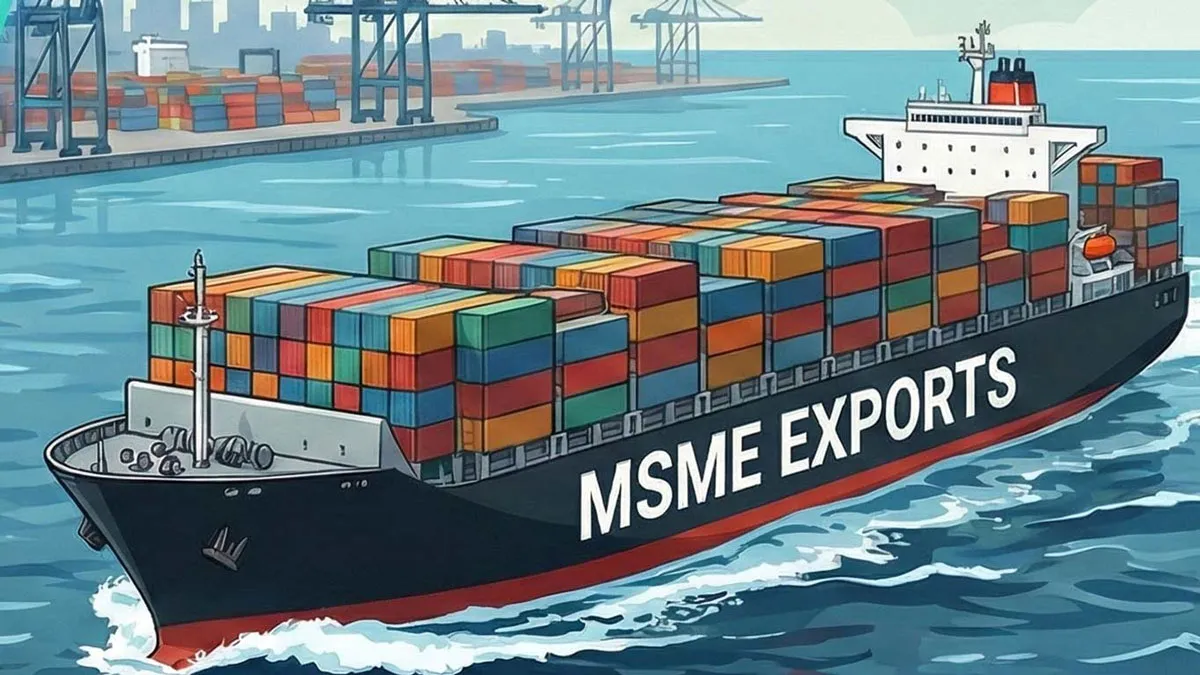
The central government has launched two new schemes under the Export Promotion Mission (EPM) to strengthen micro, small and medium enterprise exports and improve access to trade finance, the Ministry of Commerce and Industry said.

To ease working capital constraints and reduce the cost of export credit, the government will provide interest subvention on pre- and post-shipment rupee export credit extended by eligible lending institutions. A base interest subvention of 2.75 per cent has been announced, with a provision for additional incentives for exports to notified under-represented or emerging markets, subject to operational readiness.

The interest support will apply only to exports covered under a notified positive list of tariff lines at the Harmonised System six-digit level. The list covers around 75 per cent of India’s tariff lines and reflects sectors with high MSME participation. An exporter-wise annual cap of Rs 5 million per Importer Exporter Code has been prescribed for the 2025–26 financial year.

Applicable subvention rates will be reviewed twice a year, in March and September, based on domestic and global benchmarks. The commerce ministry said the positive list has been prepared using a transparent, data-driven methodology, prioritising labour-intensive and capital-intensive sectors, MSME concentration and value addition. Restricted and prohibited items, waste and scrap, and products covered under overlapping incentive schemes have been excluded.

Detailed operational guidelines for the interest subvention scheme will be issued by the Reserve Bank of India. The initiative will be rolled out as a pilot, with scope for refinement based on implementation feedback.

Alongside this, the government has introduced a collateral guarantee support scheme for export credit to address collateral constraints faced by MSME exporters and improve access to bank finance. The scheme will be implemented in partnership with the Credit Guarantee Fund Trust for Micro and Small Enterprises.

Under the framework, guarantee coverage of up to 85 per cent will be provided for micro and small exporters and up to 65 per cent for medium exporters, with a maximum outstanding guaranteed exposure of Rs 0.1 billion per exporter in a financial year. The scheme is designed to complement existing credit guarantee mechanisms and encourage banks to increase lending to export-oriented MSMEs. Detailed guidelines will be notified by CGTMSE, followed by a pilot phase.

The two schemes will be implemented on a pilot basis with continuous monitoring and data-driven refinements, the ministry said.

The Export Promotion Mission was recently approved by the Union Cabinet with an outlay of Rs 250.6 billion to enhance India’s global export competitiveness amid persistent economic uncertainty. The mission aims to lower export costs, expand access to finance, strengthen India’s export brand and diversify markets, enabling MSMEs to integrate more deeply into global value chains.

The mission is being jointly implemented by the Department of Commerce, the Ministry of MSME and the Ministry of Finance, and comprises two sub-schemes—Niryat Protsahan, focused on affordable and diversified trade finance, and Niryat Disha, which supports non-financial enablers such as market access, branding, logistics and regulatory compliance.

Welcoming the move, EEPC India chairman Pankaj Chadha said the measures would help lower finance costs for MSME exporters and improve their competitiveness in global markets. He added, however, that iron and steel products under Chapter 72 should have been included within the scope of the new schemes.

The central government has launched two new schemes under the Export Promotion Mission (EPM) to strengthen micro, small and medium enterprise exports and improve access to trade finance, the Ministry of Commerce and Industry said. To ease working capital constraints and reduce the cost of export credit, the government will provide interest subvention on pre- and post-shipment rupee export credit extended by eligible lending institutions. A base interest subvention of 2.75 per cent has been announced, with a provision for additional incentives for exports to notified under-represented or emerging markets, subject to operational readiness. The interest support will apply only to exports covered under a notified positive list of tariff lines at the Harmonised System six-digit level. The list covers around 75 per cent of India’s tariff lines and reflects sectors with high MSME participation. An exporter-wise annual cap of Rs 5 million per Importer Exporter Code has been prescribed for the 2025–26 financial year. Applicable subvention rates will be reviewed twice a year, in March and September, based on domestic and global benchmarks. The commerce ministry said the positive list has been prepared using a transparent, data-driven methodology, prioritising labour-intensive and capital-intensive sectors, MSME concentration and value addition. Restricted and prohibited items, waste and scrap, and products covered under overlapping incentive schemes have been excluded. Detailed operational guidelines for the interest subvention scheme will be issued by the Reserve Bank of India. The initiative will be rolled out as a pilot, with scope for refinement based on implementation feedback. Alongside this, the government has introduced a collateral guarantee support scheme for export credit to address collateral constraints faced by MSME exporters and improve access to bank finance. The scheme will be implemented in partnership with the Credit Guarantee Fund Trust for Micro and Small Enterprises. Under the framework, guarantee coverage of up to 85 per cent will be provided for micro and small exporters and up to 65 per cent for medium exporters, with a maximum outstanding guaranteed exposure of Rs 0.1 billion per exporter in a financial year. The scheme is designed to complement existing credit guarantee mechanisms and encourage banks to increase lending to export-oriented MSMEs. Detailed guidelines will be notified by CGTMSE, followed by a pilot phase. The two schemes will be implemented on a pilot basis with continuous monitoring and data-driven refinements, the ministry said. The Export Promotion Mission was recently approved by the Union Cabinet with an outlay of Rs 250.6 billion to enhance India’s global export competitiveness amid persistent economic uncertainty. The mission aims to lower export costs, expand access to finance, strengthen India’s export brand and diversify markets, enabling MSMEs to integrate more deeply into global value chains. The mission is being jointly implemented by the Department of Commerce, the Ministry of MSME and the Ministry of Finance, and comprises two sub-schemes—Niryat Protsahan, focused on affordable and diversified trade finance, and Niryat Disha, which supports non-financial enablers such as market access, branding, logistics and regulatory compliance. Welcoming the move, EEPC India chairman Pankaj Chadha said the measures would help lower finance costs for MSME exporters and improve their competitiveness in global markets. He added, however, that iron and steel products under Chapter 72 should have been included within the scope of the new schemes.

Next Story
Infrastructure Transport

Second Mountain Tunnel Breakthrough in Palghar Advances High Speed Rail

The Mumbai-Ahmedabad high speed rail (MAHSR) project reached a milestone with the breakthrough of a mountain tunnel in Palghar, Maharashtra. Mountain tunnel MT-six measures 454 metres long and 14.4 metres wide and will accommodate up and down tracks. The breakthrough follows MT-five near Saphale on second January 2026 and the MT-six excavation was completed from both ends using the New Austrian Tunnelling Method. The ministry reported that the tunnelling was completed within 12 months. The New Austrian Tunnelling Method is favoured for its flexibility in complex geology and irregular tunnel s..

Next Story
Infrastructure Transport

Modi Government Pushes Atmanirbhar Container Drive With BCSL MoU

The Union Government advanced a plan to create an integrated, domestically anchored container ecosystem with the signing of a Memorandum of Understanding to establish the Bharat Container Shipping Line (BCSL). The MoU was signed by key agencies including the Shipping Corporation of India and Container Corporation of India alongside major port authorities and Sagarmala Finance Corporation Limited under the Ministry of Ports, Shipping and Waterways, in the presence of senior ministers. The initiative aligns with the Container Manufacturing Assistance Scheme announced in the Union Budget 2026–2..

Next Story
Infrastructure Urban

Ministry Reports Gains In Mobility For Marginalised Communities

The Ministry of Social Justice and Empowerment is implementing skill development, education and rehabilitation schemes to promote socio-economic mobility and sustainable livelihoods for marginalised and disadvantaged communities across the country. Programmes target Scheduled Castes, Other Backward Classes, Economically Weaker Sections, De-notified Tribes and Safai Karamcharis through specialised implementing corporations and empanelled training institutes. Pradhan Mantri Dakshata Aur Kushalta Sampann Hitgrahi Yojana, or PM-DAKSH, provided skill training and placement support through the Nati..

Advertisement

Subscribe to Our Newsletter

Get daily newsletters around different themes from Construction world.

STAY CONNECTED

Advertisement

Advertisement

Advertisement

Open In App