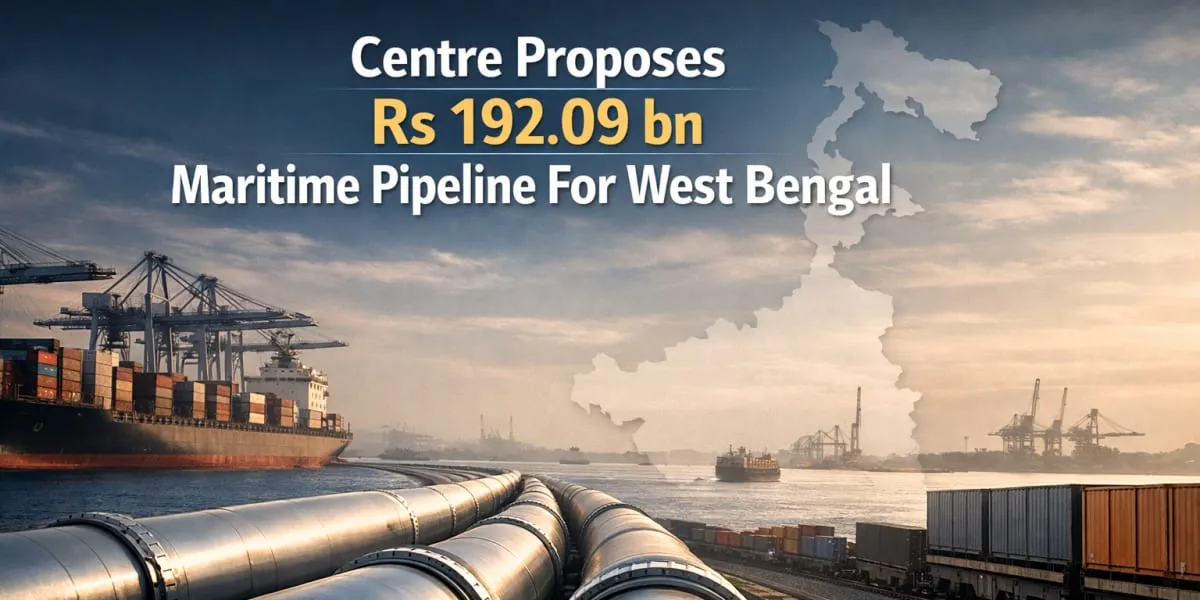
Centre Proposes Rs 192.09 bn Maritime Pipeline For West Bengal
ECONOMY & POLICY

Centre Proposes Rs 192.09 bn Maritime Pipeline For West Bengal

Union Minister for Ports, Shipping and Waterways Sarbananda Sonowal met the Chief Minister of West Bengal Suvendu Adhikari in Kolkata to discuss a proposed maritime investment pipeline of Rs 192.09 billion (Rs 192.09 bn) aimed at transforming the state into eastern India's maritime and logistics hub by 2031. The projects in the pipeline are expected to generate more than 62,500 employment opportunities both direct and indirect and to position West Bengal as a major gateway for trade and industry. The plan was framed under the Maritime Amrit Kaal Vision 2047 and seeks to attract substantial private capital.

The investment roadmap reviewed at the meeting covers development of the Balagarh Multimodal Logistics Hub, expansion and mechanisation of Kolkata and Haldia docks, strengthening of inland waterways, development of shipbuilding and ship repair facilities, cruise tourism infrastructure, riverfront redevelopment and port-led industrial clusters. Officials discussed initiatives to improve connectivity, dredging and protection of river embankments and to expedite land and irrigation support for port projects. These interventions are designed to create integrated maritime corridors linking ports, logistics parks and industrial estates.

The minister indicated that the programme is intended to unlock large-scale employment and enhance competitiveness in maritime services and manufacturing across the state. The chief minister welcomed continued collaboration with the central government and sought support for priority projects including Sagarmala 2.0 and a proposed tunnel across the Hooghly River. Senior officials from the Ministry and the state administration participated in the deliberations.

The Port Authority has recorded an increase in cargo throughput at Syama Prasad Mookerjee Port from 46.29 million tonnes (46.29 mn t) in 2014 to 70.87 million tonnes (70.87 mn t) in 2025-26, while inland waterways cargo movement has risen nearly five-fold over the last decade. The programme is expected to strengthen logistics efficiency, reduce transportation costs and support exports by developing multimodal transport links. Integrated development of ports, waterways, logistics parks and maritime manufacturing facilities is intended to accelerate economic growth across West Bengal and the wider eastern and north-eastern region.

Union Minister for Ports, Shipping and Waterways Sarbananda Sonowal met the Chief Minister of West Bengal Suvendu Adhikari in Kolkata to discuss a proposed maritime investment pipeline of Rs 192.09 billion (Rs 192.09 bn) aimed at transforming the state into eastern India's maritime and logistics hub by 2031. The projects in the pipeline are expected to generate more than 62,500 employment opportunities both direct and indirect and to position West Bengal as a major gateway for trade and industry. The plan was framed under the Maritime Amrit Kaal Vision 2047 and seeks to attract substantial private capital. The investment roadmap reviewed at the meeting covers development of the Balagarh Multimodal Logistics Hub, expansion and mechanisation of Kolkata and Haldia docks, strengthening of inland waterways, development of shipbuilding and ship repair facilities, cruise tourism infrastructure, riverfront redevelopment and port-led industrial clusters. Officials discussed initiatives to improve connectivity, dredging and protection of river embankments and to expedite land and irrigation support for port projects. These interventions are designed to create integrated maritime corridors linking ports, logistics parks and industrial estates. The minister indicated that the programme is intended to unlock large-scale employment and enhance competitiveness in maritime services and manufacturing across the state. The chief minister welcomed continued collaboration with the central government and sought support for priority projects including Sagarmala 2.0 and a proposed tunnel across the Hooghly River. Senior officials from the Ministry and the state administration participated in the deliberations. The Port Authority has recorded an increase in cargo throughput at Syama Prasad Mookerjee Port from 46.29 million tonnes (46.29 mn t) in 2014 to 70.87 million tonnes (70.87 mn t) in 2025-26, while inland waterways cargo movement has risen nearly five-fold over the last decade. The programme is expected to strengthen logistics efficiency, reduce transportation costs and support exports by developing multimodal transport links. Integrated development of ports, waterways, logistics parks and maritime manufacturing facilities is intended to accelerate economic growth across West Bengal and the wider eastern and north-eastern region.

Next Story
Real Estate

AI: The New Recruit

From getting ideas to evaluating designs, presenting concepts to clients and tracking projects, artificial intelligence (AI) is helping architects work better and faster.“AI allows architects to spend more time doing what only they can do: think critically, synthesise complexity and design with intent,” says Dikshu C Kukreja, Managing Principal, CP Kukreja Architects. “Every minute reclaimed from repetitive processes can be invested in creativity, contextual understanding, interdisciplinary collaboration and innovation – the qualities that define meaningful architecture.”To read the ..

Next Story
Real Estate

Redevelopment 2.0

In 2017, Mumbai identified 160,000 ageing buildings due for structural audit. Close to half of these were in the Western Suburbs. Redeveloping the oldest and structurally weakest of these would help unlock new housing, much needed given the city’s growing population density and constant developed area of 437.7 sq km. At 30,600 people per sq km in 2024, Mumbai’s density was almost thrice that of Gurugram, and 60 per cent higher than Bengaluru’s.Essentially, Mumbai’s realty market has demand. It has capital. It has realty development potential.Fast forward to 2026. Mumbai has 1,094 regis..

Next Story
Technology

Cost intelligence will become a strategic contributor to project success

As India's construction industry accelerates its digital transformation, integrated platforms, AI and connected data are becoming essential to improving cost certainty, project efficiency and sustainability. Ravi Kumar, Sales Director – India, RIB Software India, shares how digital workflows are reshaping project planning, commercial management and decision-making across the construction value chain.India's construction sector is embracing digital technologies at an unprecedented pace. From your perspective, what are the biggest shifts driving this transformation and how is RIB Software enab..

Advertisement

Subscribe to Our Newsletter

Get daily newsletters around different themes from Construction world.

STAY CONNECTED

Advertisement

Advertisement

Advertisement