Connectivity Projects Advance Under Northeast Economic Corridor
ECONOMY & POLICY

Connectivity Projects Advance Under Northeast Economic Corridor

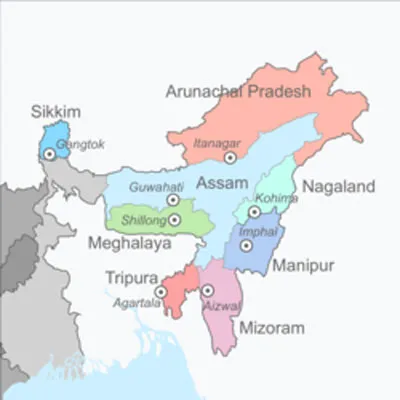
Connectivity and economic infrastructure projects under the Northeast Economic Corridor (NEEC) are progressing as part of a coordinated strategy for the region’s development. Following the consensus reached at the 72nd plenary meeting of the North Eastern Council (NEC) held in Agartala in December 2024, the Ministry of Development of North Eastern Region (DoNER) constituted eight High-Level Task Forces (HLTFs), each led by the Chief Minister of a North Eastern state.
The HLTF on the Northeast Economic Corridor is convened by the Chief Minister of Mizoram, with the Union Minister for DoNER and the Chief Ministers of Assam, Meghalaya and Manipur as members. Its mandate includes assessing existing economic infrastructure and the investment ecosystem in the region, identifying gaps and formulating strategies to attract investments. Three meetings of the HLTF on NEEC have been held so far.
The broader objective of the PM-DevINE scheme is the rapid and holistic development of the North-Eastern Region through infrastructure development, social projects aligned with regional needs, enhancement of livelihood opportunities for youth and women, and addressing critical development gaps across sectors. Under this framework, 48 projects with a total outlay of Rs 6,044.36 crore have been sanctioned since the scheme’s inception up to 21 January 2026.
Projects approved under the schemes of the Ministry of DoNER are implemented by the respective state government agencies, which also bear the primary responsibility for monitoring. In addition, the Ministry oversees progress through Field Technical Support Units, Project Quality Monitors, third-party technical inspection agencies, and periodic inspections by officials from DoNER and NEC. Inspection reports are uploaded on the Poorvottar Vikas Setu portal for digital monitoring, while project progress is also updated on the PM Gati Shakti portal to ensure timely resolution of bottlenecks.
This information was provided by Dr Sukanta Majumdar, Minister of State for the Ministry of Development of North Eastern Region, in a written reply to the Rajya Sabha.  

Connectivity and economic infrastructure projects under the Northeast Economic Corridor (NEEC) are progressing as part of a coordinated strategy for the region’s development. Following the consensus reached at the 72nd plenary meeting of the North Eastern Council (NEC) held in Agartala in December 2024, the Ministry of Development of North Eastern Region (DoNER) constituted eight High-Level Task Forces (HLTFs), each led by the Chief Minister of a North Eastern state.The HLTF on the Northeast Economic Corridor is convened by the Chief Minister of Mizoram, with the Union Minister for DoNER and the Chief Ministers of Assam, Meghalaya and Manipur as members. Its mandate includes assessing existing economic infrastructure and the investment ecosystem in the region, identifying gaps and formulating strategies to attract investments. Three meetings of the HLTF on NEEC have been held so far.The broader objective of the PM-DevINE scheme is the rapid and holistic development of the North-Eastern Region through infrastructure development, social projects aligned with regional needs, enhancement of livelihood opportunities for youth and women, and addressing critical development gaps across sectors. Under this framework, 48 projects with a total outlay of Rs 6,044.36 crore have been sanctioned since the scheme’s inception up to 21 January 2026.Projects approved under the schemes of the Ministry of DoNER are implemented by the respective state government agencies, which also bear the primary responsibility for monitoring. In addition, the Ministry oversees progress through Field Technical Support Units, Project Quality Monitors, third-party technical inspection agencies, and periodic inspections by officials from DoNER and NEC. Inspection reports are uploaded on the Poorvottar Vikas Setu portal for digital monitoring, while project progress is also updated on the PM Gati Shakti portal to ensure timely resolution of bottlenecks.This information was provided by Dr Sukanta Majumdar, Minister of State for the Ministry of Development of North Eastern Region, in a written reply to the Rajya Sabha.  

Next Story
Infrastructure Urban

Public Capex Push In Budget To Boost Tyre Industry: ATMA

The Indian tyre industry is expected to benefit from the government’s renewed emphasis on infrastructure development outlined in the Union Budget 2026–27, according to the Automotive Tyre Manufacturers Association (ATMA).ATMA said the tyre sector is closely linked to the performance of the transport and infrastructure ecosystem, and the sharp rise in public capital expenditure to Rs 1.2 trillion is a significant positive for sustained long-term demand growth.The association noted that the enhanced capex allocation reflects the government’s continued focus on building future-ready infrast..

Next Story
Infrastructure Transport

Underground Rail Line Planned In Siliguri ‘Chicken’s Neck’

Indian Railways is planning to construct underground railway tracks along a critical 40 km stretch of the Siliguri Corridor, popularly known as the Chicken’s Neck, to strengthen connectivity between the North East and the rest of India while enhancing security preparedness. According to the Indian Railways, the underground section is strategically significant due to the corridor’s narrow geography and proximity to international borders. Chetan Kumar Srivastava, General Manager of the Northeast Frontier Railway, said the proposed underground alignment is extremely important from a security..

Next Story
Infrastructure Urban

Agriculture Infrastructure Fund Boosts Post-Harvest Assets

The Agriculture Infrastructure Fund (AIF), a Central Sector Scheme of the Government of India, continues to strengthen post-harvest management infrastructure by enabling access to medium- and long-term debt financing through interest-subvented loans. The scheme focuses on improving agri-logistics, reducing post-harvest losses, promoting modern storage, processing and value-addition facilities, and enhancing farm-gate infrastructure to support efficient agricultural supply chains. Under AIF, banks and financial institutions provide loans with an interest subvention of three per cent per annum,..

Advertisement

Subscribe to Our Newsletter

Get daily newsletters around different themes from Construction world.

STAY CONNECTED

Advertisement

Advertisement

Advertisement

Advertisement

Open In App