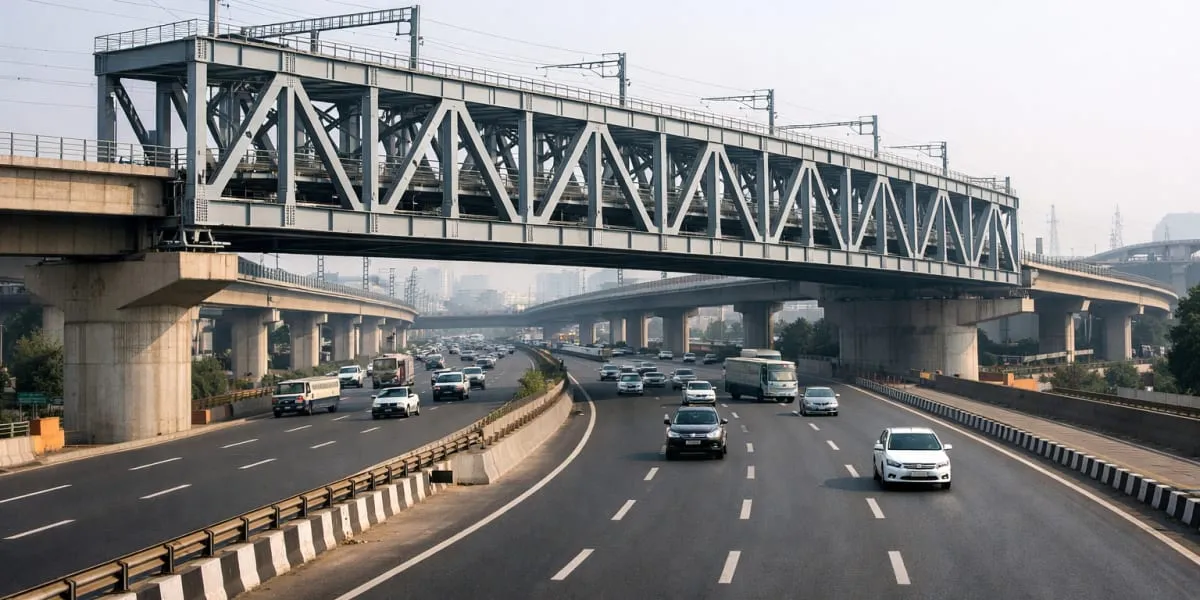
DMRC Erects Steel Span Over NH-9 and Delhi-Meerut Expressway
ECONOMY & POLICY

DMRC Erects Steel Span Over NH-9 and Delhi-Meerut Expressway

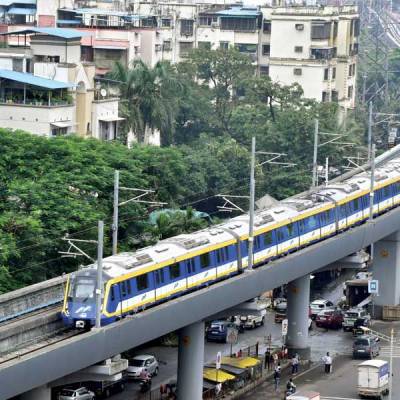
The Delhi Metro Rail Corporation has erected a 58-metre steel span across National Highway-9 and the Delhi-Meerut Expressway near Noida Electronic City Metro station without disrupting traffic, marking a milestone in the construction of a reversal facility for Blue Line trains. The structure was installed as part of work to enable trains to change direction after completing trips, intended to improve operational efficiency. DMRC described the operation as carried out safely on a busy corridor.

The reversal facility will require two specialised steel spans measuring 58 metres and 73 metres to cross the highway and the expressway. The 58-metre span has been set between piers 384 and 385, and the 73-metre span is expected to be erected later this year. Officials said the project design accommodates the alignment and traffic flows beneath.

Installation presented technical challenges because the span had to pass beneath an energised high-tension overhead power line near pier 384, necessitating precise planning and safety measures. For the operation, steel trestles were erected at designated locations on the highway and the expressway and support beams were placed on them to receive the prefabricated element. The prefabricated span was launched from the Indirapuram side and progressively pulled into position using specialised machinery until it sat between the piers. The method avoided interruption to road users.

The span now stands about 14 metres above the highway and the expressway. Civil work for the reversal facility is likely to be completed by the end of the year, after which track laying, electrification and other system works will follow. DMRC noted that this was the first instance of a Delhi Metro viaduct being constructed over an operational expressway without traffic interruption and cited earlier projects such as the Moolchand intersection and viaducts at Dhaula Kuan. The agency said lessons from prior projects informed planning and execution.

The Delhi Metro Rail Corporation has erected a 58-metre steel span across National Highway-9 and the Delhi-Meerut Expressway near Noida Electronic City Metro station without disrupting traffic, marking a milestone in the construction of a reversal facility for Blue Line trains. The structure was installed as part of work to enable trains to change direction after completing trips, intended to improve operational efficiency. DMRC described the operation as carried out safely on a busy corridor. The reversal facility will require two specialised steel spans measuring 58 metres and 73 metres to cross the highway and the expressway. The 58-metre span has been set between piers 384 and 385, and the 73-metre span is expected to be erected later this year. Officials said the project design accommodates the alignment and traffic flows beneath. Installation presented technical challenges because the span had to pass beneath an energised high-tension overhead power line near pier 384, necessitating precise planning and safety measures. For the operation, steel trestles were erected at designated locations on the highway and the expressway and support beams were placed on them to receive the prefabricated element. The prefabricated span was launched from the Indirapuram side and progressively pulled into position using specialised machinery until it sat between the piers. The method avoided interruption to road users. The span now stands about 14 metres above the highway and the expressway. Civil work for the reversal facility is likely to be completed by the end of the year, after which track laying, electrification and other system works will follow. DMRC noted that this was the first instance of a Delhi Metro viaduct being constructed over an operational expressway without traffic interruption and cited earlier projects such as the Moolchand intersection and viaducts at Dhaula Kuan. The agency said lessons from prior projects informed planning and execution.

Related Stories

Gold Stories

Next Story
Infrastructure Urban

EMO Energy and e-Sprinto to Deploy 8,000 Electric Scooters

EMO Energy has announced a partnership with electric two-wheeler maker e-Sprinto to deploy 8,000 electric scooters across India this financial year. The rollout will include both low-speed and high-speed models and will be phased across several cities. The scooters will be aimed at quick-commerce and last-mile delivery operations where uptime and energy efficiency are prioritised. EMO Energy said the scooters will use its patented ZenPac liquid-cooled battery platform with active thermal management, battery intelligence and energy optimisation to improve reliability and performance. ZenPac con..

Next Story
Infrastructure Energy

Octillion Opens Third EV Battery Plant in India

Octillion Power Systems has opened its third manufacturing facility in Halol, Gujarat, adding production capacity as demand for electric vehicle battery systems grows across passenger, commercial and public transport segments. The facility covers more than 13,000 square metres and was converted from an empty structure into an operational battery manufacturing plant in less than eight months. At full capacity the Gujarat plant will manufacture more than 48,000 battery systems annually, representing over three GWh of energy storage capacity. With the addition of the Halol facility Octillion's co..

Next Story
Real Estate

Land Reforms Could Unlock Urban Affordable Housing

Former cabinet secretary and NITI Aayog member Rajeev Gauba said India’s urban housing shortage could be tackled by unlocking 10 million (mn) vacant homes and using excess unutilised land held by public sector undertakings (PSUs). He said land availability lay at the heart of the problem and estimated that land accounted for as much as 50 to 70 per cent of total project cost. He urged states to waive land?use change fees and exempt stamp duty on land and transactions linked to affordable housing. He noted that urban population was projected to rise from 500 million to nearly 900 million by 2..

Advertisement

Subscribe to Our Newsletter

Get daily newsletters around different themes from Construction world.

STAY CONNECTED

Advertisement