
Downstream Aluminium Industry Seeks Duty Relief
ECONOMY & POLICY

Downstream Aluminium Industry Seeks Duty Relief

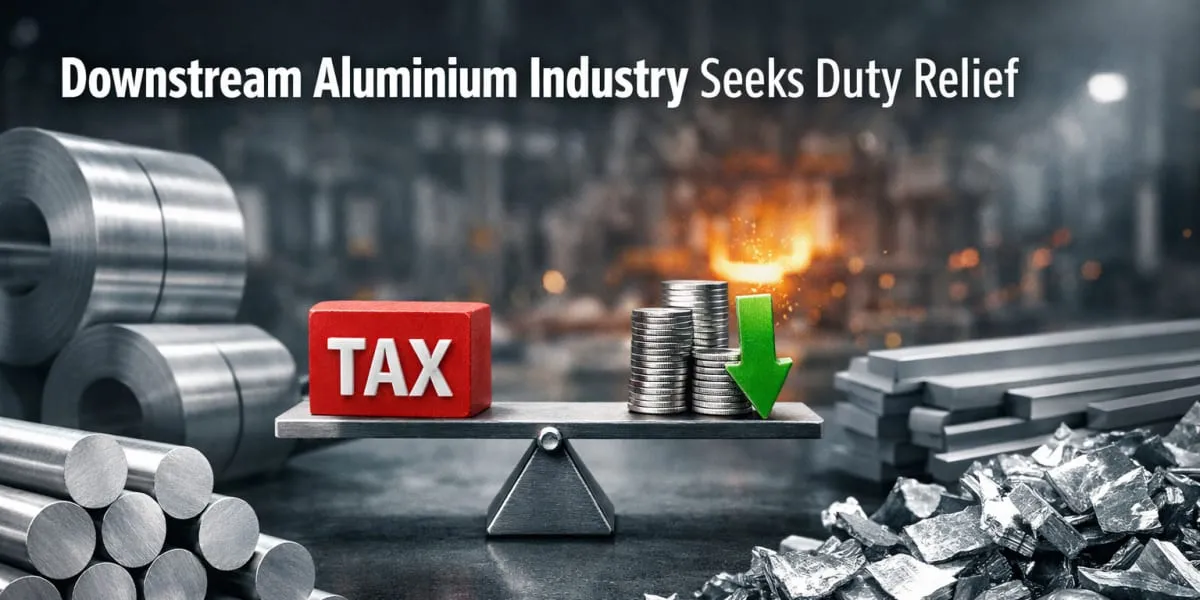
Downstream aluminium manufacturers have urged the Centre to reduce customs duty on primary aluminium and aluminium scrap, arguing that the current tax structure has placed micro, small and medium-sized enterprises (MSMEs) under severe cost pressure and eroded their competitiveness. The associations said high input costs and squeezed margins have constrained expansion and employment within the value chain, prompting a joint appeal to the mines ministry for policy relief.

The Aluminium Secondary Manufacturers Association (ASMA), the Cables and Conductors Manufacturers Association of India (CACMAI) and the Federation of All India Aluminium Utensils Manufacturers (FAIAUM) submitted a joint representation noting that the effective import duty of 8.25 per cent on primary aluminium and 2.75 per cent on scrap has enabled domestic producers to price metal at import parity, disadvantaging downstream units. They argued that any reduction in duty could ease input costs, support capacity utilisation and underpin exports, although such measures may face resistance from primary producers.

The industry bodies highlighted that India’s per capita aluminium consumption at two point five kilogram (kg) remains well below the global average of 11 kg, and expressed concern about a sharp rise in input costs. They reported that margins of downstream MSMEs have compressed by as much as 70 per cent over recent years, while input costs have risen by between 20 and 35 per cent in the last three months. The associations said the duty structure has created an inverted playing field.

Finished aluminium products enter under preferential free trade agreement concessions at near zero duty while primary metal attracts higher import levies, the representation noted, and this is harming sectors such as cables, conductors, transmission, energy storage, extrusions, foundries and recycling. The bodies warned that the European Union’s Carbon Border Adjustment Mechanism could further affect exporter competitiveness and requested that the mines ministry consider a reduction in basic customs duty, offering to present their case in person.

Downstream aluminium manufacturers have urged the Centre to reduce customs duty on primary aluminium and aluminium scrap, arguing that the current tax structure has placed micro, small and medium-sized enterprises (MSMEs) under severe cost pressure and eroded their competitiveness. The associations said high input costs and squeezed margins have constrained expansion and employment within the value chain, prompting a joint appeal to the mines ministry for policy relief. The Aluminium Secondary Manufacturers Association (ASMA), the Cables and Conductors Manufacturers Association of India (CACMAI) and the Federation of All India Aluminium Utensils Manufacturers (FAIAUM) submitted a joint representation noting that the effective import duty of 8.25 per cent on primary aluminium and 2.75 per cent on scrap has enabled domestic producers to price metal at import parity, disadvantaging downstream units. They argued that any reduction in duty could ease input costs, support capacity utilisation and underpin exports, although such measures may face resistance from primary producers. The industry bodies highlighted that India’s per capita aluminium consumption at two point five kilogram (kg) remains well below the global average of 11 kg, and expressed concern about a sharp rise in input costs. They reported that margins of downstream MSMEs have compressed by as much as 70 per cent over recent years, while input costs have risen by between 20 and 35 per cent in the last three months. The associations said the duty structure has created an inverted playing field. Finished aluminium products enter under preferential free trade agreement concessions at near zero duty while primary metal attracts higher import levies, the representation noted, and this is harming sectors such as cables, conductors, transmission, energy storage, extrusions, foundries and recycling. The bodies warned that the European Union’s Carbon Border Adjustment Mechanism could further affect exporter competitiveness and requested that the mines ministry consider a reduction in basic customs duty, offering to present their case in person.

Next Story
Infrastructure Transport

CM Announces Rs 1.5 bn Plan To Tackle Jorabat Floods

Chief Minister Himanta Biswa Sarma announced a Rs 1.5 billion (Rs 1.5 bn) flood mitigation allocation for Jorabat under the proposed Guwahati Ring Road project following recent flash flooding that disrupted traffic and waterlogged parts of the area. The measure is intended to provide a permanent solution to recurring inundation at one of the principal entry points linking Assam and Meghalaya. The sum has been included in the Detailed Project Report for the ring road. Consultants engaged on the project are preparing engineering drawings and have been instructed to obtain technical approval from..

Next Story
Infrastructure Transport

Gorakhpur Southern Road Network Upgraded With Rs 4,450 Million Works

The long neglected roads of Gorakhpur’s southern region are undergoing a major transformation as work proceeds on nine road projects costing Rs 4,450 million (mn; Rs 445 crore) across a 118 km network. The programme comprises road widening, strengthening and construction of new stretches aimed at remodelling connectivity and travel efficiency. The schemes are intended to link key routes to the Gorakhpur–Varanasi four-lane highway and the Link Expressway and reflect the Chief Minister Yogi Adityanath’s infrastructure priorities. Authorities have directed accelerated work on four-lane conn..

Next Story
Infrastructure Transport

Artefact Projects Secures Rs 30.8 mn NHAI Supervision Contract

Artefact Projects has secured an order worth Rs 30.8 million (mn) from the National Highways Authority of India for supervision services on a highway project in Chhattisgarh. The contract award was announced by the company and will be executed in association with KCS Engineering. The company indicated the award will support its order book and reinforce its presence in the highway sector. The assignment requires the firm to act as Supervision Consultant during the operation and maintenance phase of the four-lane Bilaspur-Urga section of NH-130A, covering design chainage 0.000 to 70.200 km from ..

Advertisement

Subscribe to Our Newsletter

Get daily newsletters around different themes from Construction world.

STAY CONNECTED

Advertisement

Advertisement

Advertisement